
10 Essential Personal Protective Equipment (PPE) on Board Ships
For any professional seafarer working on board, personal safety and the safety of their crew are paramount.
10 Essential Personal Protective Equipment (PPE) on Board Ships
For any professional seafarer working on board, personal safety and the safety of their crew are paramount. All shipping companies ensure that their crew adheres to personal safety procedures and regulations in all operations performed on board.
To maximize safety on board, a fundamental step is ensuring that everyone uses personal protective equipment (PPE) specifically designed for various tasks on board.
The following are essential PPE items that should always be available on board to ensure crew safety:
10 Essential PPE on Board Ships
1) Protective Clothing: Protective clothing is a full-body suit that protects the crew member's body from hazardous substances such as hot oil, water, and welding sparks. It is often referred to as "work clothes" or "full-body protective clothing."
2) Helmet: The head is the most vulnerable part of the human body. It must be provided with the highest level of protection, and the rigid plastic helmets provided on board meet this requirement. Helmets also have chin straps to secure the helmet in case of tripping or falling.
3) Safety Shoes: Cargo and machinery occupy a large portion of the ship's cabin space and are often made of hard metal, making it difficult for crew members to move around. Safety shoes ensure that crew members' feet are protected when working or moving around on board.
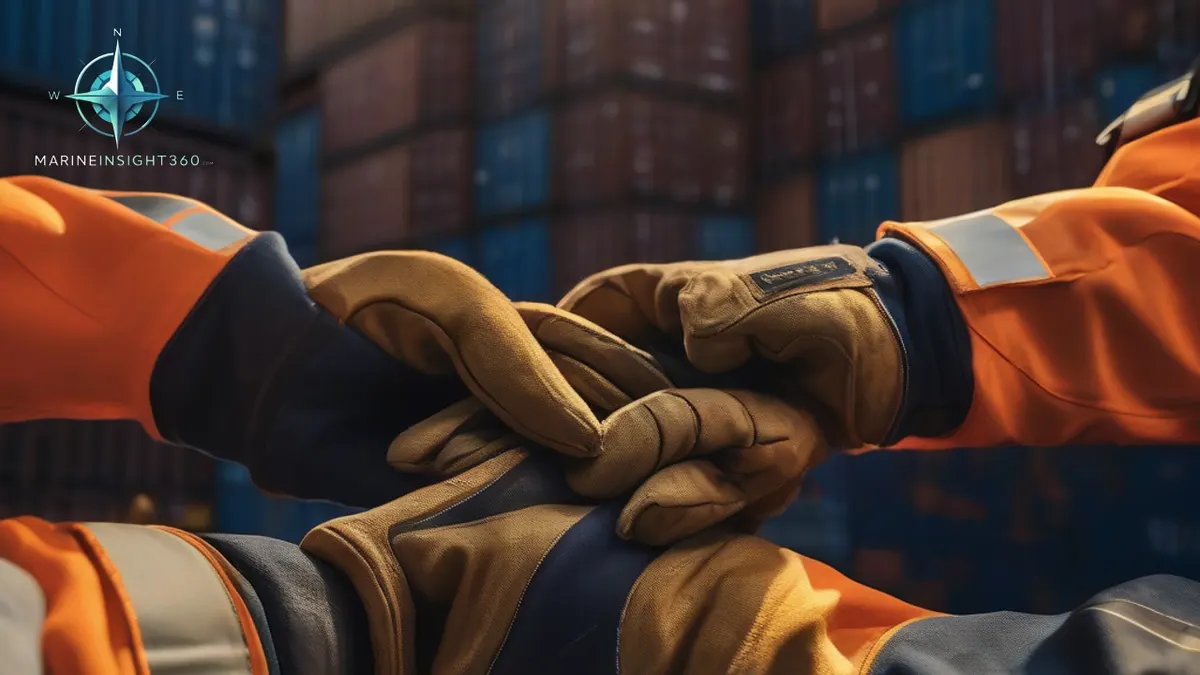
4) Safety Gloves: Various types of gloves are provided on board for all operations requiring hand protection. These gloves include heat-resistant gloves for working on high-temperature surfaces, cotton gloves for everyday work, welding gloves, chemical protective gloves, etc.
5) Safety Eyewear: The eyes are the most sensitive part of the human body. The risk of eye injury is very high during daily work on board. Safety eyewear is used to protect the eyes, while welding goggles are used for welding operations to protect the eyes from high-intensity sparks.
- Ship Earthing Systems – Protect Ships from Lightning Strike
- Biofuel Launch Technology Is Used To Protect The Hull
- The Importance of Port Security
- Immersion Suit – Different Types, Anti-Exposure Suits, And Thermal Protective Aids
- 11 Key Components of Logistics Costs
6) Earplugs/Earm Covers: The noise generated in the ship's engine room is between 110 and 120 decibels, which is very high for the human ear. Even exposure for just a few minutes can cause headaches, ear irritation, and sometimes even partial or complete hearing loss. Earplugs or earmuffs are used on board to reduce noise levels to an acceptable decibel range.
7) Safety Belts: Routine work on board includes maintaining and painting surfaces at heights, requiring crew members to access inaccessible areas. Safety belts are used to prevent falls from heights. Workers fasten one end of the safety belt and secure the other end to a fixed point.
8) Face Masks: When working on insulated surfaces, painting, or cleaning carbon deposits, crew members may come into contact with fine, harmful particles that can cause harm if inhaled directly. Face masks are provided on board to protect against inhalation of these particles.
9) Chemical Protective Clothing: Chemicals are commonly used on board, some of which are extremely dangerous upon direct skin contact. Chemical protective clothing is provided to prevent such accidents.
10) Welding Helmets: Welding is a common procedure in structural repairs on board. Welders use helmets or other protective gear to protect their eyes and avoid direct exposure to ultraviolet radiation from welding sparks.
Career planning context
For cadets, ratings and officers, essential personal protective equipment should be read alongside current company requirements, flag-state rules, medical fitness standards and training-provider instructions. The pathway can change by country, rank, vessel type and previous sea service. Candidates should verify documents before paying fees or accepting a joining offer.
Recommended Reading
Ship Decks: Every Type, What It Does, and the Equipment It Carries
What ship decks are, from tank top to bridge: the main deck types, how they are numbered, and the windlasses, winches, cranes and hatches that work on them.
Ship Mast: What the Tallest Structure on Board Actually Does
What a ship mast does on a modern vessel: the lights, antennas and radar it carries, the types you will see, and why the old sailing word never left the fleet.
Ship Navigation Equipment: The 30 Systems on a Modern Bridge
The ship navigation equipment a modern bridge carries, grouped by job: position fixing, collision avoidance, charts, communications, safety recorders and more.