
What's the Difference Between a Cruiser and a Destroyer?
How cruisers and destroyers differ in size, role and command duties, how the two types grew from separate origins, and why modern destroyers now match cruisers.
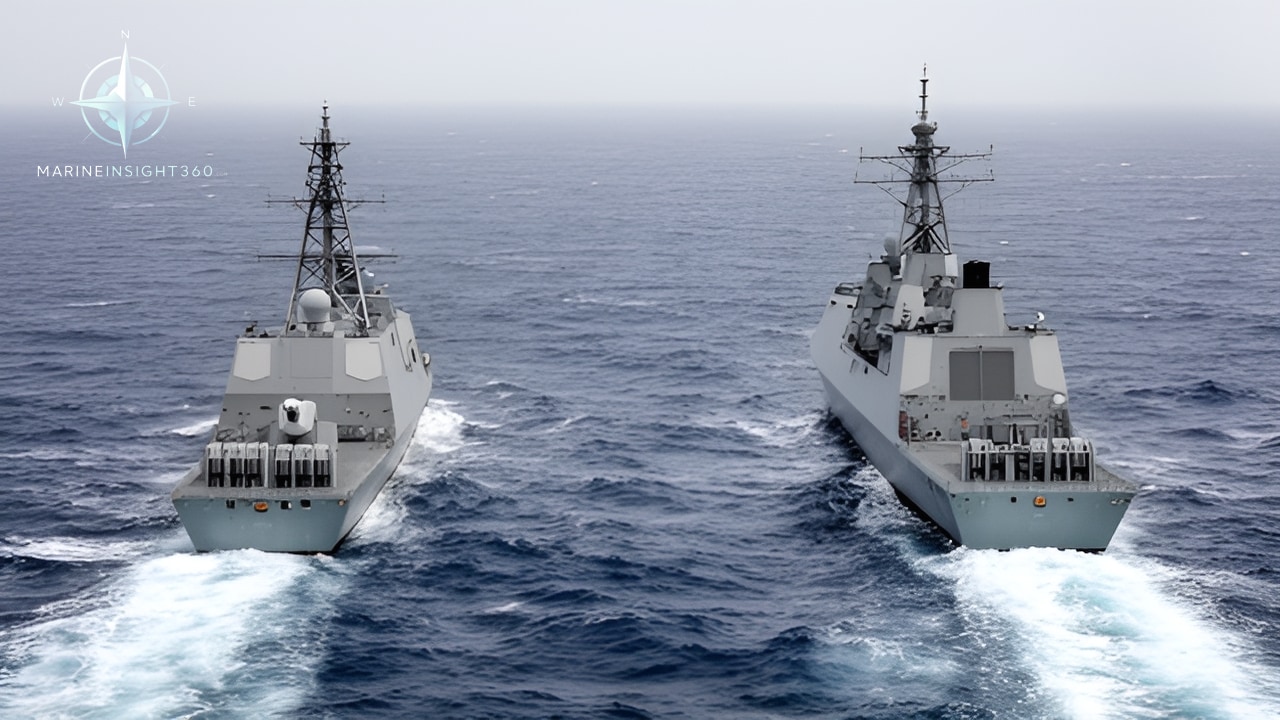
A cruiser is traditionally the larger of the two: a warship big enough to operate on its own over long distances and, in modern navies, to carry extra command facilities for directing the air defence of a whole task group. A destroyer is a smaller escort built to protect larger ships from submarines, aircraft and missiles.
Today the line between them is blurred, because the newest destroyers are as big as cruisers and carry similar weapons, so the name often says more about a navy's traditions than about the ship's size.
Where the two types came from
Cruisers
In the age of sail, "cruising" meant independent work away from the battle fleet: scouting, protecting merchant shipping and raiding the enemy's trade. Frigates did most of it. When steam and iron arrived, navies built a new type for the same jobs, the cruiser. Through the late 19th century it developed into armoured cruisers and protected cruisers with an armoured deck, and in the early 20th century into smaller light cruisers.
The Washington Naval Treaty of 1922 limited cruisers to 10,000 tons standard displacement and guns of 8 inches. The London Naval Treaty of 1930 then split them into heavy cruisers, with guns over 6.1 inches, and light cruisers, with smaller guns. In the Second World War cruisers screened carriers and battleships, bombarded beaches and protected convoys.
Destroyers
The destroyer began as an answer to the torpedo boat, a small fast craft that threatened battleships in the 1880s. In the 1890s the Royal Navy built "torpedo boat destroyers", such as HMS Havock and HMS Daring, fast enough to catch torpedo boats and armed to sink them. They soon carried torpedoes of their own, and the name was shortened to destroyer.
By the First and Second World Wars, destroyers were the workhorses of every fleet: screening battleships and carriers, hunting submarines, escorting convoys and attacking with torpedoes. A typical Second World War destroyer displaced a few thousand tons, against around 10,000 tons or more for a heavy cruiser.
The main differences
| Cruiser | Destroyer | |
|---|---|---|
| Traditional role | Independent operations, scouting, trade protection, fleet flagship | Escort, screening the fleet against torpedo, submarine and air attack |
| Modern role | Air defence command for a carrier or task group, land attack | Air defence, anti-submarine warfare, escort, land attack |
| Size | Historically larger | Historically smaller, now often similar |
| Command facilities | Space and staff for a senior officer directing other ships | Usually less, though many destroyers can lead a group |
| Numbers built | Few; many navies have none | Larger classes, operated by more navies |
Modern cruisers and destroyers compared
The United States Navy shows the overlap clearly. Its Ticonderoga-class cruisers were built on the hull of the Spruance-class destroyer and were first ordered as destroyers, before being reclassified as guided missile cruisers (CG) in 1980. The lead ship was commissioned in 1983. They are about 173 m long, and later ships of the class carry 122 vertical launch cells.
Part of the reason they are cruisers is their role: a Ticonderoga in a carrier strike group traditionally carries the air defence commander for the whole group.
The Arleigh Burke-class destroyers that followed, from 1991, use the same Aegis combat system on a shorter hull of about 155 m with 90 or 96 launch cells. The navy is retiring the Ticonderogas, and the Burkes, with later flights larger and better equipped than the first, are taking over their air defence duties. The three Zumwalt-class ships, at nearly 16,000 tonnes full load and 186 m, are much bigger than any Ticonderoga but are still classed as destroyers.
Elsewhere the pattern is similar. China's Type 055 is designated a destroyer by its own navy, but at about 180 m and over 12,000 tonnes with 112 launch cells it is classed as a cruiser by the US Department of Defense. South Korea's Sejong the Great-class destroyers and Japan's Maya-class destroyers are of similar size to the American cruisers.
Russia still has true cruisers: the nuclear-powered Kirov class, at well over 20,000 tonnes, though its remaining ships have spent years laid up or in refit, and the Slava class, one of which, Moskva, was sunk in the Black Sea in April 2022. The Royal Navy no longer has cruisers and gives the fleet air defence role to its Type 45 destroyers.
Why the names still differ
Classification is partly history and partly policy. In 1975 the US Navy reclassified many of its larger escorts, until then called frigates in American usage, as cruisers, partly to bring its ship types into line with other navies. Names can be political as well: Japan officially classes its flat-decked Izumo-class ships as helicopter destroyers. To compare two ships, look at displacement, sensors, weapons and command spaces, which say far more than the type name. The same applies further down the scale, as our articles on frigates and destroyers and frigates and corvettes explain.
One source of confusion is unrelated to warship types. A "cruiser stern" is a hull shape, the rounded, submerged stern first used on cruisers and later common on merchant ships. Our article on cruiser sterns covers it.
Recommended Reading
Difference Between Leeward and Windward Sides of Ships
Wind is important in sailing. In the Age of Navigation, which lasted nearly 400 years, wind was the main force that propelled ships. That applied to everything from commercial ships to military ones.
Difference Between Nautical Mile & Statute Mile
Whether measuring distances on land, in the air, or at sea, having accurate units is crucial. We are all familiar with the common land mile, but many…

Difference Between Bulkhead and Bulwark
A bulkhead divides a ship into watertight and fire-resisting compartments; a bulwark is the steel wall along the open deck edge. Where each one is and what it does.