
What Is the Gyro Compass in Ships Working Principle?
Steer north and your gyro compass settles slightly west of the true meridian. Come round onto a southerly heading and the bias runs east instead.

Steer north and your gyro compass settles slightly west of the true meridian. Come round onto a southerly heading and the bias runs east instead. Navigational errors like that may occur depending on the ship's course, speed and width. External magnetic fields that deflect a normal compass cannot affect a gyro compass.
Correction on modern ships comes from GPS or another navigational aid feeding data into the gyro. Fibre optic-designed orthogonal triads and ring laser gyroscopes go at the problem differently: they apply the principle of optical path difference to determine rotational speed instead of relying on mechanical parts, which helps eliminate the errors while still finding true north.
Most vessels lean on the gyro for true north and for steering; it also feeds position finding and keeps the heading record. On almost all merchant ships and warships it has become essential equipment because it can determine the direction of true north instead of magnetic north.
The phantom moves, the rotor does not
Change course and an independently powered structure called the phantom moves with the ship. The rotor system does not; it carries on pointing north. That misalignment signals the drive motors to move the phantom back into line with the rotor system, on a path that might have moved the phantom by just one or a few degrees of the compass circle. Once aligned, the phantom sends an electrical pulse to the compass for every degree of movement.
Two properties, and two forces the Earth supplies free
Mounting makes it possible. The gyroscopes move freely about three mutually perpendicular axes, and their axes of rotation are controlled to stay parallel to the true meridian under the influence of the Earth's rotation and gravity. Everything after that rests on two properties.
Gyroscopic Inertia
A rotating body tends to maintain its plane of rotation.
Precession
Apply a torque to a gyroscope and it moves, but not in the direction of the torque: at right angles to the applied torque and to the axis of the spinning wheel. Put both properties together with the Earth's two natural forces, rotation and gravity, and the gyro compass finds true north.
Set the rotor on the true meridian and it will stay there indefinitely, as long as the ship's power supply is constant, unchanging and unaffected by external forces.
What the installation is made of
Count the units and the gyroscope is one item on a long list. A main compass uses a gyroscope to determine and maintain true north; a repeating compass receives and displays the true direction transmitted electrically from it. A course recorder writes the manoeuvres continuously onto a movable piece of paper. Control panel work is electrical: it runs the system and determines its operating condition by suitable measuring devices.
Power takes up most of the rest. A voltage regulator provides constant power to the ship's motor generators. An alarm unit indicates a loss of vessel supply, and the amplifier field controls the systems below it. Converting the ship's DC power into AC and powering the compass equipment is the motor-generator's job, and a transmission system connects the gyrocompass to the relay compass.
The most important part of the system, though, is the spinning wheel, called the gyroscope. A gyro compass is a type of gyroscope: among other things, it uses an electrically powered, rapidly rotating gyro wheel and frictional forces to determine true north, relying on basic physical laws, the effects of gravity and the rotation of the Earth. That rotor weighs between 1.25 and 55 pounds, driven by another electric motor turning at several thousand revolutions per minute.
Sperry's arrangement, bearing by bearing
The Sperry unit is the archetypal gyro compass at sea because of its widespread use. Take it apart and the impeller comes first: electrically driven, mounted on pivoting ball bearings in the rotor housing. That housing tilts on ball bearings about a horizontal, approximately east-west axis in the vertical ring. Around it the vertical ring rotates about a vertical axis in the phantom ring, its weight supported by strands of steel wire from the phantom head.
A tracking system keeps phantom ring and vertical ring aligned, preventing the wires twisting and minimising support friction about the vertical axis.
A compass rose sits on the phantom head. Thrust bearings in the spider — the bracket connecting the various parts of the gyroscope — support the phantom, and the spider carries the follower motor too. All of it goes into a protective housing with a small pendulum in a compass dome, the cylindrical base that illuminates the compass disc from below, so the compass elements are protected from the rolling of the ship.
Hinged to the phantom on a horizontal, approximately east-west bearing is the ballistic mercury frame, connected to the rotor housing by a link that meets slightly east of the housing base. Mercury tank and connecting pipes sit on that frame.
Where the main gyrocompass goes is a separate decision, usually an area the external environment cannot reach. If the heading is needed where you are standing, a repeater for the indicator goes on a bridge or other structure. The course recorder permanently records the ship's course.
Why the oscillation period is not a free choice
Requirement first: the compass has to function properly inside an accelerating vehicle, and that determines its oscillation period. The pendulum motion that induces north responds to both the vehicle's acceleration and gravity. Torque associated with north-south acceleration — east-west acceleration is insignificant, given the system configuration — causes a corresponding north deviation that renders the instrument useless for navigation.
Motion adds a second problem. A vehicle moving north or south on the spherical Earth experiences an angular velocity relative to an inertial space perpendicular to the Earth's daily rotation, so the apparent meridian — the one along which the stars appear to rise and set from that moving vehicle — rotates about a vertical axis from the true meridian, west for northward motion and east for southward.
Work the angle out and its tangent is the vehicle's north-south speed divided by the product of the Earth's speed — the speed of a point on the equator, 1,667 km [1,036 mph] per hour, or 900 knots — and the cosine of the latitude. At ship speeds it is typically less than 4°.
Schuler's contribution was the discovery that the precession of the gyroscopic axis due to acceleration, with an oscillation period of 2π square root of Earth's radius/gravity, corresponds exactly to the rate of change of the angle between the apparent meridian and the true meridian as seen from a moving vehicle.
Recommended Reading

What Is The Basic Principle Behind Hatch Cover Design?
Hatch cover ships are designed to be efficient and also cost-effective both in initial investment and during operation while meeting the requirements of different types of cargo ships.
Complete Introduction of Fluxgate Compass
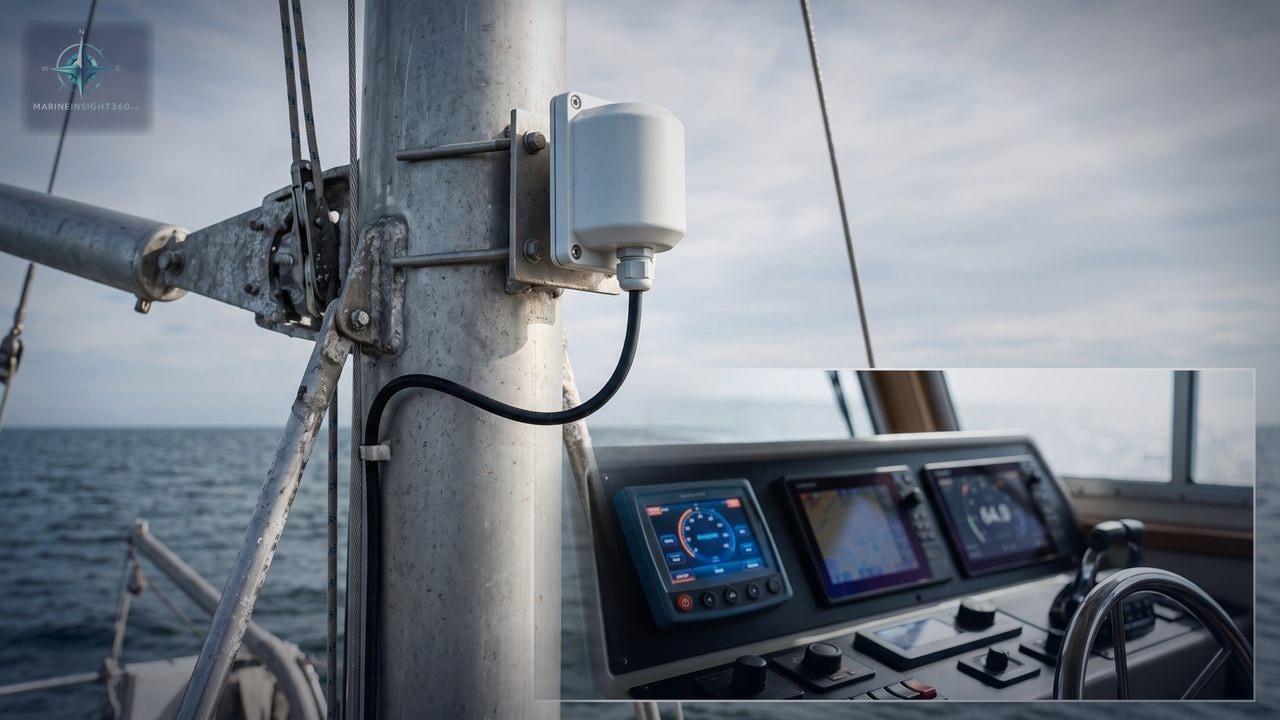
Complete Introduction of Fluxgate Compass A fluxgate compass is a device used to determine precise geographical direction on a ship.

Compass Keeper: The Essential Role of the Binnacle in Maritime Navigation
First, compasses were used for navigation by early explorers. Then, the binnacle was developed to house the compass and provide protection from the elements.