
Compass Keeper: The Essential Role of the Binnacle in Maritime Navigation
First, compasses were used for navigation by early explorers. Then, the binnacle was developed to house the compass and provide protection from the elements.

The compass was one of the first instruments sailors used to find their way at sea, and the binnacle was developed to house it, hold it steady and protect it from the weather. Both have been essential to navigators for centuries, and their importance in maritime navigation is hard to overstate: they changed how far and how confidently ships could travel. As technology has advanced, new types of compass and binnacle have appeared for different needs, but the magnetic compass is still carried on every seagoing ship because it needs no power and keeps working when everything else fails. Early explorers relied on it to keep their course, and it still has its place in modern Maritime Navigation.
What Exactly Is a Compass?
A compass is an instrument that shows direction, so the helmsman can steer a course and the navigator can take bearings. Before choosing a compass and binnacle for your boat, work out what you need. A compass must be easy to read from the steering position, so larger boats need larger compass cards, and the mounting has to suit the boat. Every boat, yacht and ship carries at least one compass, and there are types to suit different needs, including magnetic compasses, gyrocompasses, fluxgate compasses and satellite (GPS) compasses. The basic job of all of them is to let you steer a course and fix your position.
Magnetic Compass
The magnetic compass was first described in China in the 11th century, and by the early 12th century Chinese ships were using it for navigation. It spread to Europe soon afterwards, and since then magnetic compasses have been fitted on ships of every kind, whatever their purpose. Under SOLAS, every ship of 150 gross tonnage and above must still carry a properly adjusted standard magnetic compass. The compass needle or card lines itself up with the Earth's magnetic field and so points to magnetic north. Besides steering, the compass is used for taking bearings to fix the ship's position and to check whether another vessel is on a collision course: if its compass bearing stays steady as it closes, there is a risk of collision. To fix your position, take bearings of two or more charted objects with a hand-bearing compass and plot them on the chart. Two bearings should cross at a good angle, ideally near 90 degrees, and a third bearing confirms the fix.
GPS
A satellite or GPS compass uses two or more GNSS antennas mounted a short distance apart and measures the tiny differences in the satellite signals reaching each one to work out the boat's heading. It is not affected by the Earth's magnetic field or by the steel and electrical equipment on board, so it does not suffer from deviation.
Satellite compasses have become much cheaper and are common on commercial vessels and larger yachts, but they depend on power and on satellite signals, which is why the magnetic compass remains the backup.
How does an electronic fluxgate compass work?
An electronic fluxgate compass uses coils of wire wound around a core of easily magnetised material. An alternating current drives the core in and out of saturation, and the Earth's magnetic field shifts that cycle slightly; sensing coils pick up the difference and the electronics work out the heading. Because the output is electronic, it can be shown on displays anywhere on board and fed to an autopilot, which is the fluxgate's biggest advantage over a traditional compass. Like any magnetic compass, it is affected by local magnetic fields on board. Modern units correct for this electronically, and the sensor can be mounted remotely in a quiet part of the boat away from steel and electrical equipment.
Compass And Boat
The compass has to be installed and aligned carefully. Its lubber line must be exactly parallel to the boat's fore-and-aft line.
The fore-and-aft line runs from the bow to the stern along the centreline. The steering compass is normally mounted on the centreline, where it is easiest to align, and as near the middle of the boat as practical, where the motion is least, so the card stays steadier. If the compass has to be mounted off the centreline, it must still be aligned parallel to the centreline, which means measuring carefully from a fixed fore-and-aft reference.
On fibreglass (GRP) boats the hull itself does not affect the compass, but engines, steel fittings, loudspeakers and electronics can. Keep electronic devices and metal objects away from the compass, and make sure chart plotters and displays are far enough away not to disturb it.
Recommendation
Manufacturers of displays and plotters usually state a "compass safe distance" for their equipment, and it should be respected when installing the system. Steel boats and ships are a different matter. The hull itself is magnetic, so the compass needs correcting devices to cancel the ship's own magnetism. The binnacle of a ship's standard compass carries soft iron spheres on each side to correct the effect of magnetism induced in horizontal soft iron.
The ship's permanent magnetism is corrected with small permanent magnets inside the binnacle. Fore-and-aft and athwartships corrector magnets sit in trays or holes in the lower part of the binnacle, below the compass bowl, and a vertical heeling error magnet sits directly under its centre. A qualified compass adjuster decides how many magnets to fit and where, usually when the ship is in port, and records the remaining deviation on a deviation card.
The door to the corrector compartment should be kept locked so the magnets are not disturbed, and opened only for adjustment.
Flinders Bars
The Flinders bar is a vertical soft iron bar fitted in a case on the forward or after side of the binnacle, depending on whether most of the ship's superstructure and funnel lie forward or aft of the compass. It corrects the deviation caused by magnetism induced in the ship's vertical soft iron, and its length can be changed by adding or removing pieces when the compass is adjusted.
The Quadrant Corrector
The quadrant correctors are two soft iron spheres mounted on brackets on either side of the binnacle. The adjuster moves them closer to or further from the compass to correct quadrantal deviation.
The Helmet
The helmet is the cover fitted to the top of the binnacle and is made of a non-magnetic metal such as brass.
It protects the compass bowl from the weather and, in older designs, housed the lamp that lit the card at night.
Recommended Reading

Shipping Agent Role: Port Call Duties Explained
Learn how a shipping agent coordinates vessel clearance, port services, documents and communications before, during and after a port call.

Dead Reckoning Navigation Technique (Maritime Position Calculation) At Sea
Before the advent of modern navigation aids such as the Global Positioning System ( GPS ) and Electronic Chart Display and Information System ( ECDIS ),…
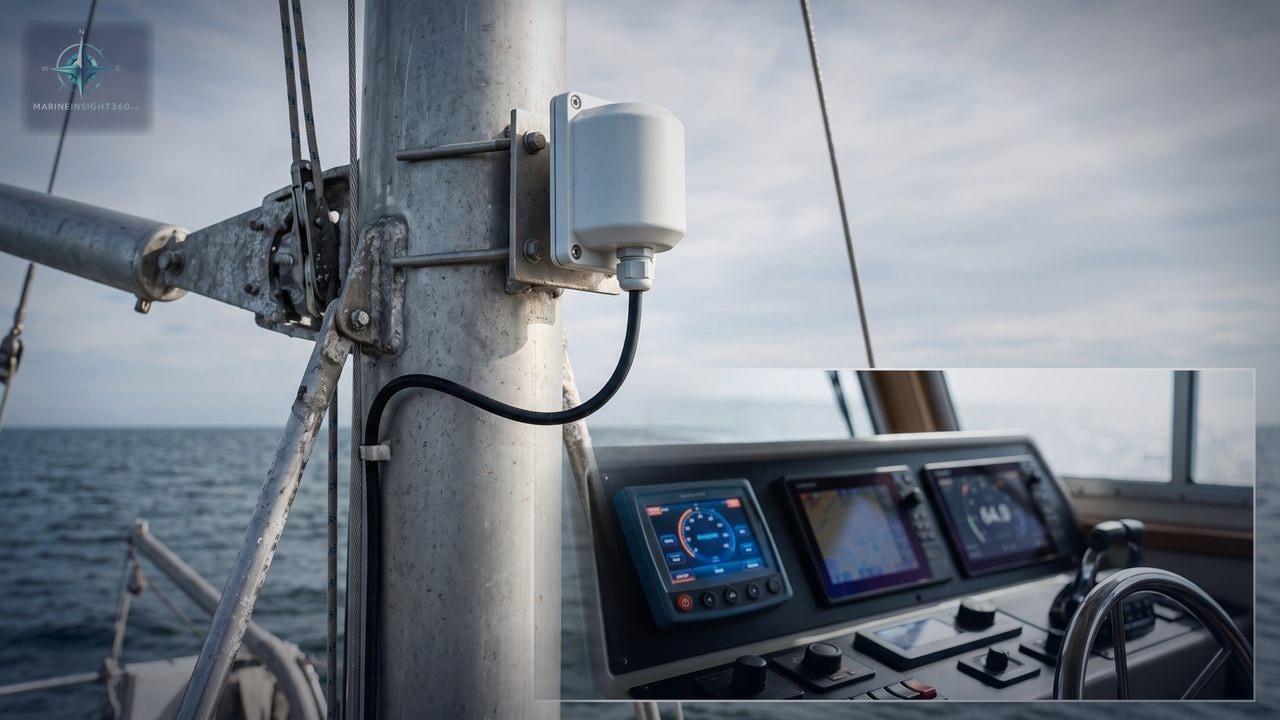
Complete Introduction of Fluxgate Compass
Complete Introduction of Fluxgate Compass A fluxgate compass is a device used to determine precise geographical direction on a ship.