
How a Ship's Propeller Works: Thrust, Pitch and Slip
How a propeller works on a ship: how blade pitch turns engine torque into thrust, why slip matters, and what causes cavitation damage on the blades.
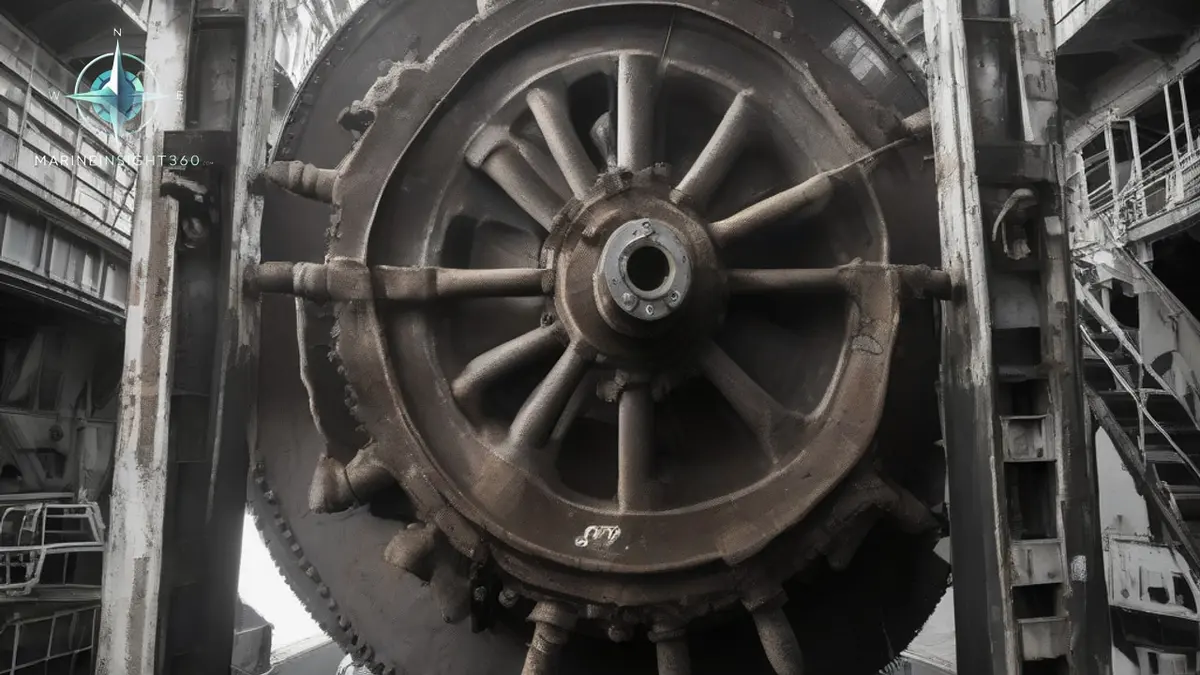
A ship's propeller works by turning engine torque into thrust: each blade is a twisted foil that accelerates a column of water astern as it rotates. The pressure difference that develops across the two blade faces produces a forward force on the shaft, and the shaft pushes the hull. Nothing is being paddled; the blade is behaving like a wing.
The same physics sets blade design for a box ship on the Rotterdam to New York run and for a Washington State ferry. It is also why class societies such as Lloyd's Register and ClassNK survey the shaft and blades on a fixed cycle.
Blade geometry, shaft speed, hull wake and local water pressure all interact, so a propeller suited to a laden bulk carrier at 12 knots will be wrong for a fast ferry. Getting that match right is most of the naval architecture. Keeping it working is most of the engineering.
Thrust: the blade is a wing, not a paddle
As a blade section moves through the water it meets the flow at an angle of attack. Flow accelerates over the forward face and slows on the after face, so pressure falls on one side and rises on the other. Integrated over the whole blade area and across all the blades, that pressure difference is thrust.
The same flow resists rotation, and that resistance is torque the engine has to supply. Propeller efficiency is simply how much of the delivered shaft power leaves as useful thrust power. A large, slowly turning propeller accelerates a big mass of water gently and does that job well, which is why merchant designs favor big diameters and low revolutions rather than high shaft speed.
Pitch and diameter are chosen together
Pitch is the theoretical distance a propeller would advance in one revolution if it were screwing through a solid, the way a bolt advances through a nut. A propeller with a 6 meter (19.7 ft) pitch would, in theory, move the ship 6 meters per turn.
Diameter sets how much water the disc can work on. A small diameter has to accelerate less water much harder, which wastes energy and invites cavitation. Draft, hull clearance and the aperture between the sternframe and the rudder set the practical ceiling on diameter, so the designer trades diameter against pitch until the propeller absorbs the engine's rated power at the intended service speed.
Get it wrong and the engine is either overloaded and unable to reach rated revolutions, or light and unable to make its power at all.
Slip is normal, and the trend tells you a lot
Water yields, so a ship never advances the full pitch in one revolution. That shortfall is slip, usually given as a percentage of the theoretical advance. Slip is not a defect. Without relative motion between blade and water there would be no angle of attack, and therefore no thrust.
What matters on board is the trend, which mates and engineers log daily from engine counter revolutions against distance run. A slip figure that climbs while draft, trim and weather stay steady usually points to a short list of causes:
- Hull and propeller fouling adding resistance and disturbing the inflow
- Head seas, swell or a strong adverse current
- A bent, eroded or rope-damaged blade
- An error in the speed log, the revolution counter or the distance run
Negative slip, where the ship appears to advance further than the pitch, normally means a following current or a measurement problem rather than a propeller defying physics.
Fixed pitch against controllable pitch
Most deep-sea merchant ships use a fixed pitch propeller, cast as one piece or with bolted blades, driven directly by a slow-speed two-stroke engine. It is simple, strong and efficient at one design condition. To go astern, the main engine itself is stopped and restarted turning the other way.
A controllable pitch propeller mounts each blade on a rotating palm driven by hydraulics inside the hub and the shaft. Blade angle can be varied from full ahead through zero pitch to full astern while the engine holds a constant speed. That suits ferries, tugs, offshore support vessels and any ship that maneuvers constantly or drives a shaft generator at fixed frequency.
The costs are a bigger hub, more machinery to maintain, an oil-to-sea interface to watch, and slightly lower efficiency at the single best design point.
Cavitation is the damage crews work to avoid
Cavitation happens when local pressure on the suction side of a blade drops below the vapor pressure of seawater. The water effectively boils at ambient temperature and forms vapor bubbles. Those bubbles sweep aft into higher pressure and collapse violently, and the implosions hammer the blade with intense, very local shock waves.
Repeated collapse erodes bronze into a pitted, sponge-like surface, usually starting near the leading edge and the blade tips. Cavitation also produces broadband underwater noise and hull vibration, which is why quieter propeller design has become a priority for naval vessels and, more recently, for commercial operators facing radiated-noise scrutiny. Typical triggers are overloading the propeller at low ship speed, a roughened or nicked leading edge, and running with the disc partly emerging in ballast condition and heavy swell.
Checks to run before blaming the propeller
Performance complaints often arrive in the engine room as a claim that the propeller is not producing. Work through the cheap checks first.
- Confirm draft, trim and displacement against the loading computer.
- Compare shaft power and revolutions with the sea trial curve at a comparable condition.
- Check hull and propeller fouling records and the date of the last polish.
- Review stern tube seal condition, bearing temperatures and shaft alignment records.
- Have divers or the next dry dock photograph the leading edges and tips for erosion.
Propeller polishing alone recovers a measurable slice of fuel consumption on a fouled ship, which is why many operators schedule it between dockings instead of waiting for the five-year cycle. For the shafting, stern tube and main engine load side of the same story, the Marine Machinery section covers the systems that sit between the cylinder and the blade.
Sources and further reading
- An introduction to propeller cavitation (IIMS)
- Quieter, more efficient propellers (Ingenia, Royal Academy of Engineering)
- How a Ship Screw Works: From Design to Performance
What to read next
Recommended Reading
How Boat Propellers Work: Pitch, Slip, Diameter and Cavitation
A boat propeller is a rotating wing. How pitch, diameter and slip set thrust, why cavitation is not ventilation, and how to match a prop to the engine.
What Is the Advantage of the Controllable Pitch Propeller?
The key advantage of a controllable pitch propeller is thrust control without reversing the engine. See CPP benefits, trade-offs, and typical uses.
Controllable Pitch Propeller (CPP) vs. Fixed Pitch Propeller (FPP)
Controllable Pitch Propeller (CPP) vs. Fixed Pitch Propeller (FPP): shipboard and port-operations context for US, UK, Canada, Australia, Singapore and...