
What Is the Advantage of the Controllable Pitch Propeller?
The key advantage of a controllable pitch propeller is thrust control without reversing the engine. See CPP benefits, trade-offs, and typical uses.
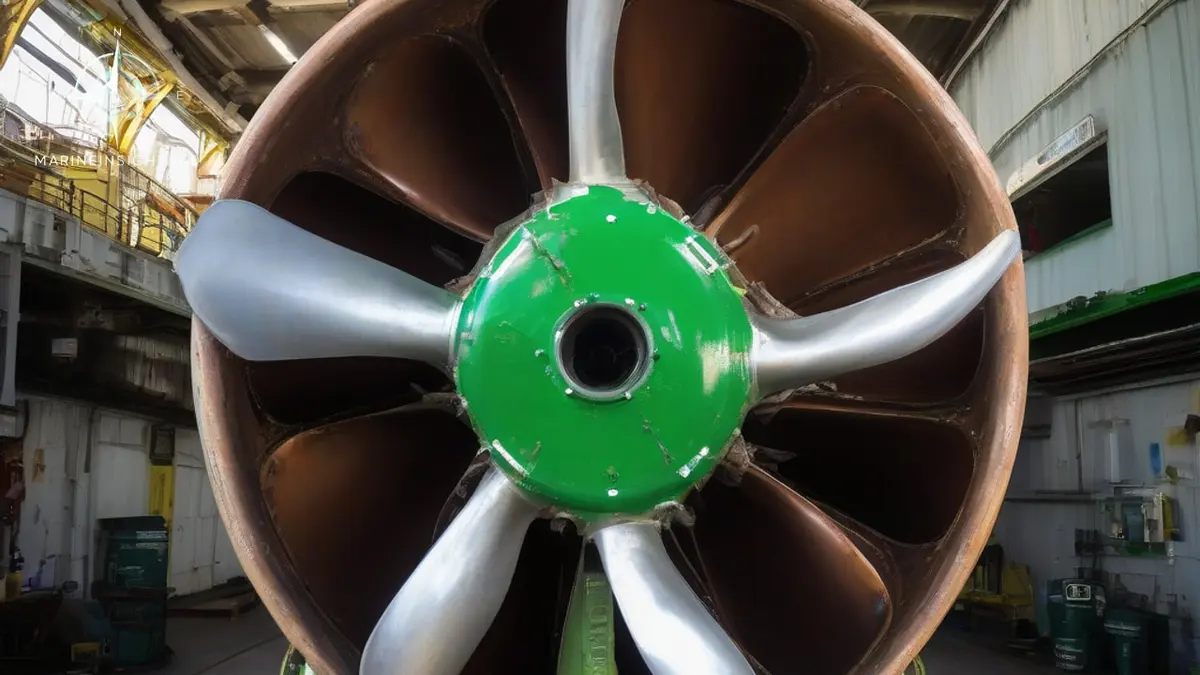
What is the advantage of the controllable pitch propeller? It changes thrust, ahead or astern, without changing engine speed or direction. The blades rotate on the hub to a new pitch angle. A shaft turning at constant revolutions can then drive the ship forward, hold it stationary, or pull it astern within seconds.
A fixed pitch propeller is a single casting; to go astern, the whole shaft must stop and reverse. A controllable pitch propeller (CPP) moves that job into the hub, where a hydraulic servo slides a crosshead that cranks each blade to the ordered angle. The difference sounds small. Operationally, it changes how the whole ship is handled.
The core advantage of the controllable pitch propeller: thrust control
With a CPP, the bridge orders thrust directly through the pitch lever or combinator, and the response is nearly immediate because no machinery has to stop and restart. Reversing thrust means swinging the blades through zero pitch, not braking a shaft line. In naval applications a full ahead to full astern order can stop some ships in under four ship lengths, and the same responsiveness is what ferry masters lean on at every berthing.
How that order reaches the blades depends on the control mode, and every watchkeeper should know which mode is selected before a maneuver. In combinator mode a single bridge lever sets shaft revolutions and pitch together along a curve programmed for that hull and engine. In constant speed mode the revolutions are locked, usually to hold a shaft generator on frequency, and the lever moves pitch alone. The same lever movement produces very different acceleration in each mode.
Secondary advantages engineers value
- Shaft generator operation. Constant shaft speed lets a shaft driven alternator supply the ship's electrical load at stable frequency, often more cheaply than running auxiliary diesels at sea.
- Load matching. Pitch can be eased when the ship is towing, trawling, or punching into heavy weather, keeping the engine on its safe operating line instead of lugging it.
- No reversing machinery. The engine needs no reversing gear or reversing starts, which removes a whole class of maneuvering failures and cuts starting air consumption.
- Fine low speed control. Small pitch settings hold creeping speeds that a direct drive fixed pitch installation cannot, useful for canal transits, station keeping, and pilot boarding.
- Less engine cycling. Fewer stops and starts during port maneuvers means less wear on the prime mover.
- Blades change individually. Each blade bolts to the hub, so a bent or eroded blade can often be replaced by divers afloat instead of waiting for a drydock slot.
Inside the hub: what the engine room actually maintains
Hydraulic oil reaches the rotating shaft line through an oil distribution box, normally mounted at the forward end of the intermediate shaft or on the gearbox. From there it runs down the bore of the shaft to a servo piston, which in most modern designs sits inside the propeller hub. The piston drives a crosshead, and a sliding block or crankpin on each blade carrier converts that fore and aft travel into blade rotation.
A feedback rod inside the shaft returns the real blade angle to the control system and the bridge indicator, so ordered and actual pitch are compared continuously rather than assumed.
The oil system is deliberately held above the sea pressure at the hub, usually by a gravity head tank mounted well above the waterline, so that a weeping blade seal pushes oil outward rather than drawing seawater in. That makes the head tank level one of the more informative readings on a CPP ship. A slowly falling level means oil is going over the side and the seal needs attention.
A rising level, or water in the drain sample, means sea pressure has won somewhere and the system is being contaminated.
The trade-offs that come with the hub
Nothing is free. A CPP costs more to buy and to maintain than a fixed propeller because the hub is a precision hydraulic machine living underwater. The oil distribution box, servo, and blade seals all need planned maintenance, and a leaking blade seal puts hydraulic oil into the sea, which is why operators increasingly specify biodegradable fluids.
In United States waters the Vessel General Permit requires an environmentally acceptable lubricant at oil to sea interfaces such as the hub and stern tube unless it is technically infeasible, and those fluids carry their own water tolerance and seal compatibility limits.
Efficiency is the second compromise. The larger hub, commonly around a quarter of propeller diameter against under a fifth on a fixed pitch design, and the compromise blade geometry give away a few percent of open water efficiency compared with a fixed propeller optimized for one service speed. Run at a badly matched combination of pitch and revolutions and fuel consumption climbs further. There is also a failure mode to respect: loss of pitch control.
Systems are designed to fail to a safe setting, and good crews drill for it anyway, which means knowing where the emergency pitch control is and what ahead pitch it will give you to reach a berth or an anchorage.
Which ships benefit most from a CPP
Controllable pitch propellers dominate where the operating profile is varied: ferries and ro-pax ships that berth many times a day, tugs and offshore vessels that swing between bollard pull and free running, trawlers that alternate towing with transit, and many naval combatants.
Deep sea tankers, bulkers, and container ships mostly stay with fixed pitch propellers driven by slow speed two stroke engines, because they spend their lives at one steady speed where the simpler propeller is cheaper and marginally more efficient.
The choice is an operating profile calculation, not a fashion decision. If the ship spends real time maneuvering, generating power from the shaft, or running at part load, the hub earns its cost. For more explainers on propulsion and shipboard machinery, see the Marine Machinery section of Marine Insight 360.
The hub is class surveyed equipment, not a black box. DNV, Lloyd's Register and ABS rules cover the propeller, the shaft line and the oil to sea interface. Their survey regimes set when the tailshaft has to be drawn. Seal condition and hub oil analysis records are what support keeping to the longer intervals rather than opening the hub.
Oil loss to sea is the part with an enforcer. The EPA administers the Vessel General Permit in United States waters. A weeping blade seal there can become an environmental report as well as a defect, and the sheen on the water is the evidence. Log head tank soundings and drain sample results daily; that record is what a class surveyor asks for first.
Sources and further reading
- Controllable Pitch Propeller (CPP) Explained (saVRee)
- Controllable-Pitch Propeller overview (ScienceDirect)
- Understanding Controllable Pitch Propellers (Chief Engineer Log)
What to read next
Recommended Reading

Controllable Pitch Propeller (CPP) vs. Fixed Pitch Propeller (FPP)
Controllable Pitch Propeller (CPP) vs. Fixed Pitch Propeller (FPP): shipboard and port-operations context for US, UK, Canada, Australia, Singapore and...
How a Ship's Propeller Works: Thrust, Pitch and Slip
How a propeller works on a ship: how blade pitch turns engine torque into thrust, why slip matters, and what causes cavitation damage on the blades.
How Boat Propellers Work: Pitch, Slip, Diameter and Cavitation
A boat propeller is a rotating wing. How pitch, diameter and slip set thrust, why cavitation is not ventilation, and how to match a prop to the engine.