
How Deep Can a Submarine Go? Test Depth, Crush Depth and Records
How deep can a sub go? Military boats work to a classified test depth set as a fraction of design depth, while submersibles reach almost 11,000 meters.
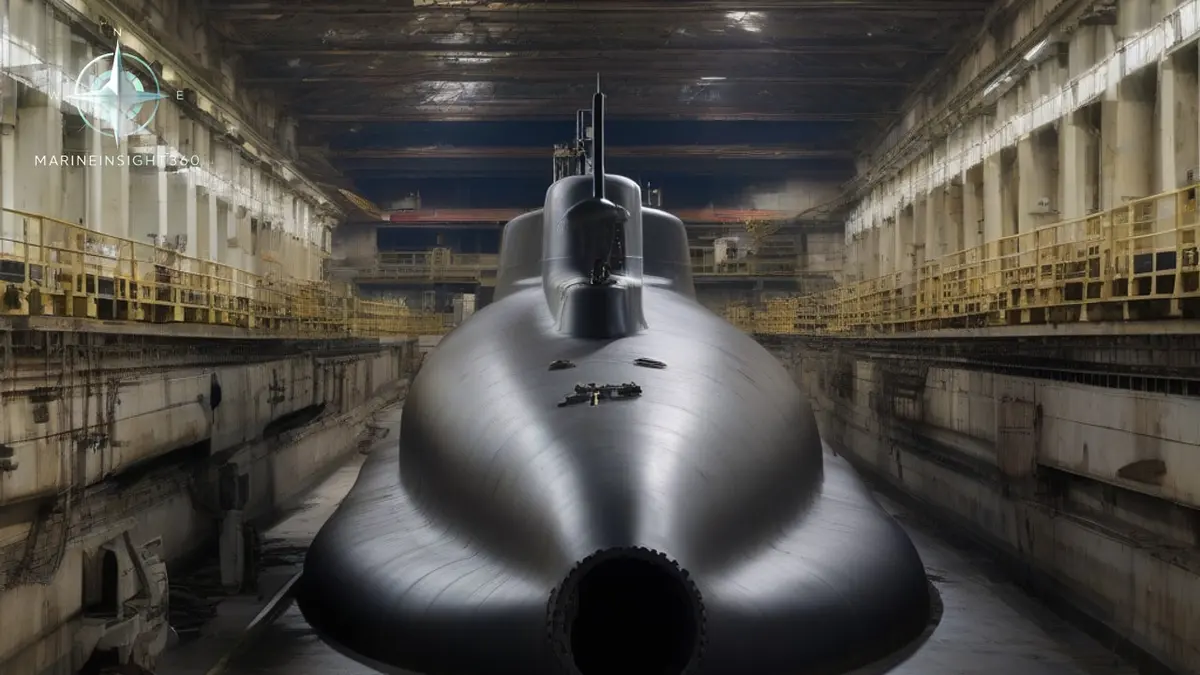
How deep can a sub go? A modern military submarine operates to a published or classified test depth that is usually a few hundred meters. Research submersibles reach the deepest point in any ocean, close to 11,000 meters. The gap is not a failure of naval engineering. It reflects two completely different design problems. A warship needs internal volume, speed, weapons and a crew of over a hundred.
A submersible needs only a small sphere that can survive pressure for a few hours with two or three people inside.
Pressure is the constraint that governs everything. Seawater adds roughly one atmosphere, about one bar, for every ten meters of depth. At 300 meters a hull is carrying about 31 bar, or around 450 psi, pressing inward on every square inch of surface. At 1,000 meters that becomes roughly 101 bar.
The load rises linearly, but the structural weight needed to resist it rises much faster, because deeper hulls need thicker plate, which means more weight, which means more buoyancy volume, which means more surface area to be crushed.
Test depth, design depth and crush depth are three different numbers
Confusion about submarine depth usually comes from mixing up three terms that mean distinct things.
- Test depth is the maximum depth at which a submarine is authorised to operate in normal peacetime service. It is the number that appears in the operating manual and the one crews work to.
- Design depth is the depth the structure is engineered to withstand, calculated during design and validated by analysis and model testing.
- Crush depth, or collapse depth, is the theoretical depth at which the pressure hull fails. It is a calculated figure. Unless a boat is lost, nobody ever establishes it empirically.
Navies apply a safety factor between design depth and test depth, and the factor differs by service. The US Navy sets test depth at about two thirds of design depth. The Royal Navy uses a more conservative four sevenths, roughly 0.57. The German Navy has used one half. So two submarines quoting the same test depth may have quite different structural margins depending on whose rules they were built to.
What military submarines actually reach
Exact test depths for front-line submarines are classified in every navy that operates them. The public figures are deliberately vague. The US Navy describes the operating depth of its Los Angeles and Virginia class boats as greater than 800 feet, about 240 meters, which is a floor rather than a limit, and the real figure is understood to be significantly deeper.
What is not secret is why the number is what it is. Operating depth for a warship is driven by tactics rather than by how deep the hull could theoretically go. Sonar performance depends on thermal layers in the water column, and a submarine positions itself relative to those layers to hide or to listen. Torpedo engagement envelopes, communication with the surface and safe separation from the seabed all sit within a few hundred meters.
Since the average depth of the world ocean is around 3,700 meters, a submarine at 300 meters in open water is nowhere near the bottom anyway. Going deeper buys very little tactically and costs a great deal structurally.
The exception that proved what titanium can do
The Soviet submarine K-278 Komsomolets, built with a titanium pressure hull, reached 1,020 meters (3,346 ft) in a 1984 test dive, a record for a military submarine that still stands. Titanium offers a much better strength to weight ratio than steel and is non-magnetic, but it is expensive, difficult to weld and demanding to work, which is why almost every other navy stayed with high-strength steels such as HY-80 and HY-100.
Research submersibles are a different class of vehicle
Deep submergence vehicles solve the pressure problem by shrinking the pressure boundary to a sphere containing only the crew. A sphere is the optimal shape for external pressure because the load is distributed evenly across the surface with no bending, whereas the long cylinder a warship needs for volume and speed is inherently a weaker geometry.
- The US research submersible Alvin, after upgrade, works to 6,500 meters, which brings the large majority of the seafloor within reach.
- The bathyscaphe Trieste took Jacques Piccard and Don Walsh to the bottom of the Challenger Deep in the Mariana Trench in 1960, at just under 11,000 meters.
- The full-ocean-depth submersible Limiting Factor repeated the Challenger Deep dive in 2019 and has made repeated crewed descents to that depth since, which was the real advance: not reaching the bottom once, but being able to go back.
What happens if a submarine goes too deep
Hull failure at depth is not a slow leak. The pressure hull buckles and collapses in a fraction of a second, faster than any human reaction. This is why depth limits are enforced with alarms, hard procedural controls on ballast and planes, and why a submarine that suffers a jam-dive on the planes at speed is treated as an immediate emergency requiring a full astern bell and an emergency main ballast tank blow.
Escape and rescue capability is far shallower than operating depth. Modern escape suits, such as the Submarine Escape and Immersion Equipment used by several navies, allow free ascent from around 180 meters (600 ft). Beyond that, survival depends on a rescue vehicle mating with the escape hatch of the disabled submarine, which needs the boat to be lying at a manageable angle on the seabed and requires international rescue assets to reach the site in time.
A submarine lost in deep ocean water is beyond either method.
The short version
- Pressure increases about 1 bar per 10 meters of seawater.
- Test depth is the authorised operating depth, design depth is what the structure was engineered for, crush depth is a calculated failure point.
- Front-line military boats work in the low hundreds of meters, with exact figures classified.
- K-278 Komsomolets, with a titanium hull, reached 1,020 meters in 1984.
- Crewed submersibles reach the bottom of the Mariana Trench, close to 11,000 meters.
- Escape by suit is realistic only to around 180 meters.
For related material on pressure hull construction and naval architecture, see the Knowledge Base section of Marine Insight 360.
Depth ratings on civilian submersibles are checked by someone other than the builder. DNV, Lloyd's Register and ABS publish rules for underwater vehicles that cover pressure hull design, material testing, pressure testing and periodic survey, and a classed vehicle carries a certificate naming its rated depth. Limiting Factor was built and certified to DNV class for full ocean depth.
Titan was not classed. The submersible imploded in 2023 during a descent to the Titanic wreck, killing all five on board, and the US Coast Guard convened a Marine Board of Investigation with NTSB participation. The evidence turned on the composite pressure hull, on repeated pressure cycling, and on the operator's decision to stay outside the certification system described above.
Sources and further reading
- Submarine depth ratings - Military Wiki
- How deep can a submarine dive? - Naval Post
- Crush Depth: What Happens When A Submarine Dives Too Deep? - SlashGear
What to read next
Recommended Reading
Typhoon Class Submarine: The Biggest Boats Ever Sent Under the Sea
The Soviet Typhoon class submarine remains the largest ever built: twin pressure hulls, 20 missile silos, and why nothing since has matched its size.
What Submarine Can Go the Deepest? Full Ocean Depth Records Explained
The deepest diving submarines explained: DSV Limiting Factor's 10,924 m record, Trieste in 1960, China's Fendouzhe, and why navy submarines stay shallower.
Where Is Challenger Deep? Location, Depth and Who Has Been There
Challenger Deep lies at the southern end of the Mariana Trench in the western Pacific. Its position, its measured depth, and the crewed dives that reached it.