
Key Features of Seismic Survey Vessels
Key Features of Seismic Survey Vessels: regulatory and compliance context for US, UK, Canada, Australia, Singapore and European maritime readers.
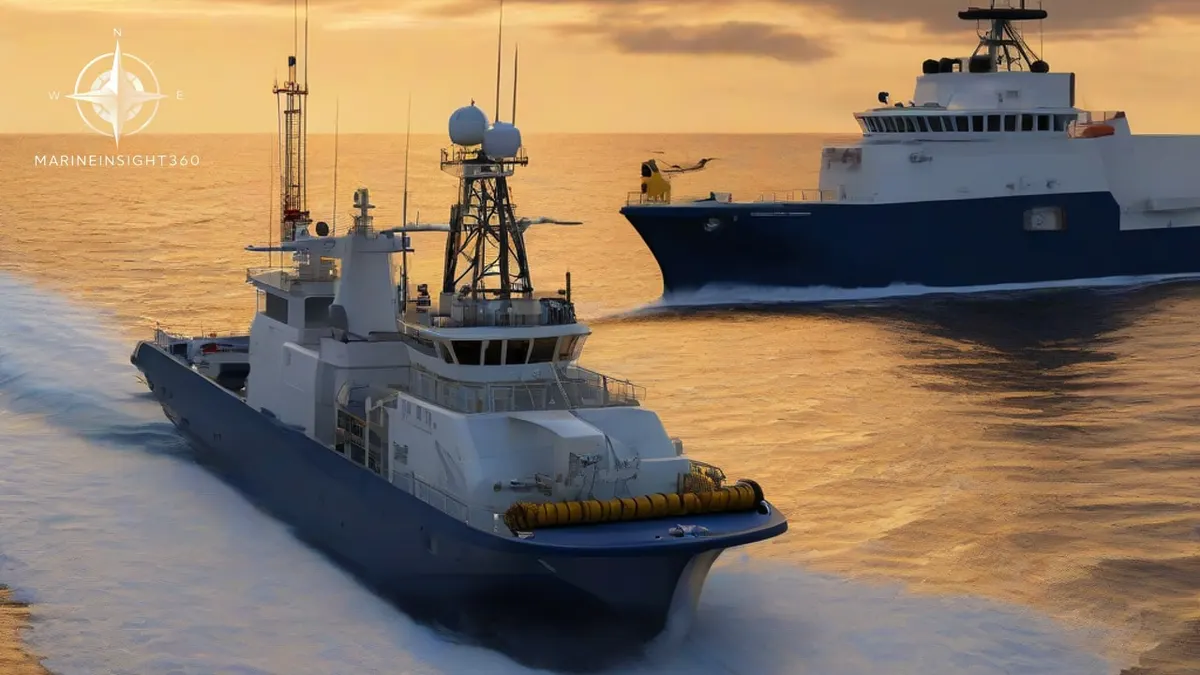
Key Features of Seismic Survey Vessels
A seismic survey vessel is a slow-moving ship, usually under 100 metres long, built to tow the hydrophone cables and air guns used in offshore seismic exploration.
Seismic survey vessels are well-designed ships characterized by: dedicated living quarters for crew and seismic survey personnel; a helicopter landing pad; an instrument room; quiet engines; an auxiliary propulsion system for unpowered propulsion; large cranes or pulleys for storing tow cables; a working deck for installing port turrets; and an auxiliary steering system.
Seismic survey personnel typically work in the instrument room, aft deck, and compressor room.
Key Features of Seismic Survey Vessels
Instrument Room:
This is the area used for data recording and monitoring operations. The deck is equipped with computers with large displays for performing all major operations, from controlling borehole depth to launching. The main navigation system in this area is connected to satellites, radio systems, GPS, echo sounders, gyroscope repeaters, and other equipment.
Aft Deck:
This is where boreholes and air guns are deployed. It is equipped with large cranes and pulleys for storing borehole cables, as well as hydraulic mechanisms for deploying cables and air guns. Maintenance areas for cables and air guns are also located here.
Compressor Room:
Seismic exploration vessels have a separate compressor room for monitoring pressure supply and compressor motors. The compressor room is typically located forward of the engine room and is equipped with a dedicated generator to power the compressors.
Planet Room:
Usually located at the bow. It is well-equipped with modern facilities. Some vessels are equipped with an auxiliary steering system (for vessels without a bidirectional steering system) and an automatic steering system (called an automatic tracking system), controlled by a synchronous computer in the navigation room. Additionally, the vessel is equipped with an auxiliary propulsion control unit (similar to a hydroplaning device) to assist maneuvering.
A camera display unit is also provided to monitor activity on the aft deck and in the waters near the hull.
Engine Room:
The engine room of a seismic exploration vessel is exceptionally spacious and equipped with many of the equipment required for vessels of similar size.
The engine room is mainly divided into three compartments:
1. Main engine room, housing auxiliary generators and port-side generators.
2. Compressor room, housing the main compressor for supplying air to the air guns or seismic exploration sources; and
3. Compressor unit and landing bay. (This area also houses auxiliary propulsion engines, often referred to as the "Caterpillar engine room" because Caterpillar typically manufactures these engines.)
- What is a Triple Hull Vessel?
- What Happens On A Fishing Vessels?
- Great War Vessels: What are Ironclad Ships?
- Best Cable Laying Vessels in the World
- How are submarine cables installed on cable vessels?
Main Seismic Exploration Equipment
The main seismic exploration equipment used on these vessels includes:
Stern Buoy:
As the name suggests, this is a buoy equipped with GPS and a flashlight, installed at the end of each transmission cable. It keeps the transmitter afloat and prevents the cable from tangling. It also provides location information and illumination at night.
Transmission Cable:
This is an optical fiber cable containing hydrophones for receiving seismic signals, electronic units for data transmission, stress membranes or Kevlar fibers to reinforce the cable, and a power transmission system to power the cable.
The launching device is divided into sections of 100 meters or less for easy replacement of damaged parts. Initially, the strip cable was filled with a liquid with a specific gravity less than 1 to provide buoyancy. Now, the liquid has been replaced by a foam material, which is relatively rigid, less prone to leakage, easier to maintain, and more evenly distributed.
Locators:
These are depth-control units mounted on the cable and spaced at regular intervals (no more than 300 meters apart). These units control the cable depth and are equipped with motors and vanes to adjust and maintain the cable depth accordingly. They are operated from the instrument room.
Seismic Exploration Vessel
Acoustic Devices:
Similar to the locators, acoustic devices are also mounted on the cable, integrated with the launchers and arranged equidistantly. The acoustic devices emit signals that are received by sensors on the ship's side to determine the relative position of the cable.
Air Gun:
This device is also called the seismic source. The air gun consists of two chambers: an upper control chamber and a lower launching chamber, along with a solenoid valve. High-pressure air (2000 psi) is supplied to the control chamber by a compressor and then enters the lower chamber.
The ignition mechanism is activated by sending an electrical pulse to the solenoid valve, causing air to escape from the lower chamber through the exhaust port.
Once the solenoid valve opens, the chamber rapidly fills with air within a very short time (a fraction of a second). This ensures continuous ignition, with the time interval between activations depending on the ship's speed. This cycle achieves optimal ignition performance without spark loss.
Recommended Reading
Safety Features on LNG-Powered Ships
Safety Features on LNG-Powered Ships: safety, training and compliance context for US, UK, Canada, Australia, Singapore and European maritime readers.
Iran retaliates with missiles and drones, defying Trump’s warning
Learn iran with practical maritime context, safety checks, operational guidance and related resources for global shipping readers.
Hapag-Lloyd Invests in APM Terminals Rotterdam to Drive Growth
Hapag‑Lloyd’s new stake in APM Terminals Rotterdam aims to expand capacity, improve hinterland links and enhance crew efficiency in Europe’s busiest port.