
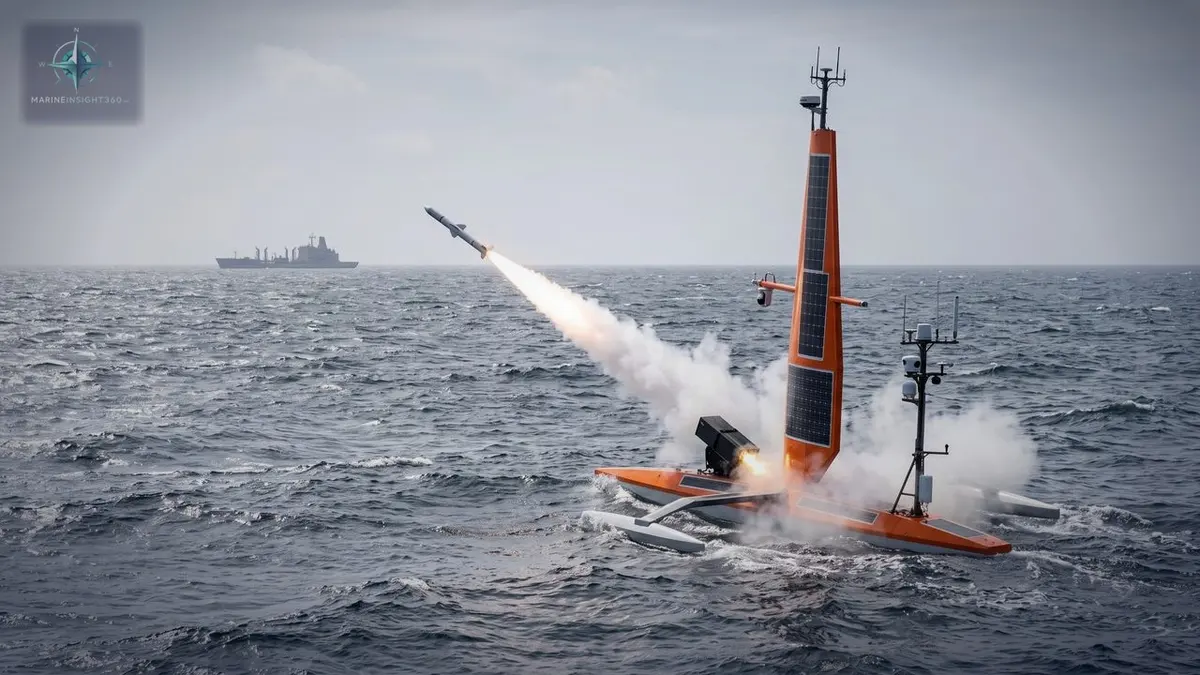
Saildrone Completes Missile Launch Test Aboard its Sail-Powered Surveyor
Saildrone’s autonomous vessel successfully launched a missile‑type payload, showing new possibilities for armed surveyors and implications for shipping operator
What the Test Shows for Autonomous Vessels
Saildrone’s recent missile‑launch test proves that a fully autonomous, sail‑powered surveyor can carry and fire a missile‑type payload without losing its sailing performance. For seafarers, cadets and shipping professionals, the result shows that future unmanned cargo ships, patrol vessels and research platforms can be fitted with advanced weapons or defensive systems while still performing their primary missions.
In short, the test demonstrates that an autonomous vessel can integrate a missile system, manage the associated power draw, and maintain stable sailing. This opens the door for armed unmanned platforms that can patrol, survey or defend without a crew on board.
Key Decision Criteria for Adding Weaponry
Payload Capacity
The vessel’s displacement and deck area must support the missile’s weight and the launch mechanism. A 2‑ton missile on a 200‑ton platform, for example, requires a deck structure that can absorb the launch forces.
Power Requirements
Launch systems draw large amounts of energy. The solar panels and battery bank must sustain both sailing and firing operations. A typical launch may consume 10 kWh, so the vessel’s power budget must include that load.
Autonomy Integrity
The launch sequence must be fully integrated into the autonomous control software. A failure to do so can cause the vessel to deviate from its planned route or lose stability during a launch.
Regulatory Compliance
Operators must confirm that the vessel meets the flag state’s weapons regulations and that the launch complies with international maritime law. Class societies such as DNV or Lloyd’s Register now issue guidance on weapon integration for unmanned vessels.
Safety Protocols
Redundant fail‑safe mechanisms are essential to prevent accidental discharge during normal survey operations. A dual‑lock system that requires both a software command and a manual override can mitigate this risk.
Common Pitfalls in Early Autonomous Missile Trials
Insufficient Structural Reinforcement
Launch forces can damage the hull or deck if the structure is not engineered for the load. A reinforced deck plate and proper load‑distribution brackets are mandatory.
Software Integration Gaps
Without seamless integration, the launch command can conflict with navigation routines, leading to loss of course or stability. A dedicated launch module that communicates with the vessel’s navigation stack is required.
Operational Impact for Crewed Vessels and Port Authorities
Although Saildrone’s platform is unmanned, the test’s success has implications for crewed vessels that might adopt similar systems:
- Port authorities will need to update security protocols to account for autonomous weapons platforms entering their waters.
- Crews on hybrid vessels may require additional training on remote launch procedures and emergency shutdowns.
- Insurance premiums could rise as the risk profile of armed autonomous vessels changes.
Next Steps for Shipping Professionals
To stay ahead, professionals should:
- Review the latest class society guidelines on weapon integration for autonomous vessels.
- Consult with maritime security experts on the legal implications of deploying armed surveyors.
- Attend upcoming Marine Insight 360 webinars on autonomous vessel design and safety.
Why This Test Matters to the Industry
The successful missile launch demonstrates that autonomous sail‑powered surveyors can safely carry and deploy advanced payloads. This opens new avenues for maritime surveillance, research and defense, and forces shipping operators to rethink vessel design, regulatory compliance and operational risk.
Recommended Reading
When Were Boats Invented? A Timeline From the First Dugout to the First Sail
The oldest boat ever found is about 10,000 years old, and humans were crossing open water long before that. The real timeline of when boats were invented.
Safety Features on LNG-Powered Ships
Safety Features on LNG-Powered Ships: safety, training and compliance context for US, UK, Canada, Australia, Singapore and European maritime readers.
The Gas Vitality LNG Bunker Vessel Completes her 100th LNG Bunker Operation in Marseille, Southern France
The Gas Vitality LNG Bunker Vessel Completes her 100th LNG Bunker Operation in Marseille, Southern France: ports, trade and shipping-market context for...