
Ship Motions - A Complete Guide
Ship Motions - A Complete Guide: ports, trade and shipping-market context for US, UK, Canada, Australia, Singapore and European maritime readers.
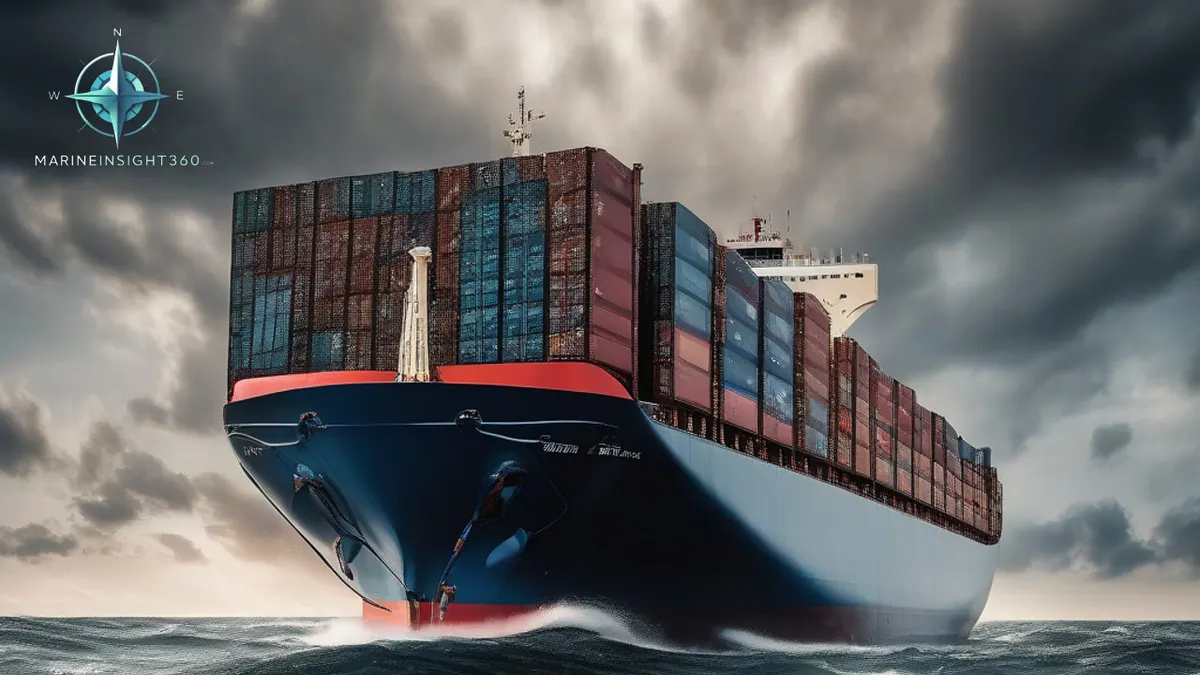
When a shipis on the high seas, it is subject to tremendous forces from all directions. Whether it is wave loads, structural stresses, wind forces, or turning forces, the ship must be able to withstand all of these loads and stresses.
The first step to dealing with these loads is to understand how the ship responds to each load.
If these loads are not carefully monitored, the ship may be forced to make unpredictable and hazardous turns, deviating from the intended course. Therefore, it is crucial to understand and analyze the various ship motions accurately.
Coordinate Systems and Reference Axes
Determining a ship's position accurately can be a challenging and time-consuming task. To do this, ships use predefined coordinate systems.
The origin of a ship is located at the intersection of the stern perpendicular and the baseline. The stern perpendicular is a vertical line that runs along the ship's rudder stock.
The rudder stock represents the axis about which the ship's rudder rotates. The baseline is the lowest structural element that forms the horizontal base of the ship. Both of these lines are imaginary and are for reference only.
Top 10 Largest Ship Propellers In The World
From this perspective, these three axes define the three dimensions of the ship.
The X-axis runs from the stern to the bow.
The Y-axis runs along the beam or width of the ship, with positive values towards the port side.
Finally, the Z axis runs along the height of the ship, with positive values towards the top.
These three axes clearly define the various areas of the ship.
The Z-axis value will never be negative, as the keel is assumed to be the lowest element in the system.
Similarly, the X-axis reading will never be negative, unless the ship is a cruiser-class ship, with the stern protruding beyond the rudder stock.
However, the Y-axis reading can be positive or negative, depending on whether the ship is positioned on the port or starboard side.
Positive values indicate a port position, and negative values indicate a starboard position. With these axes, we can now proceed to analyze the motion of the ship and its effects. Ship Motion Diagram
Three Degrees of Freedom of a Ship
An unconstrained moving object can have six degrees of freedom. Degrees of freedom refer to the ability of an object to move freely in a particular motion.
These six degrees of freedom are divided into two categories: three translational degrees of freedom and three rotational degrees of freedom.
In this section, we will analyze the three translational degrees of freedom created by the motion of a ship:
1. Lift (vertical lift - Z axis)
2. Roll (lateral lift - Y axis)
3. Heave (longitudinal lift - X axis)
Roll is when every point on an object moves at the same speed and direction. Along these three axes, we get motions called lift, pitch, and heave.
The vertical motion is called lift. When a wave hits a moving ship along its path of motion, it creates a difference in buoyancy and gravity.
This causes the ship to lift at a specific point, as shown in the figure. This imbalance of forces causes an up-and-down motion, often referred to as lift.
The lateral motion is called pitch. This occurs when a ship is hit by a wave perpendicular to its direction of motion. This causes the ship to sway from side to side, between port and starboard.
Unlike lift, with this type of loading, the forces are relatively evenly distributed, and there is no uneven loading. This side-to-side motion creates rapid acceleration and deceleration effects that can have serious consequences for the ship.
We will discuss these effects in later chapters.
Finally, the longitudinal motion of a ship is referred to as heave. Heave occurs when a ship accelerates and decelerates rapidly in the longitudinal direction, causing the ship to pitch forward or backward.
Heave is caused by waves striking the ship from the bow or stern, forcing the ship to heave forward or backward momentarily.
When this motion is combined with the motion of the ship, it can have serious structural effects on the ship's safety.
Lift, Uplift, and Pitch
Three Rotational Motions of a Ship
In this section, we will analyze the three rotational angles produced by the motion of a ship:
1. Yaw (vertical rotation - Z axis)
2. Roll (longitudinal rotation - X axis)
3. Pitch (lateral rotation - Y axis)
Rotation is the motion of an object where the speed of movement of different points on it depends on its position.
Along these three axes, we experience motions called yaw, roll, and pitch. These rotational motions are caused by pairs of forces acting on different areas of the ship.
Rotation about the vertical Z axis is called yaw. Yaw is usually less destructive than other types of ship motion because it is caused by a pair of waves that are perpendicular to the length of the ship. It is usually impossible to keep a straight course in waves and the ship will always be slightly affected by yaw.
However, with proper rudder correction, the effects of yaw can be mitigated. This motion is usually caused by oscillations resulting from rudder deflection and steering gear failure.
Roll is the rotation caused by wave motion about the longitudinal axis (equivalent to the axis parallel to the x-axis we defined earlier). This motion is usually caused by waves perpendicular to the direction of the ship's motion.
This refers to the sideways roll that occurs when a wave hits the side of the hull. Heel is the rotation about the transverse axis (equivalent to the axis parallel to the y-axis). This motion is common and causes the bow and stern of the ship to move up and down.
Longer ships tend to have smaller heels, usually less than 5 degrees, while shorter ships may have heels of 5 to 8 degrees. Generally, only the length affects the heeling characteristics, while other dimensions are insignificant.
Ship rotational motion
This motion is caused by the action of waves moving in the same direction as the ship. Rolling, which is generally the most common type of ship motion, is essentially a rotational motion and is common in high seas and in adverse weather conditions.
Major ship motion effects
Ship motion is important in the forces experienced by a ship and must be considered when calculating loads. These loads can have a significant impact on the stability, structural integrity, and physical response of the ship. Generally, rotational motion does not significantly affect the behavior or characteristics of the ship.
Ships are designed to withstand reasonable rotational loads due to the effects of centrifugal forces. However, translational motion can be a significant problem, as it can cause considerable stresses in the ship's structure. In addition, it can have adverse effects on the ship's machinery and cargo.
For example, during the heave and roll motion of a ship, containers stacked on board are likely to shift and potentially fall off, causing damage and loss of property. While rolling can also cause damage, it is less common because it requires waves to act in a specific way.
Typically, when multiple types of motion affect a ship, they create a twisting force called buckling. This force can create significant stresses in the ship's structure and is most common in long-haul container ships.
When designing a ship, it is crucial to consider the various motions of the vessel. It is also wise to test these loads and their responses on the ship using material analysis software.
The main factors that affect a ship's motion and response are its shape, size, and weight. These factors determine other important parameters such as the center of gravity, center of buoyancy, and waterline beam. These hydrostatic factors play a key role in determining how a ship behaves under specific loading conditions.
Hogging and Sagging
After discussing the six main types of ship motion, we will discuss two common reactions of a ship to wave loads: heave and sag.
These two phenomena refer to the bending of the hull due to an imbalance of forces. In various ship motions, there is sometimes a difference in the buoyancy and gravity forces along the length of the hull.
Ideally, gravity and buoyancy should be equal at all points. However, due to the action of waves, the buoyancy values are likely to change at certain points.
For example, at the crest of a wave, the buoyancy is greater, while at the trough it is less. Therefore, at the crest of the wave, that part of the ship is pushed upward, while at the trough of the wave, it is pushed downward because it is not fully supported.
Heave refers to the crest of the wave occurring in the middle of the hull, while the trough of the wave occurs on the bow and stern sides. As a result, the ship will bend concavely on the wave surface.
Sag, on the other hand, occurs when the trough of the wave is located in the middle of the hull. Since the crest of the wave is at the ends, the ship is forced to adapt to the convex shape of the wave surface.
Due to the transient nature of wave forces, ships often swing rapidly between droop and bow. This causes the ship to vibrate violently and can cause damage.
Subjecting the ship to these forces for extended periods can stress the material and weaken its structural integrity due to the bending loads. The solution to this problem is to use reinforced bracing in various parts of the ship to carry and distribute the loads evenly.
Bow, stern, and bottom
There is an eighth type of ship motion, called heel.
Heel is when a ship suddenly slows down when it hits the water. This is usually caused by huge loads acting on the three main parts of the ship (bow, stern, and bottom).
Heel refers to the front of the ship, and heel refers to how the width of the ship increases from the waterline to the bow deck.
Ships with larger bows naturally experience greater loads due to their overall design and hydrodynamic characteristics. To address this, a draft correction is required to ensure that the bow can be used normally without damaging the hull.
Bow heel is when the front of the keel suddenly enters the water. When buoyancy can no longer support the weight of the bow, the bow suddenly sinks.
Bow strikes
Bow strikes are very common in the open sea and cause enormous stresses on the vessel. If not properly handled, it can be the main cause of hull damage.
To effectively mitigate this type of strike, reinforcing profiles is crucial. They provide structural rigidity and help to distribute the loads evenly. In addition, bow strikes can be reduced by significantly increasing the draft. This strike causes huge loads that can instantly cause almost irreparable damage to the hull.
Bow thrust must be included in the load calculations when calculating material strength and structural performance. It is also the most common type of thrust, especially when sailing far from land, where strong waves can cause huge loads on the hull.
Stern thrust is similar to bow thrust, except that it occurs at the stern. It occurs when the weight balance at the stern is suddenly broken due to insufficient buoyancy.
This thrust can easily damage the stern of the ship due to the weight of the engine, propeller, and rudder. Sudden deceleration is also the main cause of weakening rudder and propeller performance.
Stern thrust is less common than bow thrust due to the shape and hydrodynamic characteristics of traditional ships. However, if not properly considered, it can lead to structural defects and metal fatigue. Proper reinforcement of the stern section, especially the stern protrusion, is essential for both keeled and rigged ships.
The latter ship movement is known as "bottoming out". This is less common and typically occurs when the mid-keel makes contact with the water.
This can happen during sagging and buckling loads, which are common in situations where weight and buoyancy are unbalanced. In such situations, the rest of the vessel may be temporarily suspended above the water while the entire mid-hull remains suspended.
This places enormous stress on the hull, which can cause permanent deformation and damage. To prevent such damage, the hull beams running along the length of the ship must be adequately reinforced with structural and other load distribution members.
In short, the movement of the ship caused by wave action can have a permanent effect on the hull and the overall structure. A careful analysis of the six basic degrees of freedom (roll, heave, lift, yaw, roll, and list) as well as secondary loads such as sagging, buckling and various impacts is essential.
To properly handle these forces, the various components of the ship must be properly reinforced and provided with additional supporting members. The key point to consider when designing a load-bearing structure is that any force acting on the structure must be evenly distributed and should not be limited to point loads.
Point loads act only at a single point and typically exceed the allowable deformation value. In contrast, by distributing the force over multiple structural components, the total load can be reduced to below the allowable value. Therefore, taking appropriate measures can protect the ship from the huge loads generated by various movements.
Recommended Reading
Ship Motions – The Ultimate Guide
Ship Motions – The Ultimate Guide: safety, training and compliance context for US, UK, Canada, Australia, Singapore and European maritime readers.
Iran retaliates with missiles and drones, defying Trump’s warning
Learn iran with practical maritime context, safety checks, operational guidance and related resources for global shipping readers.
Hapag-Lloyd Invests in APM Terminals Rotterdam to Drive Growth
Hapag‑Lloyd’s new stake in APM Terminals Rotterdam aims to expand capacity, improve hinterland links and enhance crew efficiency in Europe’s busiest port.