
The Real Titanic: What Actually Happened and What It Changed at Sea
What the real Titanic was, why her watertight compartments failed, and how the 1912 loss produced SOLAS, lifeboat rules and the Ice Patrol.
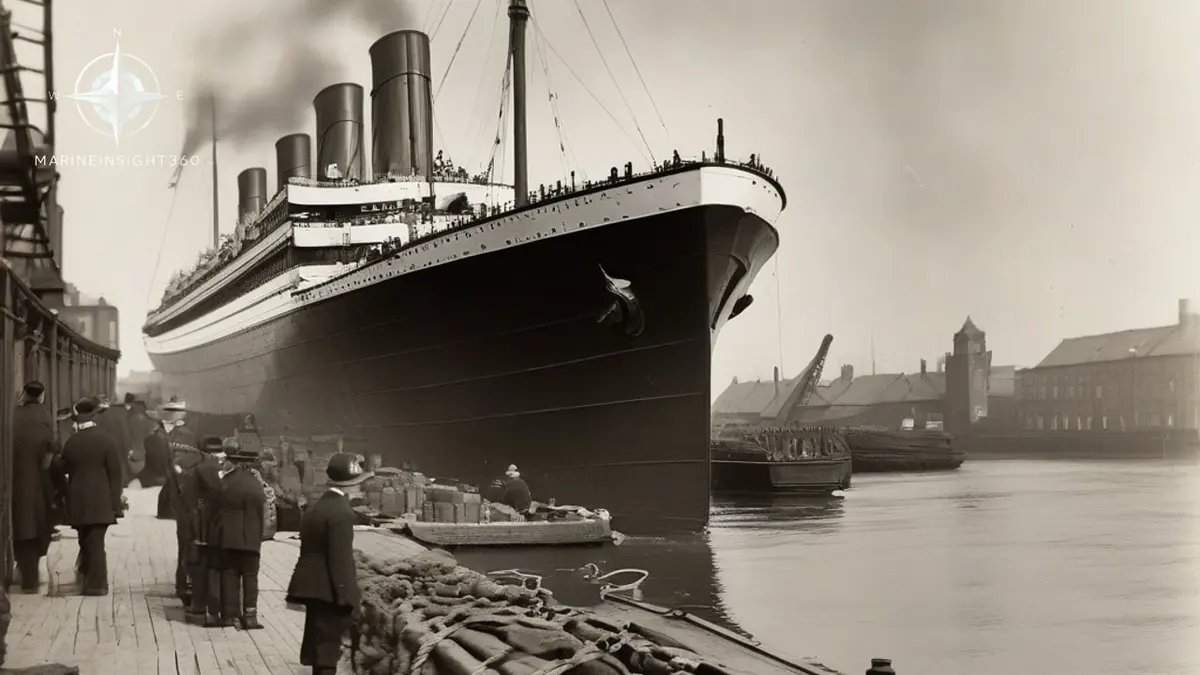
The real Titanic in plain numbers
The real Titanic was RMS Titanic, an Olympic class passenger liner built by Harland and Wolff in Belfast for the White Star Line. She struck an iceberg at 2340 ship's time on 14 April 1912 about 375 miles south of Newfoundland, sank in the early hours of 15 April, and took more than 1,500 of the roughly 2,209 people on board with her. Her 20 lifeboats had capacity for 1,178, a little over half of those aboard.
Almost every popular version of the story compresses those figures into a single tragedy. The operational picture is more useful, because the decisions that night were normal industry practice rather than negligence by one crew, and that is precisely why the disaster changed the rules for everyone.
Why the watertight compartments did not save her
Titanic was subdivided by transverse watertight bulkheads and was widely described as capable of surviving serious flooding. The weakness was vertical, not horizontal. The bulkheads were not carried up to a continuous watertight deck across the full length of the ship, so as the bow trimmed down under the weight of flooding water, the sea spilled over the top of one bulkhead into the next intact compartment and then the next.
The collision also compromised more compartments than the design assumed. Subdivision standards of the period were built around a small number of adjacent compartments flooding after a collision, typically a bow-on strike. A glancing contact along the starboard side opened a long line of damage instead, which is the failure mode the arrangement was least able to absorb. Modern damage stability rules descend directly from that lesson.
The ice warnings and the navigation decisions
Titanic received multiple ice warnings by wireless during the day of 14 April. She maintained high speed, which was standard practice at the time for liners in reported ice: the expectation was that lookouts would sight ice in time to alter. That worked in normal conditions. It did not work on a moonless, windless night with a flat sea, where there was no breaking water at the base of the berg to reveal it.
Two other factors mattered. Wireless operators on passenger liners were employed to handle commercial passenger traffic, so ice messages competed with paid telegrams for the operator's attention. And there was no requirement for a continuous radio watch, so a nearby ship whose operator had gone off duty heard nothing at all. Carpathia, further away but with an operator still listening, turned and picked up the survivors.
What the disaster changed: SOLAS 1914
An international conference met in London from November 1913 and concluded the first International Convention for the Safety of Life at Sea on 20 January 1914. It fixed the specific gaps the loss had exposed.
- Lifeboat capacity for every person on board , ending the practice of scaling boats to tonnage rather than to people.
- Lifeboat drills for each voyage, so that launching was practised rather than improvised.
- A 24 hour radio watch on ships carrying wireless, so that a distress call could not go unheard because an operator had turned in.
- Stricter subdivision and construction standards , including watertight arrangements that could not be defeated by trim.
SOLAS has been revised repeatedly since, and the version in force today covers construction, fire protection, life saving appliances, radiocommunications, navigation safety, cargoes, safety management and maritime security. Survival craft capacity now exceeds the number of people carried rather than merely matching it.
The International Ice Patrol
The same 1914 conference created the International Ice Patrol, operated by the United States Coast Guard and funded by the states whose ships benefit from it. It monitors iceberg drift in the North Atlantic and publishes the limit of all known ice, which is still the reference North Atlantic operators use when planning a track in the ice season. No vessel following the published limit has been lost to an iceberg collision.
What the Titanic still teaches on a modern bridge
Three points survive intact more than a century later, and all three appear in current practice.
- Safe speed is conditional, not fixed. COLREGs Rule 6 requires speed to suit visibility, traffic, manoeuvrability and the state of wind, sea and current. A speed that is prudent in a clear seaway is not prudent in reported ice at night.
- Received information has to reach the person conning the ship. A warning that stays with the radio operator, or in an unread email on a modern ship, has no safety value at all.
- Muster and launching capability is a drill outcome, not a paperwork outcome. Boats that exist on the plan but have never been swung out under load do not evacuate anyone.
For a deeper look at how these rules operate today, the Marine Insight 360 Knowledge Base covers SOLAS life saving appliance requirements and abandon ship procedures in detail.
Sources and further reading
- From Disaster to Framework: How the Loss of Titanic Reshaped Maritime Safety, Lloyd's Register Foundation
- Remembering Titanic: The tragedy behind SOLAS, SAFETY4SEA
- The Titanic disaster led to a rethink of international regulations, CNN
What to read next
Recommended Reading
Container Tracking: How Shippers Actually Follow a Box Across the Ocean
How container tracking works, from free carrier lookups to visibility platforms: what each tool layer does, what it costs, and how to pick for your volume.
The Kursk Submarine Disaster: What Happened and What It Changed in Submarine Rescue
How the Kursk submarine was lost in the Barents Sea in August 2000, what the investigation found, and how the disaster reshaped submarine escape and rescue.
Do You Know About The Titanic Real Story?
Before the Titanic was launched on April 10, 1912, excitement was in the air. The new ship was the largest artificial moving object in the world. It had…