
What Is MHE in a Warehouse? Material Handling Equipment Explained
MHE means material handling equipment: the forklifts, reach trucks, conveyors and racking that move cargo through a warehouse or container freight station.
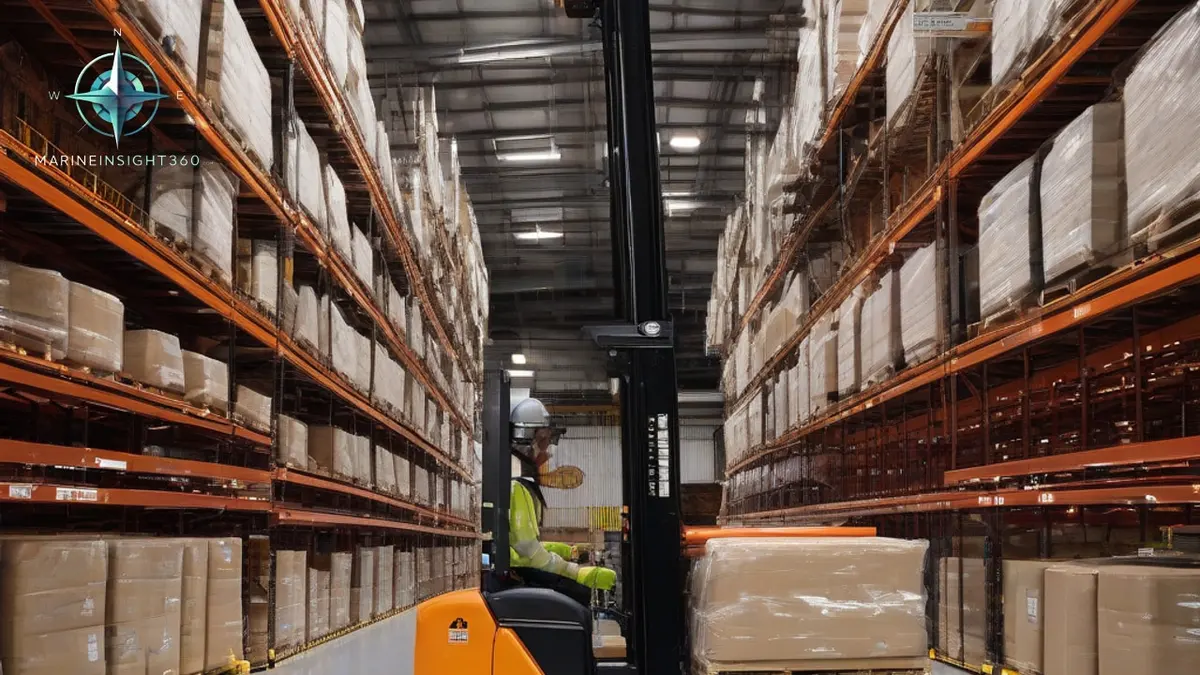
What is MHE in warehouse logistics? MHE stands for material handling equipment: the trucks, conveyors, lifting devices and storage systems used to move, position, store and retrieve goods inside a facility. The term covers everything from a hand pallet truck to a wire-guided turret truck and an automated storage and retrieval system. In port-side logistics it stretches further, to the reach stackers and terminal tractors that feed the shed.
For anyone moving cargo between a container and a rack, the MHE fleet decides throughput, storage density and damage rates more than the building does.
The four functional groups of MHE
- Transport equipment moves goods between points: forklifts, pallet trucks, conveyors, cranes, and automated guided or mobile robots.
- Positioning equipment handles goods at a single point: scissor lifts, tilters, manipulators, dock levellers and turntables.
- Unit load formation equipment holds goods together as one handling unit: pallets, slip sheets, stretch wrappers, strapping and containers.
- Storage and retrieval equipment holds the stock: pallet racking, shelving, drive-in racking, carousels and automated systems.
Most operational problems trace back to a mismatch between two of these groups, typically a truck chosen for one aisle width and racking installed for another.
The trucks, and what each one is actually for
- Hand pallet truck. Manual, floor level, short moves. Cheapest MHE in any building and the most abused.
- Powered pallet truck. Long horizontal runs and trailer loading, where the operator rides or walks alongside.
- Counterbalance forklift. The rear counterweight balances the load, so nothing has to straddle the pallet. It handles rough ground, works outdoors and drives into trailers, but it needs the widest aisles, around 3.5 to 4 metres (11 to 13 ft).
- Reach truck. The mast or forks reach forward over the load wheels, removing the need for a counterweight. Aisles of roughly 2.5 to 3 metres (8 to 10 ft) and lift heights above 10 metres (33 ft) are normal. Indoor use on good floors only.
- Very narrow aisle turret truck. Wire or rail guided, works in aisles under 2 metres (6.6 ft) and lifts higher again, at the cost of a superflat floor and dedicated racking.
- Order picker. The operator rises with the platform to pick cases or singles at height.
- Conveyors and sortation. Fixed routes at high volume, where a truck fleet would be uneconomic.
MHE at the port end
Container freight stations and bonded warehouses run the same equipment plus a heavier tier. Reach stackers and empty container handlers move boxes in the yard, terminal tractors shuttle chassis, and yard gantry cranes stack. Container handling forklifts reach capacities far beyond warehouse work, in the tens of tonnes.
Stuffing and stripping containers adds a constraint most warehouse planners miss. A standard 40 foot container has an internal height of about 2.39 metres (7 ft 10 in), so a conventional mast will not enter it. Container entry work needs low-mast trucks with limited free lift, or powered pallet trucks working off a dock leveller. Floor loading inside the box, and the ramp gradient at the door, also limit truck weight.
Choosing MHE: the questions that decide the fleet
- What aisle width can the building give up, and what storage density do you need in return?
- What is the top beam level, and does the truck have residual capacity at that height? Rated capacity falls as the mast extends.
- How many pallet moves per hour at peak, and for how many hours a day?
- How flat and how strong is the floor? Narrow aisle equipment is unforgiving of joints and settlement.
- Indoors, outdoors or both, and is there a cold store or a hazardous area to serve?
- What is the unit load? Non-standard, unstable or overhanging loads change the attachment and the truck.
Power: lead-acid, lithium-ion and combustion
Lead-acid batteries are cheapest to buy and need a ventilated charging area, spare batteries and a change routine for multi-shift operations. Lithium-ion costs more up front but accepts opportunity charging during breaks, removes the battery room and the change bay, and holds voltage better through a shift. Hydrogen fuel cells suit very high throughput sites where refuelling time is the binding constraint.
Diesel and LPG trucks remain the answer outdoors and on uneven ground, but exhaust makes them a poor fit for enclosed sheds.
Operator training and legal duties
In the United States, the OSHA powered industrial truck standard requires formal training, practical evaluation and refresher training after an incident, near miss or unsafe operation, with a re-evaluation of each operator at least every three years. In the United Kingdom, lift trucks fall under PUWER and LOLER, with the approved code of practice for rider-operated lift trucks setting the training expectation and thorough examination of lifting equipment required at statutory intervals.
Racking carries its own duty. Impact damage from trucks is the leading cause of rack collapse, so damage reporting, protection at aisle ends and uprights, and a periodic inspection by a competent person are part of running MHE, not separate from it.
The cost that hides in the fleet
Purchase price is the smallest number in the calculation. Operator wages dominate cost per pallet move, followed by energy, maintenance contracts, downtime and the damage the fleet causes to stock, racking and doors. A truck chosen one size too small costs a second pass on every move, forever.
For related coverage of cargo handling, terminals and warehousing, see the Ports and Shipping sections of Marine Insight 360.
Where the shed sits inside a port, the reference above national law is the ILO code of practice on safety and health in ports. It covers lift truck operation, container handling and the competence expected of operators. It also covers the segregation of pedestrians from mobile equipment. Terminal operators and their insurers treat it as the benchmark for dock work.
That matters for who can be told to stop. A port safety inspector, a terminal audit and an insurer's survey look for the same records. Those are operator authorisation by truck type, pre-use checks signed for the shift, thorough examination reports for lifting equipment, and a rack damage log with actions closed out. Missing paperwork is the finding, not the near miss.
Sources and further reading
- What types of MHE are there? (Materials Handling Equipment)
- Material Handling Equipment in Warehouse: Full Guide
- MHE: Material Handling Equipment Explained
What to read next
Recommended Reading
List Of Warehouse Material Handling Equipment (MHE) Used for Cargo
List Of Warehouse Material Handling Equipment (MHE) Used for Cargo: ports, trade and shipping-market context for US, UK, Canada, Australia, Singapore...

What Is the Beam of the Boat? Width, Stability and Handling
The beam of a boat is its width at the widest point. What beam means for stability, beam-to-length ratios, and the limits set by locks and trailers.
How a Windlass Works: Anchor Handling from Gypsy to Chain Stopper
A windlass lowers the anchor under gravity on the brake and heaves it home under power. Components, the letting go sequence and the failures that hurt crew.