
What Is the Lubber Line in a Magnetic Compass?
The lubber line is the fixed mark on a compass bowl aligned with the ship's head. How it gives heading, why misalignment hides as error, and how to check it.
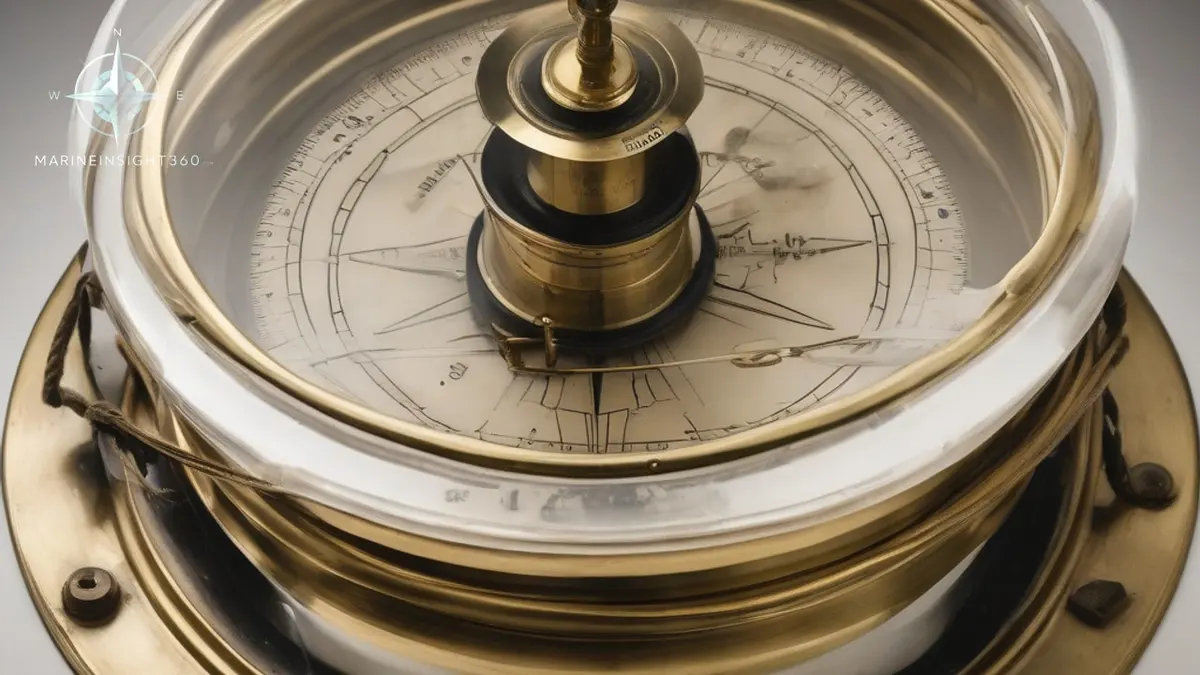
What is lubber line in magnetic compass terms? It is the fixed vertical mark on the inside of the compass bowl, aligned with the ship's fore and aft line. The graduation on the compass card sitting under that mark is the ship's compass heading. The card stays pointed at the magnetic meridian. The bowl, the binnacle and the lubber line all turn with the ship, so the reading changes as the vessel alters course.
SOLAS Chapter V still requires a properly adjusted magnetic compass on every ship, and MCA, USCG and AMSA surveyors check the deviation card against it.
The name comes from lubber, the old term for an unskilled sailor. The mark was there to tell someone with no feel for the sea which way the ship was actually pointing.
How a floating card becomes a heading
A magnetic compass card carries magnets and floats in a liquid that damps its motion. Left alone, it aligns itself with the local magnetic field and effectively stays still while the ship swings around it. The card has no idea where the bow is. The lubber line supplies that reference by being permanently fixed to the structure of the ship.
Get the reference wrong and the card is still perfectly accurate while the heading you read from it is not. That is the whole reason the alignment of the mark matters more than the quality of the card.
Reading the compass, then correcting it
The figure under the lubber line is compass heading. Two corrections turn it into a true heading you can plot.
- Deviation. The ship's own steel and electrical equipment deflect the card. Deviation changes with heading, so it is read from the deviation table or curve for the heading you are steering. Compass heading plus deviation gives magnetic heading.
- Variation. The angle between magnetic north and true north at your position, taken from the chart compass rose or the ENC, adjusted for the annual change. Magnetic heading plus variation gives true heading.
Both corrections are applied as east positive and west negative going from compass to true, and reversed going the other way. Compass error, the combined figure, is checked regularly by azimuth or transit and logged.
Why lubber line misalignment is worse than it looks
If the lubber line is not exactly parallel to the fore and aft line, every heading is wrong by the same constant amount. That is the dangerous part. A constant error looks identical to constant deviation, and a compass swing will quietly absorb it into the deviation card as coefficient A, the constant term. The table then appears correct while the underlying fault is mechanical.
The same problem appears if the whole compass or binnacle has been refitted out of line after deck work, or if a bearing repeater has been remounted. A mechanical misalignment corrected with magnets is a fault hidden, not fixed.
How the alignment gets checked
Compass adjusters check it as part of a swing. On board, the usual practical checks are simple. Sight from the compass through the lubber line to a fixed centreline object such as the jackstaff or a mast, and confirm they line up. Compare the standard compass against the steering compass and the gyro on several headings, looking for an error that stays the same size on every heading rather than changing with the ship's head.
Any refit that disturbed the binnacle, the deck under it, or nearby steelwork calls for a fresh swing and a new deviation table.
Lubber lines on other equipment
The idea reappears across the bridge. A gyro repeater has its own lubber line and must be aligned to the ship's centreline before relative bearings taken from it mean anything. A radar display shows the same reference as the heading marker, the line drawn from own ship's position along the ship's head.
A hand bearing compass has a lubber line too, but it is aligned by the person holding it, which is why hand bearing compass errors are dominated by technique rather than installation.
Some compasses carry secondary lubber lines at 45 and 90 degrees, so a helmsman standing off the centreline, or an officer conning from a wing position, can still read a heading without parallax.
What the rules require
SOLAS Chapter V requires ships to carry a properly adjusted standard magnetic compass, a means of taking bearings over an arc of the horizon, and the means to determine and display heading and bearings as true values at all times. A current deviation table or curve has to be available, and the compass must be swung when the ship's magnetic character changes.
Practical triggers for a swing include major structural work, welding near the compass position, a change of trade to very different magnetic latitudes, a long lay-up on one heading, and carriage of steel cargo. Deviation over about five degrees on any heading normally means the compass needs adjusting rather than a new table.
Habits that keep the reading honest
- Keep magnetic material away from the binnacle: mobile phones, portable radios, speakers, toolboxes and steel mugs all move a card.
- Log compass error at least once a watch and after every substantial course change, and act on a trend rather than a single reading.
- Check the deviation table date. An out of date card is a common port state control finding.
- Confirm the binnacle securing arrangements after any deck work near the compass position.
For more on compass work, bearings and bridge equipment checks, see the Navigation and Knowledge Base sections of Marine Insight 360.
Sources and further reading
- Lubber line
- Handbook of Magnetic Compass Adjustment - National Geospatial-Intelligence Agency
- Marine Magnetic Compass: Working Principle, Use, Errors and Care
What to read next
Recommended Reading

What Is a Lubber Line? The Compass Mark That Keeps a Ship on Course
A lubber line is the fixed mark on a compass aligned with the ship's centerline. It shows heading, sets relative bearings, and misalignment causes error.
What Is a Nautical Course? True, Magnetic and Compass Explained
A nautical course is the intended direction of travel in three-figure degrees. How true, magnetic and compass courses convert, and where errors creep in.
Magnetic Compass Maintenance: Daily Checks, Adjustment Intervals and the Deviation Card
Practical magnetic compass maintenance for watchkeepers: daily error checks, bubble and gimbal care, adjustment triggers, deviation cards and PSC records.