
What is the Margin plates on a ship?
What is the Margin plates on a ship?: ports, trade and shipping-market context for US, UK, Canada, Australia, Singapore and European maritime readers.
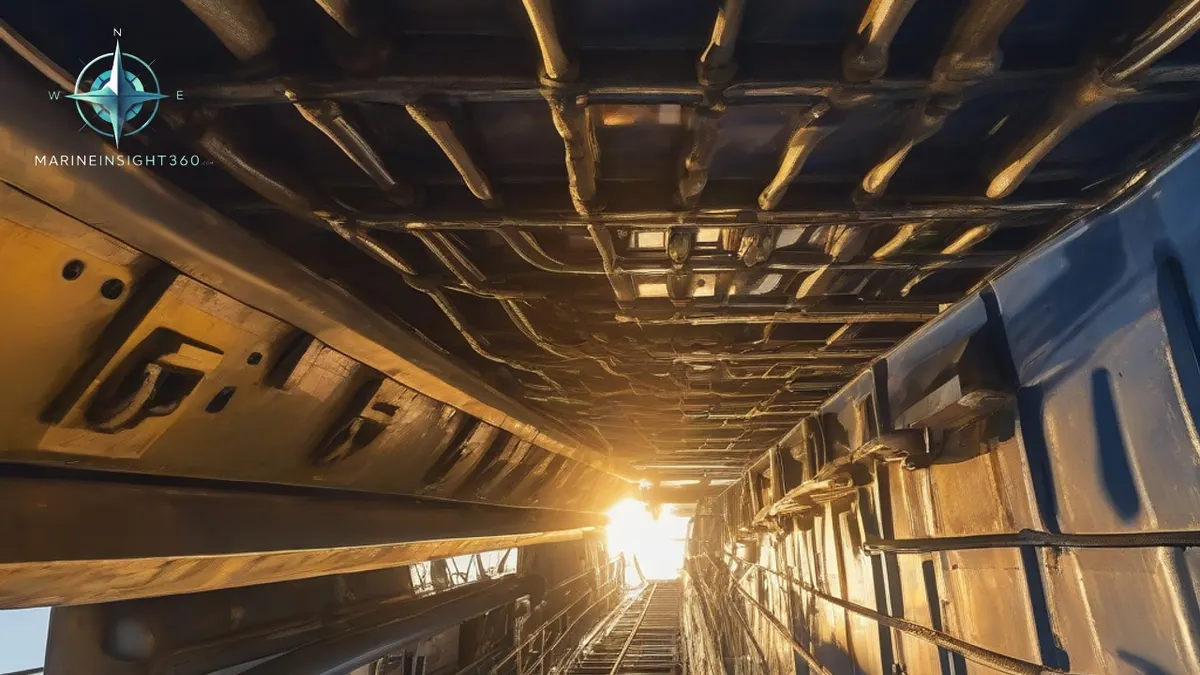
What is the Margin plates on a ship?
We are all familiar with the concept of a double bottom structure. This structure provides better protection from damage and is also used to store fuel, ballast water, fresh water, and other consumables. Currently, most cargo ships, such as oil tankers and bulk carriers, are required by regulations to have a double bottom structure.
According to these regulations, only cargo ships with a gross tonnage of less than 500 tons may adopt a simple monohull structure. Larger cargo ships, especially oil tankers, must have a full double bottom structure. In addition to the bottom area, the side areas must also be protected by a double layer, with the side plating lining the inside of the outer deck.
Margin Plates on a Ship
The simplest form of a double bottom structure has a top plating located at a certain height above the bottom, supported by internal beams called floorboards.
There are various types of floorboards. The top plating is called the inner bottom plating. Furthermore, according to classification guidelines, the inner bottom plating is reinforced with longitudinal stiffeners and bottom plating. The height of the inner hull also complies with guidelines and standards, depending on the type, size, and design of the ship.
The thickness of the inner hull complies with the guidelines. However, for obvious reasons, it is typically less than the thickness of the outer hull. However, its height is still sufficient, as the inner hull not only contributes to the overall longitudinal strength of the ship but also withstands higher loads, such as cargo, tank, and machinery loads, as well as internal pressure loads generated when the inner hull space is used for ballast, fresh water, and fuel storage.
From a structural perspective, the inner hull consists of longitudinally welded plates—two continuous plates joined side by side. The gunwale plate refers to the plate, or more precisely, the two plates located at each transverse end of the inner hull (both starboard and port), where the inner hull plate meets the side hull plate or inner hull plate.
This inner plate may seem unimportant, but it is a key component in forming a suitable frame or transverse connection, typically located at the pitch bend, connecting the inner bottom to the side frame members.
- How to Become a Shipbroker – Everything You Need to Know
- Proper Use of ECDIS Safety Settings
- Do You Know About Hygroscopic, Hydrophilic, and Hydrophobic?
- Where is Yellow Sea? Location & Significance
- How To Build A Green Supply Chain?
- The Structure And Purpose Of Mast Of Ship
- ECDIS – Electronic Chart Display And Information System
Therefore, it not only supports loads reaching the inner bottom frame members but also acts as a load path connection, helping to transfer loads from the bottom area to the deep transverse frames and vice versa.
They are also crucial for the structural continuity of the inner side frame at the junction with the inner bottom frame members.
Since the margin plates are located at the transverse ends of the inner bottom, they are also called the outer plates of the inner bottom frame. It can be inferred that they absorb more net loads, including concentrated bending stresses, than other inner bottom plating elements.
In reality, the margin plates are no different from other inner bottom shell plating.
The composition and construction of the margin plates vary. They may simply be flat plates attached to the inner bottom or head, or they may be angled downwards for connection to the outer shell.
In the latter case, the upper edges or ends are typically flanged for connection to the inner shell/head, while the lower ends are connected to the outer shell using suitable angle connectors or brackets.
In double-walled structures, the margin plates are either angled upwards and welded to the inner shell or they remain flat but are connected to it via braces.
Where does the margin plate sit in the drainage arrangement?
The margin plate is the outboard strake of the inner bottom. It closes the double bottom at the ship's side, and its shape decides what happens to water in the hold above it.
Two arrangements are common. A flat margin plate runs outboard horizontally and meets the shell at the turn of the bilge. A sloped one angles down to the shell instead, and the triangular space it leaves at each side of the hold is where drainage collects.
Bilge wells are fitted at the after end of the hold in that space, and the hold bilge suction takes from them. That is why the connection is treated as part of the drainage system and not only as structure.
Ships with hopper tanks work differently. On most bulk carriers the hopper slope carries the tank top out to the side shell, so the arrangement described here does not appear in the same form.
Why this connection is a survey hotspot
The area sits wet and works hard. Cargo residue, hold washing water and condensation collect at the bilge, so coating breakdown and pitting show there before they show anywhere else on the tank top.
It is also a change in stiffness. Loads pass from the bottom structure into the side framing through this corner, and cracking is reported at bracket toes and at the ends of tank side brackets rather than in the middle of a plate.
Surveys reflect that. Bulk carriers and oil tankers are examined under the enhanced survey programme, which calls for close-up survey and thickness measurement at these connections rather than a walk through the hold. Class societies in IACS set the diminution limits that decide whether a plate is renewed or accepted.
Coatings are covered separately. The IMO's performance standard for protective coatings applies to dedicated seawater ballast tanks on ships of 500 gross tonnage and above, and is built around a target useful coating life of 15 years. The tanks either side of this connection fall inside it.
The rules behind the structure sit in two places. SOLAS Chapter II-1 sets the double bottom requirement for cargo ships, and MARPOL Annex I sets the double hull requirement for oil tankers.
Recommended Reading

Iran retaliates with missiles and drones, defying Trump’s warning
Learn iran with practical maritime context, safety checks, operational guidance and related resources for global shipping readers.

Hapag-Lloyd Invests in APM Terminals Rotterdam to Drive Growth
Hapag‑Lloyd’s new stake in APM Terminals Rotterdam aims to expand capacity, improve hinterland links and enhance crew efficiency in Europe’s busiest port.

Saildrone Completes Missile Launch Test Aboard its Sail-Powered Surveyor
Saildrone’s autonomous vessel successfully launched a missile‑type payload, showing new possibilities for armed surveyors and implications for shipping operator