
When Did Christopher Columbus Discover America?
Columbus Day sparked widespread controversy, and the celebration of Columbus's assassination was eventually replaced by Indigenous Peoples Day, which is…
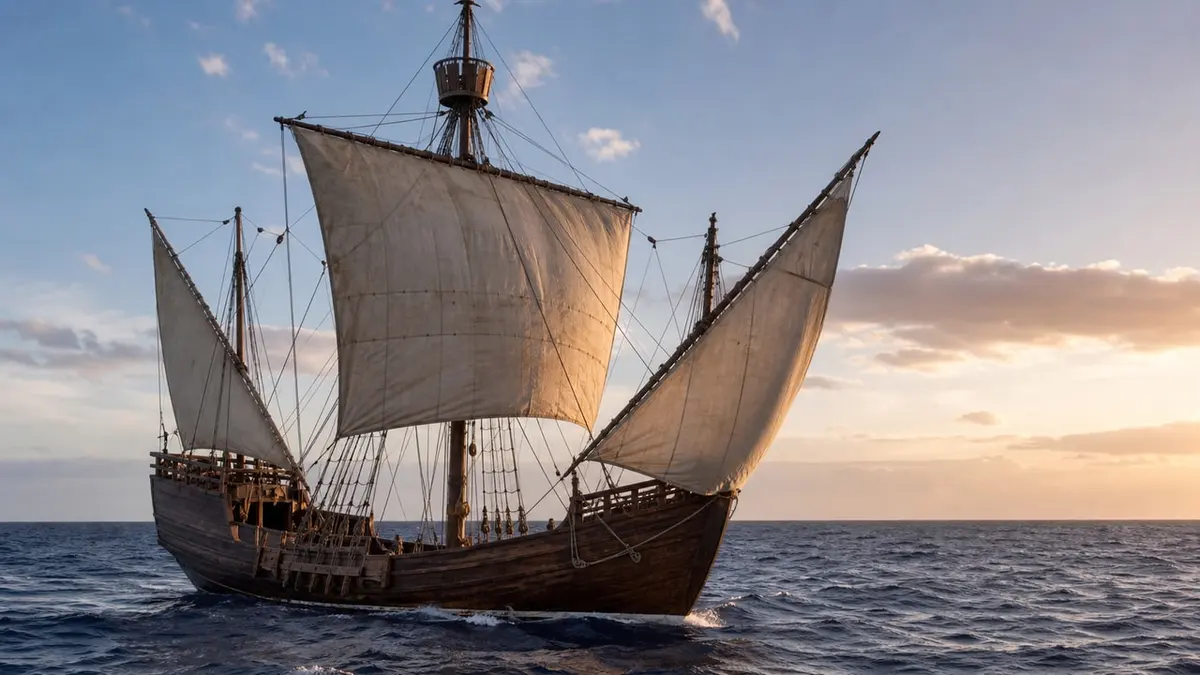
Christopher Columbus reached the Americas on 12 October 1492, when his crew sighted Guanahani in the Bahamas, and because those islands were already inhabited, the word discover is contested.
Columbus Discover America: The 1492 Voyage That Changed Shipping
On 3 August 1492, Christopher Columbus left Palos, Spain, with three modest vessels and a crew of 90, aiming to reach Asia by sailing west. The journey that followed would not only alter global trade routes but also set a precedent for how maritime ventures are planned, financed, and risk‑managed—a lesson still relevant to seafarers today.
The 1492 Expedition: Funding, Planning, and the Santa Fe Privilege
Columbus’s ambition was born from the fierce rivalry between Portugal and Spain for maritime dominance. The fall of Constantinople in 1453 had disrupted traditional trade, prompting European powers to seek new sea routes. Columbus, an Italian explorer, persuaded King Ferdinand and Queen Isabella to fund his crossing of the Atlantic. In return, the monarchs granted him the “Santa Fe Privilege,” awarding titles, privileges, and a share of the profits.
He drew on the works of Ptolemy, Strabo, and Marco Polo, as well as his own Mediterranean trading experience, to estimate that a westward voyage could reach Asia in under a year.
Decision criteria for the expedition were clear: secure a small fleet, recruit a manageable crew, and rely on proven navigational theories. The trade‑off was risk—limited ship size meant less cargo capacity but higher maneuverability and lower upfront costs. A common mistake of the era was underestimating the Atlantic’s scale; Columbus’s crew had no accurate charts, and the voyage would test their endurance and decision‑making under uncertainty.
Facing the Atlantic: Crew Challenges and Navigational Decisions
The crossing proved perilous. Mutinies erupted as the crew grew weary, storms battered the ships, and navigational errors threatened their survival. On 12 October 1492, the crew sighted land they believed to be part of the East Indies. In reality, they had reached Guanahani Island in the Bahamas, which Columbus renamed San Salvador. The crew’s misidentification illustrates a critical trade‑off: speed versus accuracy.
Relying on limited celestial navigation, they prioritized swift progress over precise mapping, a decision that would have lasting consequences.
Operational impact for the crew was immediate: the crew had to adapt to unfamiliar waters, manage scarce supplies, and maintain morale during prolonged isolation. For modern operators, the lesson is clear—adequate training in emergency protocols and flexible navigation plans can mitigate the risks of uncharted waters.
First Contact: Interactions with the Lucayans and the Beginning of the Columbian Exchange
Columbus’s arrival on San Salvador marked the first documented European contact with the Lucayans, the indigenous people of the Bahamas. The initial interactions were ambivalent; the crew traded goods for local knowledge, but violence soon erupted, foreshadowing centuries of conflict. Over the next months, Columbus sailed through the Caribbean, gathering information on flora, fauna, and potential resources.
He returned to Spain in 1493 with captured natives and a cache of wealth, including precious metals and exotic goods. The Santa Maria sank off the coast of Haiti on 25 December 1492, a reminder of the fragility of early maritime technology. The exchange of goods and ideas—what historians call the Columbian Exchange—set the stage for a global trade network that would shape the modern shipping industry.
New World crops like corn, tobacco, and potatoes found their way to Europe, while European livestock and technology were introduced to the Americas.
Subsequent Voyages: Expansion, Colonization, and Long‑Term Consequences
Columbus’s later expeditions (1493‑1494, 1498‑1500, 1502‑1504) expanded Spanish influence. The second voyage established the first Spanish colony, Isabela, on Hispaniola. The third explored the South American coast, and the fourth sought a trans‑Pacific route. These voyages intensified European colonization, leading to the displacement and exploitation of indigenous peoples. Columbus himself enslaved Native Americans, and the spread of diseases like smallpox and influenza decimated native populations—estimates suggest a 90 % loss by the 19th century.
For shipping professionals, the legacy is twofold. On one hand, the discovery opened new trade routes and markets; on the other, it introduced complex legal and ethical considerations that modern maritime law continues to grapple with, such as the treatment of indigenous peoples and the environmental impact of new trade flows.
Contemporary Reassessment: From Columbus Day to Indigenous Peoples Day
In recent decades, the celebration of Columbus has become controversial. Many U.S. cities and states now observe Indigenous Peoples Day on the second Monday of October, replacing Columbus Day. The movement seeks to re‑evaluate the historical narrative, preserve indigenous languages, and promote equality. For seafarers, this shift underscores the importance of cultural sensitivity and the need to acknowledge the historical context of maritime routes that were once exploited.
Understanding this history helps modern operators navigate the ethical dimensions of global trade, ensuring that shipping practices respect the rights and cultures of all communities along maritime corridors.
Why This History Matters to Shipping Today
Columbus’s voyages illustrate how bold exploration, coupled with strategic risk management, can reshape global trade. The lessons—accurate navigation, crew welfare, ethical engagement with local populations—remain vital for seafarers, cadets, and shipping professionals navigating the complex waters of international commerce.
For deeper insight into maritime history and its modern implications, explore Marine Insight 360’s Maritime History section.
The route the 1492 crossing proved
Columbus sailed south to the Canaries first, then west with the northeast trade winds, and came home on a northern arc through the Azores where the westerlies blow. That clockwise pattern was not his invention. Portuguese navigators had already worked it out in the eastern Atlantic as the volta do mar, and his crossing showed it held good all the way across.
Sailing ships used the same pattern for the next three centuries. A westbound ship went south for the trades even though the direct line looked shorter, and an eastbound ship went north for the westerlies. Wind, not distance, set the route, and the same logic still shapes ocean routeing for slow ships and for wind-assisted hulls.
Why the landfall was recorded as the East Indies
Latitude could be taken from the sun or the Pole Star, but there was no way to fix longitude at sea. Position was kept by dead reckoning: a compass course, an estimated speed and time run, with the error in each accumulating across an ocean. The method is explained in the guide to dead reckoning.
That is how a crew could sight Guanahani on 12 October 1492 and record the East Indies. The distance west was a guess built on a serious underestimate of the size of the earth. Longitude was not solved at sea until the 18th century, after Britain's Longitude Act of 1714 put a prize behind the problem and John Harrison's sea clocks earned it.
Further reading on the 1492 ships
The three vessels themselves, and what happened to the Santa Maria on Christmas Day 1492, are covered in the account of the ship Columbus sailed on.
Recommended Reading
What Ship Did Christopher Columbus Discover America On?
Christopher Columbus may have discovered America, but his santa maria ship deserves immediate recognition. However, despite decades of intensive research…
DOF vessel wins ‘very large contract’ in North America
DOF vessel wins ‘very large contract’ in North America: regulatory and compliance context for US, UK, Canada, Australia, Singapore and European...
Iran retaliates with missiles and drones, defying Trump’s warning
Learn iran with practical maritime context, safety checks, operational guidance and related resources for global shipping readers.