
Gulf Energy Infrastructure Under Attack: What a Struck Tanker Near Hormuz Means at Sea
Drone and missile attacks have hit Gulf gas fields, the Fujairah oil zone and tankers near Hormuz. What changes for tanker crews, insurers and charterers.
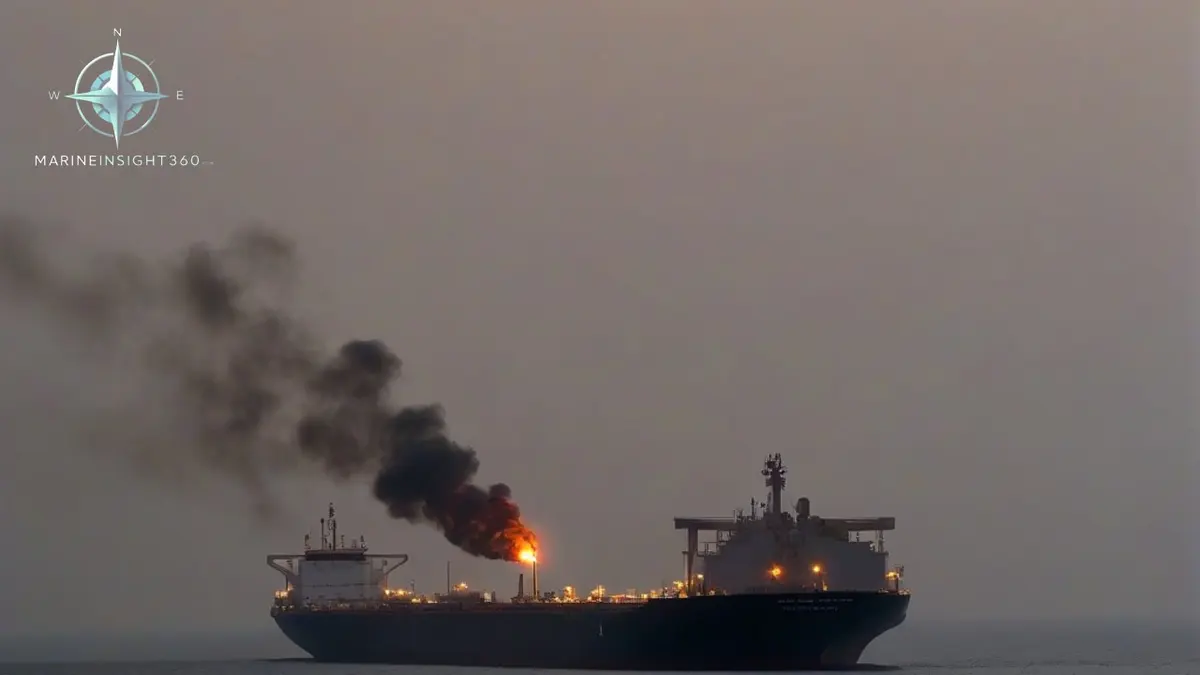
Attacks on UAE energy infrastructure have moved Iran's war in the Gulf from the waterway onto the shore installations it serves. Drone attacks set fire to the Shah gas field and to the Fujairah Oil Industry Zone. Operations at Shah stayed suspended afterwards.
On 8 August 2026 the UAE said Iran hit a tanker owned by the Abu Dhabi National Oil Company with a missile. The strike happened as she crossed the Strait of Hormuz, without casualties. The UAE called it the sixteenth attack on an ADNOC vessel since the war began on 28 February. For European and Japanese refiners lifting Gulf crude, the change is that loading terminals are now targets.
For shipowners the practical question is narrow. What does a campaign against loading terminals, storage and bunkering hubs do to a voyage that has to load, bunker or transit in the Gulf?
Why Fujairah is the point of the campaign
Fujairah sits on the Gulf of Oman coast, outside the Strait of Hormuz. That geography is the whole reason it exists in its current form. Crude piped from Abu Dhabi to the Fujairah terminal can be loaded without a Hormuz transit. The anchorage is also one of the largest bunkering and storage hubs in the world.
An attack on the Fujairah Oil Industry Zone therefore does something that mining the strait does not: it closes the bypass. A gas field fire suspends production; a strike on the outside-the-strait loading and bunkering complex removes the alternative that operators were relying on to keep trading. That is why incidents at Fujairah move freight and bunker markets harder than their physical damage suggests.
What has changed for the tanker trade
Hormuz has been shut to routine commercial traffic for most of 2026, after Iran mined and militarised the waterway. It reopened briefly in June and closed again in July following further attacks on merchant vessels. Before the war, roughly a fifth of the world's oil and gas moved through it.
The binding constraints on any transit are now insurance and crew rather than availability of tonnage:
- The International Group of P and I Clubs issued 72 hour cancellation notices for the area on 2 March 2026. Cover had largely evaporated within days.
- War risk premiums for a single transit have priced at many times pre-crisis levels. Some brokers report cover still obtainable, but few owners or charterers choose to use it.
- More than 150 tankers anchored outside the strait rather than transit at the height of the closure.
- Underwriters have publicly attributed reduced traffic to safety concerns rather than an absence of cover, which matters for how charterparty war risk clauses are argued.
What crews can and cannot do about it
Ship protection measures designed for piracy do very little against a missile or an armed uncrewed craft. Razor wire, water spray and a citadel address boarding. None of them addresses a weapon arriving at 400 knots.
The measures that do help are unglamorous:
- Watchkeeping tuned to the threat. Small radar returns closing at speed, and visual scanning of the quarters and stern, where an uncrewed surface craft is hardest to see.
- Reduced exposure time. Passage planning that minimises hours in the highest risk band, and transiting during periods advised by naval forces rather than by schedule convenience.
- Fire and damage control readiness at transit stations. Fire pumps running, hoses rigged, foam system lined up, boundary cooling plan briefed, and the engine room manned rather than on unattended machinery space mode.
- Accommodation protection. Personnel moved out of the exposed sides of the accommodation block and away from the bridge wings during the highest risk period. The bridge team drops to the minimum needed to navigate.
- Communications redundancy. A pre-briefed distress and reporting order, with satellite and VHF alternatives, because a strike on the mast area removes primary communications first.
Crew consent is a legal issue, not a morale issue
Where a warlike operations area is declared under the applicable collective agreement, seafarers normally have the right to refuse to sail into it. They can also be repatriated at company cost, on bonus and doubled compensation terms. Owners who plan a transit without settling those entitlements in advance risk a crew refusal at the pilot station. That is a far more expensive outcome than the bonus would have been.
Why this matters to operators with no Gulf exposure
A closed or high risk Hormuz absorbs tanker tonnage in waiting time and pushes cargoes onto longer routings. It also raises bunker prices through disruption at one of the largest bunkering hubs. Owners trading Atlantic or Pacific basin routes pay for that in fuel cost and in a tighter charter market without ever approaching the Gulf.
Operators should confirm war risk cover, additional premium and crew entitlements before fixing any Gulf voyage. Existing charters need their war risk and deviation clauses read against current conditions. Our Maritime Safety section follows the security picture in the Gulf and the Gulf of Oman as advisories change.
The authoritative channel for this area is UKMTO. It takes vessel reports and issues advisories and incident notices for the Gulf, the Strait of Hormuz and the Gulf of Oman. Masters entering the region file a vessel movement report and monitor the advisory traffic. Any suspicious approach, drone sighting or attack goes to UKMTO first, and to the company security officer alongside it.
Behind that sit the bodies that decide whether the ship sails at all. The IMO circulates member state warnings and maritime security guidance. Flag administrations issue their own instructions to their fleets, and the Joint War Committee listing drives the additional premium. Class societies such as DNV and Lloyd's Register survey the damage afterwards and decide what repairs a struck vessel needs before she trades again.
Sources and further reading
- Iran targets UAE energy infrastructure as gas field set ablaze, tanker struck near Strait of Hormuz, CNBC
- UAE says Iran targeted ADNOC tanker in Strait of Hormuz, no casualties, Al Jazeera
- Strait of Hormuz report, Howden Re
- Safety concerns, not insurance availability, driving reduced vessel traffic in the Strait of Hormuz, Lloyd's Market Association
What to read next
Recommended Reading
Typhoon Class Submarine: The Biggest Boats Ever Sent Under the Sea
The Soviet Typhoon class submarine remains the largest ever built: twin pressure hulls, 20 missile silos, and why nothing since has matched its size.
For Gulf States, Strait of Hormuz Uncertainty Casts a Long Shadow Over Every Transit Decision
Transit counts, war risk premiums and GPS jamming in the Strait of Hormuz, and how owners and masters weigh a passage against a diversion.
Trucking Around Hormuz: How Arabian Peninsula Land Corridors Move Gulf Cargo
How MSC, Maersk and Hapag-Lloyd route Gulf cargo overland across Saudi Arabia and Oman to avoid Hormuz, what the workaround costs, and what changes on board.