
Trucking Around Hormuz: How Arabian Peninsula Land Corridors Move Gulf Cargo
How MSC, Maersk and Hapag-Lloyd route Gulf cargo overland across Saudi Arabia and Oman to avoid Hormuz, what the workaround costs, and what changes on board.
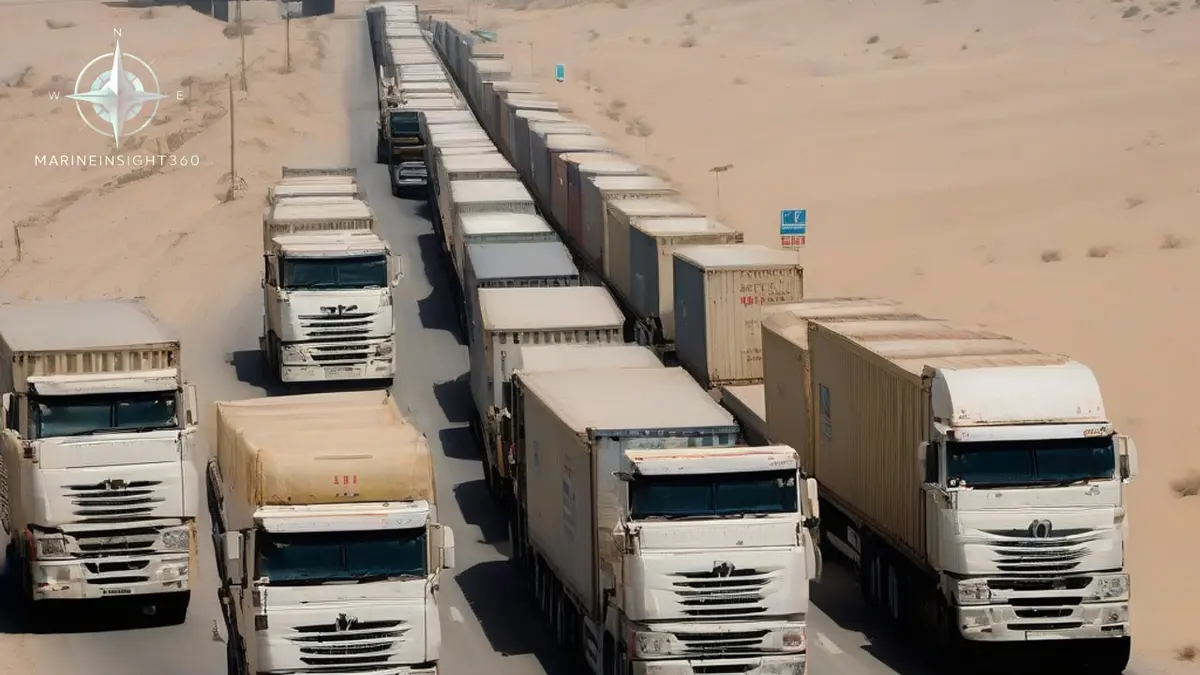
Why shipping lines are using Arabian Peninsula truck routes to bypass Hormuz
Bypassing Hormuz is an overland routing: container lines discharge Gulf-bound cargo at Red Sea or Gulf of Oman gateway ports and move it across the Arabian Peninsula by rail and truck, so the boxes never transit the strait. It costs more and takes longer, but it removes the single chokepoint that can strand a shipment for weeks.
MSC, Maersk, CMA CGM and Hapag-Lloyd have each developed versions of this routing, using overland corridors across Saudi Arabia and Oman in place of a direct Gulf call.
The Saudi trans peninsula land bridge
The most developed option runs west to east across Saudi Arabia. Ships from Europe and the Americas discharge at Jeddah Islamic Port or King Abdullah Port on the Red Sea coast. Cargo then moves inland by rail and road.
Saudi Arabia Railways carries containers daily from the western ports to the Riyadh dry port, and the network continues east to Dammam on the Gulf coast. From Riyadh or Dammam, trucks distribute into Kuwait, Bahrain, Qatar and the eastern UAE.
The advantage is clean: the sea leg ends on the Red Sea side, so no vessel, cargo or crew has to accept Hormuz risk at all.
The east coast UAE and Oman option
The second family of routes uses ports that already sit outside the strait on the Gulf of Oman. Khorfakkan and Fujairah on the UAE east coast and Sohar in Oman all lie beyond Hormuz. Boxes discharged there are trucked overland into Dubai, Abu Dhabi and onward to Kuwait and the eastern province of Saudi Arabia.
These routes carry a much shorter land leg than the Saudi corridor, which usually makes them cheaper per container. They also concentrate pressure onto a small number of gateway terminals that were never sized for the volume.
The crude oil bypass is a different system
Container cargo can go on a truck. Crude oil cannot, in any meaningful volume, so energy exporters use pipelines instead. The Habshan to Fujairah line moves UAE crude to a loading terminal outside the strait, and Saudi Arabia operates an east to west pipeline delivering crude to its Red Sea coast.
Pipeline capacity is fixed and sits well below normal Hormuz throughput, so the crude bypass reduces exposure rather than removing it. That gap is why tanker freight rates react sharply to strait disruption even when container cargo has already found a land route.
What the workaround costs
The bypass solves one problem and creates several others.
- Truck and driver supply. A corridor absorbs thousands of movements a week. Tractor units and licensed drivers are the binding constraint, not road capacity.
- Gateway congestion. Jeddah, King Abdullah, Fujairah and Sohar were not built for redirected Gulf volume. Yard density rises and berth productivity falls.
- Extra handling. Every additional lift adds damage risk, and reefer and dangerous goods cargo need equipment and permits the corridor may not have.
- Border formalities. Cross border trucking needs customs transit documentation, and a single paperwork error idles a load for days.
- A different cost base. Land transport pricing moves with diesel and driver availability rather than with vessel supply, so it does not fall the way ocean freight does.
What it means on board
For crews, the change shows up as a shift in routing patterns and port rotations rather than in the work itself.
- Red Sea and Gulf of Oman gateway ports see more calls, longer stays and heavier restow workloads.
- Ships that would once have called at several Gulf ports now discharge a full parcel at a single gateway.
- Vessels still transiting Hormuz meet a thinner traffic mix, more naval activity and continuing reporting obligations.
- Crew change planning shifts as manning agencies build capacity around the new gateway ports.
How long the corridors last
Land bridges are a hedge, not a replacement. A truck corridor moves a fraction of what one mainline container ship carries, and the economics only work while the alternative is a closed or high risk strait. When the risk premium falls, cargo returns to the direct routing quickly, because ocean freight remains far cheaper per tonne kilometer.
The durable change is optionality. Shippers and carriers that built and tested these corridors now hold a proven fallback, and contracts increasingly name an alternative routing instead of assuming Hormuz stays open. Operators tracking chokepoint risk can follow route disruptions through the Marine Insight 360 Ports section.
Ships still making the direct transit report to UKMTO, which runs the voluntary reporting scheme for the Gulf and the Gulf of Oman and passes advisories back to the bridge. The IMO circulates security guidance to flag states, and war risk underwriters set the listed area that decides the premium. Those three inputs, not the freight rate, are what make a land bridge look cheap.
The corridor has its own failure modes. Reefer boxes fail on a long road leg because genset fuel runs out or the unit trips unnoticed overnight. Dangerous goods loads are rejected at a border when the transit paperwork does not match the manifest. And a truck shortage does not queue politely: it strands boxes in a yard that is already congested, so the delay compounds instead of clearing.
Sources and further reading
- Shipping Companies Leverage Arabian Peninsula Truck Routes to Bypass Hormuz
- Arabian Truck Corridors Become Shipping's New Hormuz Workaround
- Habshan pipeline begins oil shipments
What to read next
Recommended Reading
Dredgers: The Ship Types That Dig Harbors, Channels and New Land
What dredgers do and how each type works: trailing suction hoppers, cutter suction dredgers, backhoes, grabs and the jobs that keep ports open to shipping.
For Gulf States, Strait of Hormuz Uncertainty Casts a Long Shadow Over Every Transit Decision
Transit counts, war risk premiums and GPS jamming in the Strait of Hormuz, and how owners and masters weigh a passage against a diversion.
Gulf Energy Infrastructure Under Attack: What a Struck Tanker Near Hormuz Means at Sea
Drone and missile attacks have hit Gulf gas fields, the Fujairah oil zone and tankers near Hormuz. What changes for tanker crews, insurers and charterers.