
How a Steamboat Works: Boiler, Engine and Paddle Wheel
How a steamboat works, from furnace and boiler through cylinder, valve gear and condenser to the paddle wheel, and why screw propellers replaced paddles at sea.
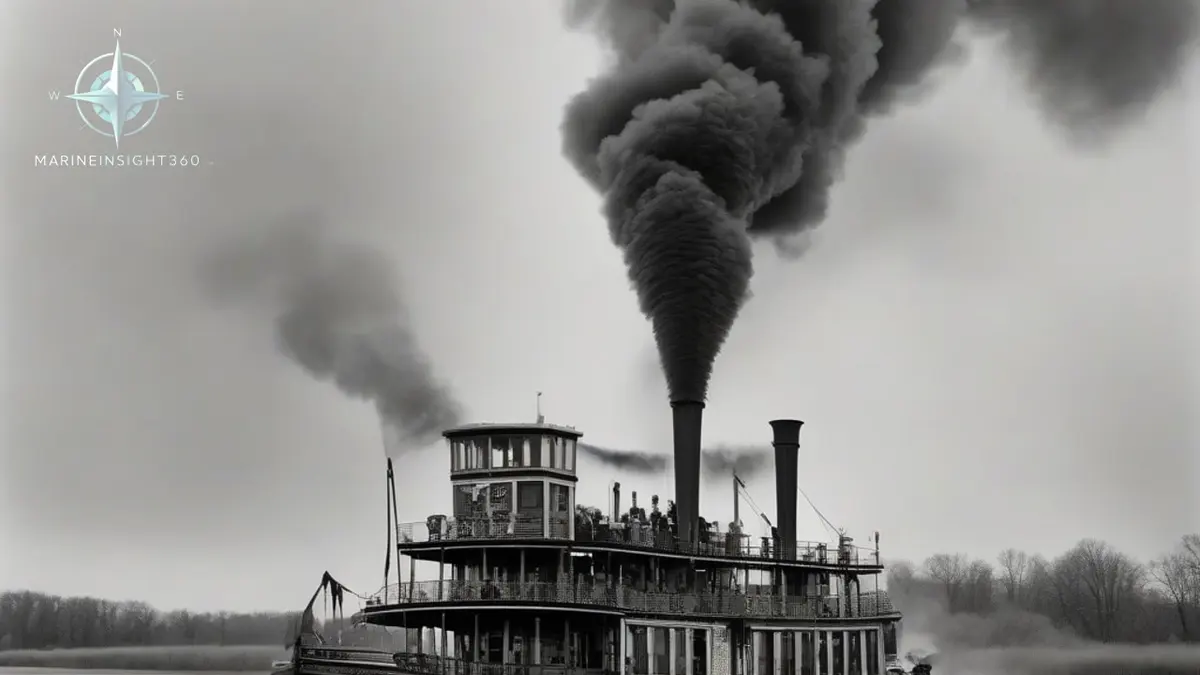
How a steamboat works is a four stage loop that turns heat into rotation. Fuel burns in a furnace and boils water in a boiler to make steam under pressure. That steam is admitted to a cylinder where it expands and drives a piston back and forth. A connecting rod and crank convert that reciprocating motion into rotation.
The rotating shaft turns a paddle wheel or a screw propeller, and the used steam is either exhausted to atmosphere or condensed back to water and pumped to the boiler again.
Every part of a modern steam plant, including the ones still running on steam turbine LNG carriers, is a refinement of that loop. Understanding the original makes the modern version obvious.
The boiler and the fuel
The boiler is where the energy enters and where the danger lives. Early river steamboats burned wood, then coal, and later oil, heating water in a pressure vessel until it produced steam.
Two boiler families matter. Fire tube boilers pass hot gases through tubes surrounded by water. They are simple and tolerant, but the large volume of water at pressure limits how high that pressure can safely go. Water tube boilers reverse the arrangement, running water inside tubes surrounded by furnace gases. They hold less water, raise steam faster and safely handle far higher pressures, which is why they took over as pressures climbed.
Feed water quality decided how much work the engineers had. Early boats fed raw river or sea water into the boiler, so salts and silt built scale on the heating surfaces, cut heat transfer and forced constant blowdown. Once surface condensers allowed the same fresh water to circulate repeatedly, higher pressures became practical and boiler maintenance fell sharply.
The engine: cylinder, valve gear and expansion
Steam enters one end of a cylinder, pushes the piston along its length, and is then released while steam is admitted to the other end. The component that makes this work is the valve gear. A slide valve driven by an eccentric on the crankshaft opens and closes the steam ports at the right moment, and link motion allows the engineer to change the point of cut-off, the fraction of the stroke over which steam is admitted.
Cut-off is the economy control. Admit steam for the whole stroke and the engine is powerful and wasteful. Cut off early and the trapped steam expands on its own, doing work as its pressure falls, which extracts far more energy from the same weight of steam. The same link motion also reverses the engine, which is how a paddle steamer goes astern without a gearbox.
Compounding took the idea further. Instead of expanding steam once, a compound engine passes it through a small high-pressure cylinder, then a larger intermediate cylinder, then a larger low-pressure cylinder, expanding it in stages. Triple expansion engines became the standard for ocean steamers late in the nineteenth century, and the fuel saving is what made long-distance steam shipping commercially viable against sail.
The condenser and why vacuum matters
Exhaust steam can be dumped to atmosphere, and river boats often did. Condensing it instead creates a partial vacuum at the exhaust end of the cylinder, which increases the pressure difference across the piston and therefore the work obtained from each unit of steam.
Jet condensers mixed exhaust steam directly with cooling water, which contaminated the feed. Surface condensers keep the two apart, passing exhaust steam over tubes carrying seawater so the condensate stays clean and returns to the boiler as pure feed water. Condenser vacuum is still a headline watchkeeping parameter on any steam plant, because losing it costs power immediately.
Paddle wheels, and why they lost
A paddle wheel carries flat boards, called floats, around its rim. As the wheel turns, the floats push against the water and drive the boat forward. Two layouts were used:
- Sidewheelers , with a wheel on each side, sometimes on independent engines. Running one ahead and one astern turns the vessel almost within her own length, which is superb maneuverability in a crowded river port.
- Sternwheelers , with a single wide wheel at the stern. The wheel is protected in narrow channels, the boat can be built with very shallow draft, and the layout suited shallow, snag-filled rivers.
Feathering floats, which stay closer to vertical as they enter and leave the water through a linkage, reduced shock loading and improved efficiency over fixed floats.
Paddles failed at sea for reasons that have nothing to do with the engine. Immersion changes as the vessel loads and burns fuel, so wheel efficiency varies through the voyage. In a seaway a rolling ship lifts one wheel clear of the water while burying the other, which is hard on the machinery and useless for propulsion. Wheels also occupy midships space and are exposed to damage.
A screw propeller stays fully immersed, is protected under the hull and works at a constant depth, so from the 1840s onward ocean steamers moved to screw propulsion while paddle craft held on in sheltered and shallow waters.
Safety, and the regulation that followed
Nineteenth century steamboats killed people mainly through boiler explosions. A boiler holding a large volume of water at pressure releases an enormous amount of energy if the shell fails, and low water level, corroded plate, tampered safety valves and racing between boats all contributed.
The response built the machinery inspection system still recognizable today. In the United States, the Steamboat Acts of 1838 and 1852 introduced boiler inspection, pressure limits and licensing of engineers, and the inspection service created to enforce them is a direct ancestor of modern marine inspection work. The idea that a pressure vessel must be surveyed, certified and operated by a certificated person began on the river steamers.
For the modern equivalents of this plant, the Marine Engineering section covers boiler operation, feed systems and condenser performance on ships that still raise steam today.
The inspection regime that grew out of those Acts still exists under different names. The US Steamboat Inspection Service was folded into later federal bodies and its work passed to the US Coast Guard, which is why a USCG marine inspector still examines boilers and pressure systems today. In Britain the equivalent survey function now sits with the Maritime and Coastguard Agency.
Classification developed alongside it. Lloyd's Register and the American Bureau of Shipping published rules covering boiler plate, shell thickness and safety valve capacity, and surveyed the work at the builder rather than after a casualty. That split still holds: class sets and verifies the technical standard, the flag state inspector enforces carriage and operation, and both look at the same steam plant on a preserved paddle steamer today.
Sources and further reading
What to read next
Recommended Reading
How Does a Steamboat Work? Boiler, Engine and Paddle Wheel Explained
A steamboat burns fuel to boil water, feeds the steam to a piston engine and turns a paddle wheel. Here is each stage, the safety history and modern echoes.
Cashew in the Bunkers: Why Ships in Singapore and Rotterdam Hit Engine Failures
Ships bunkering in Singapore and Rotterdam hit sludging, injector and turbocharger failures traced to cashew nutshell liquid blended into marine fuel.
What Is a Boiler on a Ship? Types, Steam Uses and Safety
A ship boiler makes the steam that heats fuel and cargo and drives deck machinery. Fired boilers, exhaust gas economizers, water treatment and safety checks.