
How Does a Steamboat Work? Boiler, Engine and Paddle Wheel Explained
A steamboat burns fuel to boil water, feeds the steam to a piston engine and turns a paddle wheel. Here is each stage, the safety history and modern echoes.
Heat, Steam, Piston, Wheel: the Chain in Order
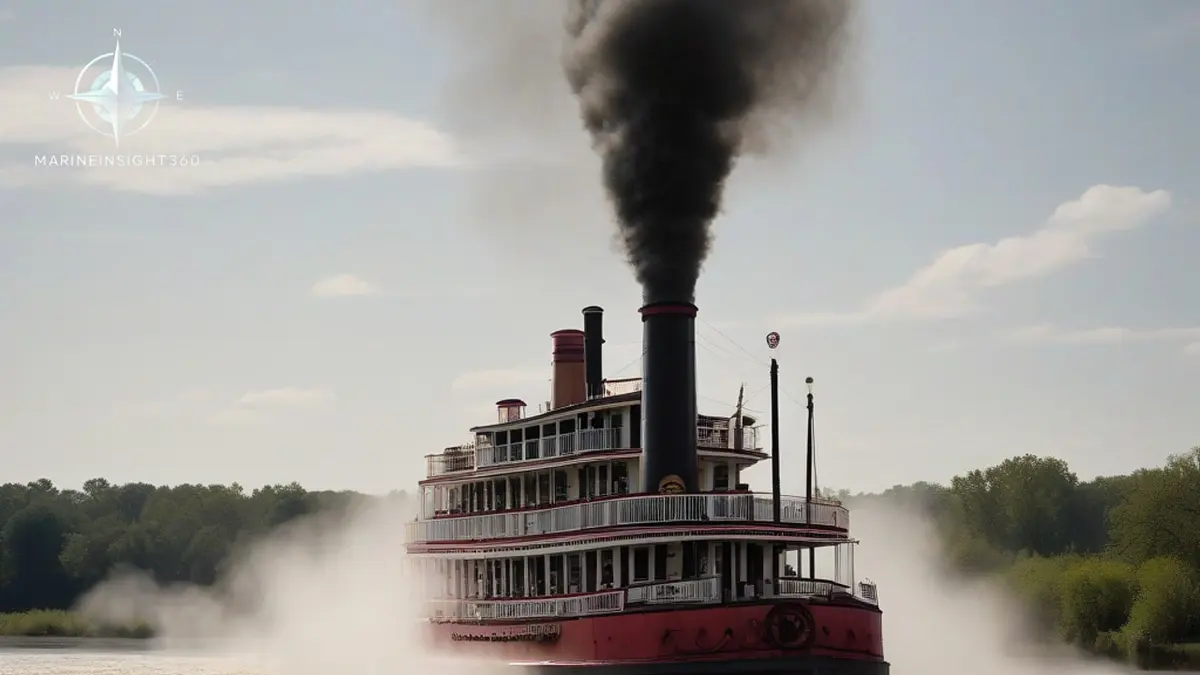
How does a steamboat work? It burns fuel to boil water in a boiler, and that high pressure steam is admitted into a cylinder where it pushes a piston back and forth. A crank and connecting rod turn that motion into rotation, which drives a paddle wheel or a propeller.
Every steamboat ever built is a variation on those four stages. Each stage also has a failure mode. Boiler explosions on American river steamers forced the first federal inspection laws. Those rules are the ancestor of today's US Coast Guard machinery inspections.
Follow the energy through the ship. Wood, coal or fuel oil burns in a firebox. Hot gas passes through the boiler and turns feed water into steam. A valve gear admits steam to one end of the cylinder and exhausts the other end, so the piston is driven in both directions. The piston rod drives a connecting rod, called the pitman on American river boats, which turns a crank on the paddle wheel shaft.
Exhaust steam either vents to atmosphere or passes to a condenser, where it becomes water again and is pumped back to the boiler by the feed pump.
The Boiler Is Both the Heart and the Hazard
River steamboats used fire tube boilers: hot gases from the firebox travel through tubes that run inside a drum full of water, transferring heat through the tube walls. Fire tube boilers hold a large volume of water at moderate pressure, tolerate poor quality feed water and can be fired with almost anything, which is why they suited a vessel burning cordwood bought from a bank side woodyard.
Water level is the parameter that kills. If the level drops far enough to expose the crown sheet above the firebox, the plate loses its cooling water, overheats, weakens and can tear open. The stored energy in a drum of saturated water flashes to steam instantly.
That is why gauge glasses, try cocks and safety valves are the oldest instruments in a marine engine room, and why an engineer's first action on watch has always been to prove the water level rather than read it.
Muddy river water brought a second problem. Silt and dissolved solids concentrate as steam is drawn off, so boilers needed frequent blow down and periodic cleaning, and scale on the tube surfaces cut heat transfer and raised fuel consumption.
Simple, Compound and Triple Expansion Engines
The earliest marine engines were simple: steam entered a single cylinder, expanded once and exhausted. It worked, but most of the energy left with the exhaust.
The compound engine expanded the same steam twice, first in a small high pressure cylinder and then in a larger low pressure cylinder. Triple expansion added a third stage. Each additional stage extracted more work from the same mass of steam, and the effect on fuel consumption was dramatic enough to change what ships could do.
A vessel that could cross an ocean without filling most of her hull with coal only became possible once multiple expansion engines and higher boiler pressures arrived together.
Titanic is a useful illustration of where the technology finished. She carried two four cylinder triple expansion reciprocating engines driving the wing propellers, with a low pressure turbine on the centre shaft running on the exhaust steam from those engines.
Paddle Wheels Versus Screws, and Why Rivers Chose Paddles
A sidewheeler carries a paddle wheel on each side, often with an independent engine for each. Running one wheel ahead and the other astern turns the boat almost within her own length, which is what a pilot needs in a narrow river bend. A sternwheeler carries a single wide wheel at the stern, protected from bank contact, ice and floating debris, and it draws less water.
Paddle wheels are efficient at low speed and shallow immersion, and they work in water far too shallow for a propeller. Their weaknesses are equally clear. Efficiency drops as the hull rolls or as changing cargo alters the immersion depth, the buckets are exposed to damage, and the whole assembly becomes inefficient once speeds rise. Propellers stay fully immersed, sit protected under the hull and win comprehensively at sea. Rivers kept paddles long after the ocean trades abandoned them.
Shallow Draft Decided the Whole Design
On the Mississippi and Missouri the controlling factor was not power but water depth over shifting bars. The response was a flat bottomed hull with minimal draft, with boilers and machinery mounted on the main deck rather than buried in a hold, and weight spread along the length so the hull behaved like a shallow raft.
That layout is why steamboats opened the American interior to trade before the railroads arrived. It is also why they were fragile: a light hull with heavy machinery on deck, no watertight subdivision worth the name and a snag waiting on every bend.
Boiler Explosions Produced the First Marine Safety Rules
Boiler explosions on American river steamers killed passengers in numbers that no other transport mode matched at the time. The legislative response, the US Steamboat Act of 1838 and the far stronger Act of 1852, created the Steamboat Inspection Service, required hydrostatic testing of boilers, mandated safety valves and introduced licensing of engineers and pilots. Its functions passed through the Bureau of Marine Inspection and Navigation to the United States Coast Guard, which still inspects passenger steam vessels today.
That sequence should look familiar: a casualty, a public inquiry, then prescriptive equipment standards plus competency certification. The same pattern produced SOLAS after Titanic and produces amendments to it today. Marine safety regulation has always been written after the fact.
What Survives in Modern Machinery
Steam did not vanish from ships. Steam turbine propulsion remained standard on LNG carriers for decades because cargo boil off gas could be burned directly in the boilers, and steam turbine LNG vessels still trade. Auxiliary boilers on tankers raise steam for cargo heating and for steam driven cargo pumps, and exhaust gas economisers recover heat from diesel main engine exhaust to make steam for free.
An engineer joining a modern tanker still works with feed water treatment, condensate return, gauge glass routines and safety valve testing, and still respects the crown sheet logic that governed a river boat in 1850. Preserved paddle steamers in the United States, the United Kingdom and Switzerland are surveyed under boiler rules descended directly from that first inspection service. If you want the mechanism rather than the history, start with the auxiliary boiler section of the Marine Machinery pages.
Sources and further reading
- Steamboat - Britannica
- A History of Steamboats - US Army Corps of Engineers
- How Steamboats Worked: Boilers, Paddlewheels, and Shallow Drafts
What to read next
Recommended Reading
How a Steamboat Works: Boiler, Engine and Paddle Wheel
How a steamboat works, from furnace and boiler through cylinder, valve gear and condenser to the paddle wheel, and why screw propellers replaced paddles at sea.
Marine Machinery Explained: Main Engine, Auxiliaries and Deck Plant
Marine machinery explained: the main engine, generators, boilers, purifiers, pumps, steering gear and deck plant, and the SOLAS rules that govern them.
How an Engine Room Explosion Sank the Russian Cargo Ship Ursa Major
The Russian ship Ursa Major sank after an engine room explosion. What causes engine explosions at sea, how they sink ships, and the defenses that work.