
What Is a Boiler on a Ship? Types, Steam Uses and Safety
A ship boiler makes the steam that heats fuel and cargo and drives deck machinery. Fired boilers, exhaust gas economizers, water treatment and safety checks.
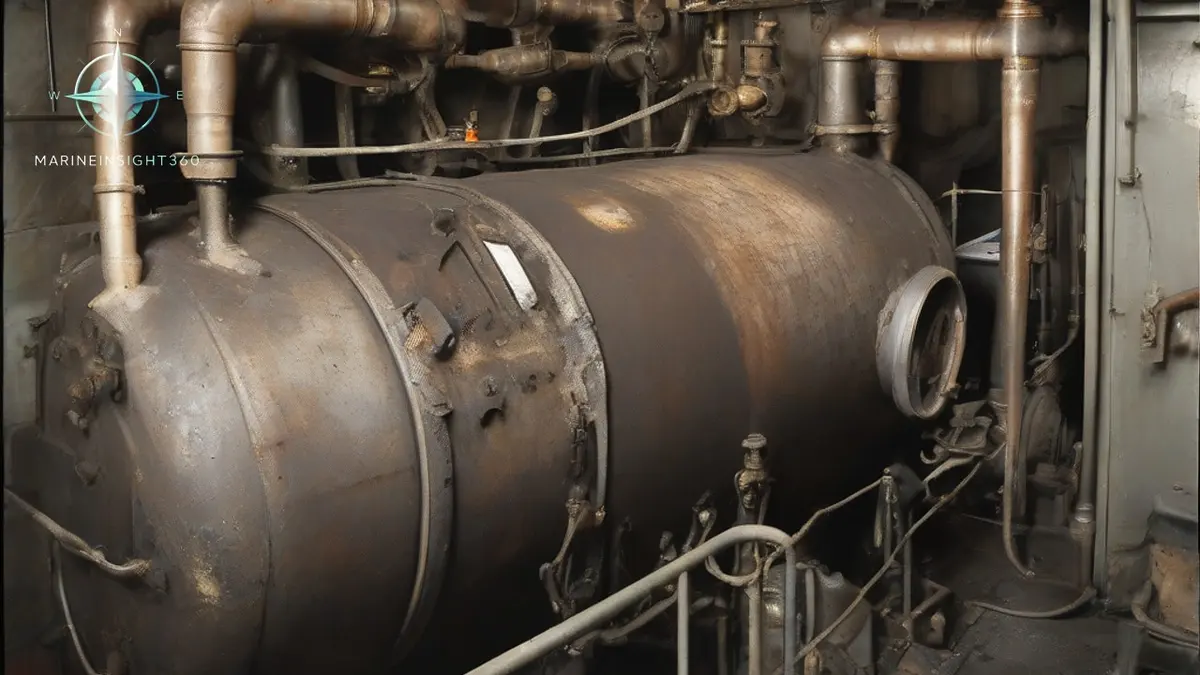
A boiler on a ship is a pressure vessel that turns feed water into steam. The heat comes either from burned fuel or from waste heat in the main engine exhaust. Steam is the ship's general purpose heating and power medium. It warms heavy fuel oil so it will pump and atomize. It heats cargo and accommodation and drives the fresh water generator. On tankers it runs the cargo pumps and the inert gas plant.
Class societies such as Lloyd's Register, DNV and ClassNK survey the boiler and its mountings. USCG and MCA port state inspectors check the safety valves and gauge glasses.
Almost every merchant ship carries at least one boiler even though very few are steam propelled today. Motor ships need steam for the fuel system alone. Heavy fuel oil is close to solid at ambient temperature. Bunker tanks, settling tanks, service tanks, purifiers and the engine fuel line all depend on steam heating coils and heaters to keep the oil moving at the right viscosity.
Fired boilers and exhaust gas boilers do different jobs
Ships normally carry two steam sources working as a pair.
The oil fired auxiliary boiler burns diesel or heavy fuel oil in its own furnace. It is the ship steam supply in port, at anchor, during maneuvering and whenever the main engine is stopped or running at low load. It is also the boiler that has to raise steam from cold, which is a slow and carefully controlled operation.
The exhaust gas boiler , often called the exhaust gas economizer or EGE, sits in the main engine uptake and recovers heat from exhaust gas that would otherwise go up the funnel. At normal sea speed the exhaust gas boiler frequently covers the entire steam demand on its own, and the fired boiler is shut down or left on standby.
That is real fuel saving, not a marginal gain, and it is why the unit is treated as part of the ship efficiency package.
Some ships fit a composite boiler , which puts an oil fired furnace and an exhaust gas section into a single shell so one unit serves both duties.
Smoke tube versus water tube construction
The difference is simply which side of the tube the water is on.
- Smoke tube, also called fire tube. Hot gas passes through tubes surrounded by water in a large shell. Simple, tolerant of variable water quality, and it holds a big reserve of water, so steam pressure is steady under swinging load. It is heavy, slow to raise steam, and limited in working pressure. Most auxiliary and exhaust gas boilers on motor ships are of this type.
- Water tube. Water circulates inside tubes with hot gas outside. Much higher pressures and steam output for the weight, and it raises steam quickly, but the small water content makes it unforgiving of level control faults and it demands strict feed water chemistry. This is the type used on steam turbine ships and on steam driven LNG carriers, and for high pressure auxiliary duties.
The mountings that keep a boiler safe
Boiler mountings are not optional fittings, and a watchkeeper should be able to name and test every one of them.
- Two spring loaded safety valves, set to lift below the design pressure, with an easing gear that can be operated from outside the boiler space.
- Two independent water level gauge glasses, which must be blown through each watch to prove they read true.
- Main steam stop valve and auxiliary steam stop valve.
- Feed check valves, normally in duplicate, so feed can be regulated and isolated.
- Bottom blow down valve and a surface scum valve for removing sludge and floating contaminants.
- Pressure gauge, air vent or air cock, and low water level alarm with automatic burner shutdown.
Low water is the failure mode that destroys boilers and kills people. If the level disappears from the glass, the correct action is to shut off fuel and let the boiler cool, never to feed cold water into a boiler that may already be overheated.
Boiler water treatment is a daily discipline
Feed water chemistry decides whether a boiler lasts decades or fails in a few years. Three problems have to be held off at once. Scale forms from hardness salts and insulates the heating surface until the metal overheats. Corrosion is driven by dissolved oxygen and by acidic conditions. Carryover drags water into the steam line and damages downstream equipment.
Engineers therefore test the boiler water routinely for alkalinity, chlorides, hardness and dissolved oxygen, and dose chemicals to keep conditions alkaline within the maker specified band, usually a pH in the region of 9.5 to 11. Chlorides are the tell-tale for a leaking heating coil or a condenser leak letting sea water into the system. Regular blow down removes the concentrated sludge that testing cannot fix.
The failures that show up in practice
Two specific defects account for a large share of boiler trouble on motor ships.
Exhaust gas boiler soot fires. Prolonged low load running leaves unburnt fuel and soot on the gas side. That deposit can ignite, and a soot fire that gets air can escalate into an iron fire hot enough to destroy the tube nest. Prevention is regular soot blowing at sea, scheduled water washing, keeping the water circulation running whenever the main engine is turning, and monitoring exhaust gas outlet temperature for an unexplained rise.
Burner and combustion faults on the fired boiler. Poor atomization, a dirty burner tip, incorrect fuel temperature or a failing photocell shows up as smoke, repeated flame failure lockouts and soot in the tubes. Clean burners burn less fuel and produce less deposit, so the maintenance pays for itself.
Survey and testing
Ship boilers are surveyed items under classification society rules. They are examined internally and externally on a defined cycle, generally at intervals not exceeding two and a half years. Safety valve settings are verified, and hydraulic testing is carried out when the survey requires it. Keep the boiler water test log, the safety valve setting records and the mountings overhaul history together, because that is the evidence a surveyor asks for first.
Our Marine Machinery section covers boiler operation and steam plant maintenance in more depth.
Sources and further reading
- Marine Auxiliary Boiler and Composite Boilers Explained
- Ship exhaust gas economizer - SAACKE
- Exhaust Gas Boiler on Ships - Marine Engineering Online
- Aalborg XS-TC7A exhaust gas economizer - Alfa Laval
What to read next
Recommended Reading
How a Steamboat Works: Boiler, Engine and Paddle Wheel
How a steamboat works, from furnace and boiler through cylinder, valve gear and condenser to the paddle wheel, and why screw propellers replaced paddles at sea.
Italian Coast Guard Detains Livestock Carrier With 54 Safety Deficiencies
Italy detained the livestock carrier Blue Ocean A at Cagliari after 54 deficiencies. How Paris MoU detention works and why converted stock ships fail.
How to Improve a RightShip Safety Score: What Actually Moves the Number
The RightShip Safety Score runs 1 to 5 and rebuilds as data arrives. Where scores are lost, what fixes them, and how long improvement takes.