
How Big Is a Cruise Ship Propeller? Size, Pods and Power
Large cruise ship propellers run about 6 meters across. Oasis of the Seas uses three 6.1 m Azipod propellers at 20 MW each. What actually sets the size.
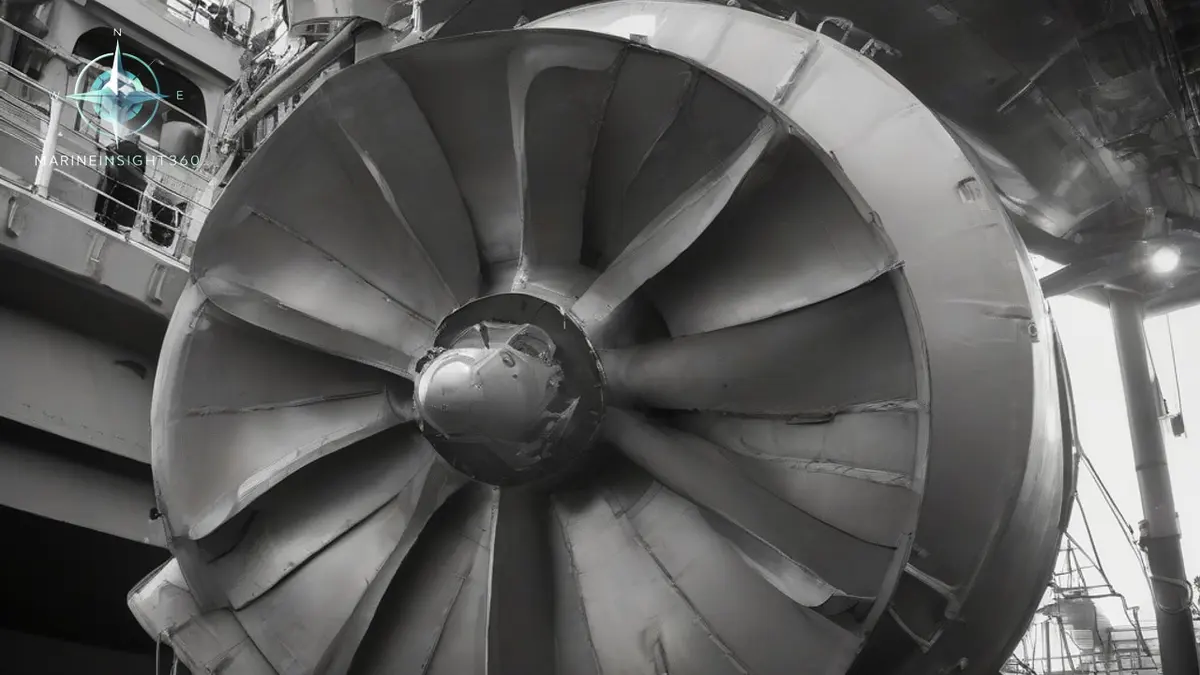
How big is a cruise ship propeller? On the largest vessels afloat it is around 6 meters (20 ft) in diameter. Oasis of the Seas is the clearest documented example. Built at the Turku yard in Finland and based at Port Everglades in Florida, she carries no conventional shafts and no rudder. Instead she uses three ABB pod units, each with a five-blade fixed-pitch propeller of 6.1 metres (20 ft) driven by an electric motor delivering 20 MW.
The two outboard pods steer; the centre pod is fixed. That gives 60 MW of installed propulsion power turning three propellers roughly the height of a two-storey house.
The number that surprises people is that it is not larger. A cruise ship of 225,000 gross tons is enormous by any measure, yet its propellers are smaller than those fitted to big container ships. The reason is draught, and it is worth understanding because it explains most cruise ship propulsion design.
Why draught, not power, sets the propeller diameter
A propeller has to sit fully immersed with clearance above it and below it. It needs enough water over the blade tips at the top of the rotation to avoid drawing air down from the surface, which is called ventilation and destroys thrust instantly, and it needs clearance from the hull above to keep pressure pulses out of the structure.
Cruise ships are draught-limited by the ports and berths they need to reach. The biggest ships in the world draw only around 9 meters, far less than a laden bulk carrier of comparable size, because a cruise itinerary is worthless if the ship cannot get alongside. Once draught is fixed at that level, the geometry leaves room for a propeller of roughly 6 meters and no more.
Container ships face no such limit. A single-screw large container vessel can carry a fixed propeller in the region of 9 to 10 meters in diameter, because a deeper draught is acceptable and a single shaft has to absorb the whole power output through one propeller. Cruise ships spread their power across two or three units instead.
Azipods: why the propeller hangs below the hull
An azimuth thruster puts the electric propulsion motor inside a pod suspended beneath the hull, with the propeller mounted directly on the motor shaft. On most cruise installations the propeller sits forward of the pod in a pulling configuration, so it works in undisturbed water ahead of the pod body rather than in the wake of a shaft, strut and hull.
The whole unit rotates through 360 degrees. Steering comes from pointing the thrust rather than deflecting flow across a rudder, which means no rudder, no long shaft line, no stern tube and no shaft brackets. The maneuvering gain is dramatic. A ship with pods can turn in its own length, move sideways and hold a position against wind and current with far less tug assistance than a conventional twin-screw ship of the same size.
There are costs. The pod is outside the hull, so bearing or seal problems mean a dry-dock or a demanding underwater intervention rather than an engine room repair. The units are heavy, expensive, and tie the owner to a specialist supply chain for the life of the ship.
Diesel-electric power behind the pods
Nothing mechanically connects the main engines to the propellers. Diesel generator sets, and on some ships gas turbines, feed a common electrical bus. That bus supplies the propulsion motors in the pods and the hotel load at the same time: air conditioning, galleys, lighting, laundries, pools and thousands of cabins.
Sharing one power plant is what makes the arrangement efficient. Generators can be started and stopped so that those running stay near their optimum load, instead of one large engine throttling down inefficiently at low speed. It also gives redundancy, because losing one generator reduces available power rather than stopping the ship.
Blade design, materials and weight
Cruise propellers are usually cast in nickel aluminum bronze, chosen for strength, fatigue resistance and corrosion performance in seawater. A 6 metre propeller of that material weighs in the tens of tonnes, and it is a single casting finished to close tolerances.
Blade count on large cruise units is typically four to six. More blades reduce the load on each and smooth the pressure pulses reaching the hull, and that matters more on a cruise ship than on any cargo vessel, because passenger cabins sit directly above the propellers.
Vibration and noise that a cargo crew would tolerate would generate complaints on a cruise ship, so blade geometry is skewed and shaped specifically to spread the pressure pulse over the rotation rather than deliver it as a sharp beat.
The propellers also turn slowly. Large, slow-turning propellers accelerate a bigger mass of water by a smaller amount, which is the efficient way to produce thrust, and low tip speed keeps cavitation and noise down. A cruise propeller running at a few tens of revolutions per second would be unthinkable; these units work at a small fraction of the speed of a small boat propeller.
What crews and yards do to keep them working
- Polishing. Blade roughness and fouling cost fuel continuously and invisibly. Underwater propeller polishing by divers is routine on commercial and cruise tonnage between dockings.
- Blade inspection. Leading edges are checked for cavitation erosion and impact damage, since a small deformity spreads its effects across every revolution.
- Pod seals and bearings. The seal arrangement where the shaft leaves the pod is the critical wear item, monitored by oil condition and inspected at docking.
- Bow thrusters. Separate tunnel thrusters forward supplement pod maneuvering for berthing, and their impellers and grids need the same attention.
Cruise ship propeller figures worth remembering
- Oasis of the Seas: three azimuth thruster units, propeller diameter 6.1 m (20 ft), five fixed-pitch blades, 20 MW per unit
- Typical large cruise ship propeller diameter: around 5 to 6 m
- Typical large container ship propeller diameter: around 9 to 10 m on a single shaft
- Limiting factor on cruise ships: draught and tip clearance, not available power
For more on propulsion machinery, shafting and thruster maintenance, see the Marine Machinery section of Marine Insight 360.
Propeller and shafting design on a classed ship is approved before anything is cast. DNV, Lloyd's Register, Bureau Veritas and ABS publish rules covering blade scantlings, shaft diameters and podded propulsion, review the drawings, and set the survey cycle for tailshafts and pod bearings. The interval between inspections belongs to the classification society, not to the operator or the yard.
That approval carries into repair. A blade damaged by cavitation erosion or by contact is not simply ground smooth: welded repairs on nickel aluminum bronze are done by an approved firm to a procedure the surveyor has accepted, and the blade is checked for balance afterwards. An unrecorded repair can leave the propeller out of true, which shows up as vibration in the after cabins.
Sources and further reading
- Oasis of the Seas - Wikipedia
- The Oasis of the Seas: a cruise ship of superlatives (Bender Monitor)
- Cruise Ship Propeller Size - How Big Are They?
What to read next
Recommended Reading
VLCC and ULCC Tankers: Capacity, Size and How Supertankers Work
VLCC capacity in barrels, tonnes and meters: what separates a VLCC from a ULCC, how supertankers load at sea, and why giant tankers dominate crude shipping.
Titanic vs Cruise Ship: How Modern Ships Compare in Size and Safety
Titanic measured 269 m and 46,328 gross tons. Icon of the Seas runs 365 m and 248,663. Here is what the numbers mean and how ship safety changed after 1912.
How Does A Cruise Ship Get Its Power?
How Does A Cruise Ship Get Its Power?: technology, equipment and fleet context for US, UK, Canada, Australia, Singapore and European maritime readers.