
Titanic vs Cruise Ship: How Modern Ships Compare in Size and Safety
Titanic measured 269 m and 46,328 gross tons. Icon of the Seas runs 365 m and 248,663. Here is what the numbers mean and how ship safety changed after 1912.
The Numbers Side by Side
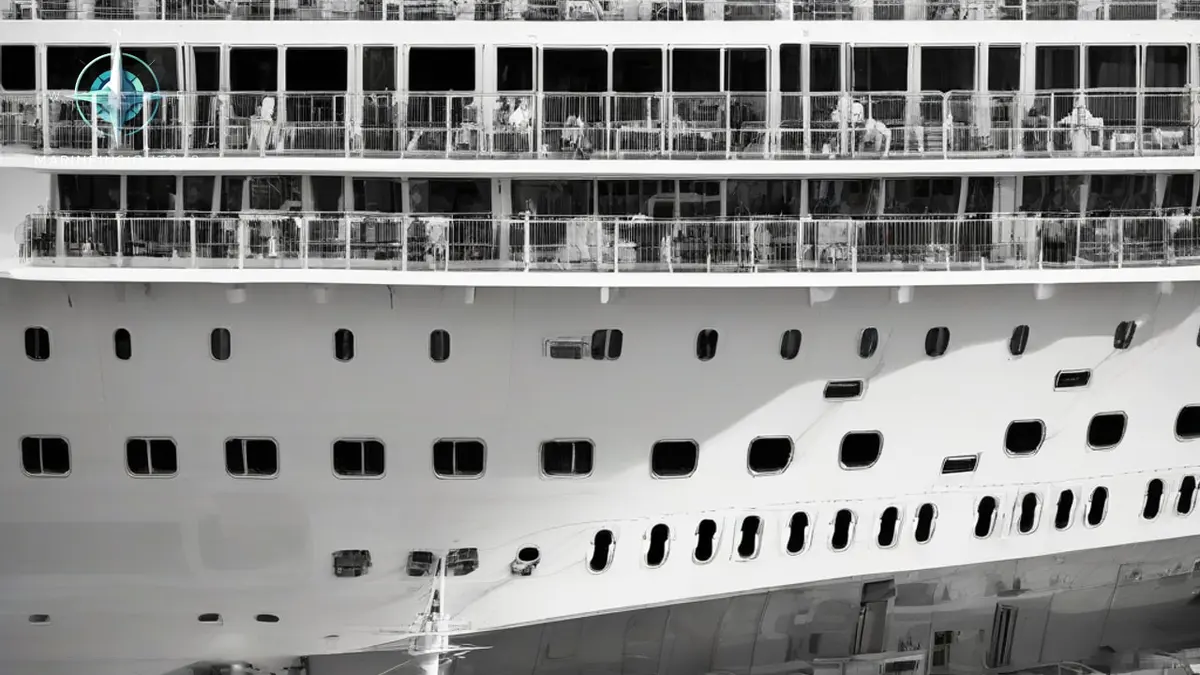
Any Titanic vs cruise ship comparison starts with the measurements. Titanic was 269 meters (882 ft 9 in) long, with a beam of 28 meters (92 ft 6 in). She measured 46,328 gross register tons across nine decks. On her maiden voyage she carried 2,224 people and 20 lifeboats for 1,178. Icon of the Seas, delivered in 2024 as the largest cruise ship afloat, runs 365 meters and 248,663 gross tonnage.
She takes 5,610 passengers at double occupancy, up to 7,600 at full capacity, plus a crew of 2,350. A modern flagship is therefore about 35 percent longer than Titanic but more than five times her measured tonnage.
That gap between a modest length increase and an enormous tonnage increase is the interesting part of the comparison, and it is where most published versions of it go wrong.
Gross Tonnage Is Volume, Not Weight, and the Rules Changed
Gross tonnage measures a ship's total enclosed volume. It is not weight, not displacement and not cargo capacity. A ship's actual mass is her displacement, the mass of water she pushes aside, and a cargo ship's earning capacity is her deadweight.
There is a second complication. Titanic's 46,328 was gross register tons, measured under the British rules of 1912, which counted enclosed space in units of 100 cubic feet with a long list of exemptions. Modern gross tonnage comes from the International Convention on Tonnage Measurement of Ships of 1969, which applies a different non linear formula and produces a dimensionless figure rather than a count of tons.
So the 46,328 against 248,663 comparison is not strictly like for like. Modern ships genuinely are vastly larger in enclosed volume, but the raw ratio flatters the difference, and any comparison that presents those two figures as weights is wrong on both counts.
Modern Ships Grew Upward and Outward, Not Along
Titanic was an ocean liner, and her hull form was set by that job: a fine lined shape driven at about 21 knots across the North Atlantic in winter, with a large power plant and enough bunker space for the crossing. Her 28 meter beam was appropriate for a ship whose priority was holding a schedule in a heavy sea.
Modern cruise ships are not liners. They run defined itineraries at moderate service speeds in mostly benign water, so the naval architect can trade hull efficiency for internal volume. Beam grows, decks stack higher above the waterline, and enormous public spaces open up inside the hull. Length grows only modestly because berth lengths, turning basins and channel geometry limit it.
The consequences are operational. Very tall superstructures create enormous windage area, which is why the largest cruise ships need substantial thruster power and careful berthing plans, and why a blackout alongside in strong wind is a serious event. Wide beam and heavy machinery low in the hull compensate for the high centre of gravity.
And the largest ships now exceed the 51.25 meter (168 ft) beam limit of the Neopanamax locks, which ties them to itineraries that do not need the Panama Canal.
Titanic's Real Failure Was a Rule, Not a Size
Titanic carried 20 lifeboats with a combined capacity of 1,178, enough for around 53 percent of the 2,224 people aboard. The boats actually launched carried capacity for 1,084, and 712 people survived.
The uncomfortable detail is that she exceeded the requirement. The British Board of Trade scaled lifeboat provision to a ship's tonnage rather than to the number of people carried, and the table had not been revised as ships grew far beyond the sizes it was written for. The failure was regulatory lag, which is a pattern the industry has repeated since.
What Changed After 1912
Delegates from thirteen countries met in London between November 1913 and January 1914 and adopted the first International Convention for the Safety of Life at Sea. It required lifeboats and lifejackets for everyone on board, boats strong enough to be lowered safely when full, and a continuous radio watch.
The First World War interrupted ratification and only five nations ratified that first text, but the framework survived through the 1929, 1948, 1960 and 1974 conventions, with the International Maritime Organization taking responsibility for it from 1960 onward.
The International Ice Patrol, run by the United States Coast Guard, was established in the same period to monitor iceberg drift in the North Atlantic and still issues limits of known ice.
A passenger ship built today operates under a much longer list: survival craft capacity for everyone on board plus additional liferafts, passenger musters held before or shortly after departure, the Global Maritime Distress and Safety System, damage stability requirements under SOLAS Chapter II-1, and safe return to port rules applying to passenger ships of 120 meters or more, or with three or more main vertical zones, constructed on or after 1 July 2010.
That last set is the most significant conceptual change: after a defined casualty the ship herself is expected to remain the safest place, with essential systems still running and the vessel able to make port under her own power.
What Would Happen Today in the Same Situation
Ice would be tracked by satellite and by the Ice Patrol, routing services would keep the ship clear of reported limits, and SOLAS Chapter V makes reporting dangerous ice a duty for any master who encounters it. Radar would detect a large berg in clear conditions, and the collision regulations require a safe speed in restricted visibility rather than the schedule keeping that governed the North Atlantic trade in 1912.
Watertight subdivision rules now require the ship to survive defined flooding cases rather than relying on bulkheads that stop below the waterline of a listing hull. Evacuation would use survival craft for everyone, supported by marine evacuation systems and drilled procedures. Distress alerting would reach shore rescue coordination centres and nearby ships automatically.
None of that makes a modern ship unsinkable, and the industry should be careful with the word. The loss of Costa Concordia in 2012 showed that a fully compliant modern passenger ship can still be put ashore by navigational decisions on the bridge. Regulation reduces the consequences of a casualty. It does not remove the need for a competent watch.
Using the Right Number for the Right Question
Pick the measure that matches the question. Displacement answers how heavy. Deadweight answers how much cargo. Gross tonnage answers how much enclosed volume, and it drives port dues, manning scales and many regulatory thresholds. Length, beam and draft answer where the ship can go. The Ships and Vessels section covers tonnage and dimension terms in more detail.
Sources and further reading
- Surviving disaster - the Titanic and SOLAS (IMO)
- The Convention for the Safety of Life at Sea - The National Archives
- The Largest Cruise Vessel in the World (2025): Icon of the Seas
- RMS Titanic: an introduction
What to read next
Recommended Reading
VLCC and ULCC Tankers: Capacity, Size and How Supertankers Work
VLCC capacity in barrels, tonnes and meters: what separates a VLCC from a ULCC, how supertankers load at sea, and why giant tankers dominate crude shipping.
What Is a Frigate? Role, Size and Modern Frigate Classes
A frigate is a mid-sized escort warship built for anti-submarine and general escort work. How frigates differ from destroyers and corvettes.
How Big Is a Cruise Ship Propeller? Size, Pods and Power
Large cruise ship propellers run about 6 meters across. Oasis of the Seas uses three 6.1 m Azipod propellers at 20 MW each. What actually sets the size.