
How Does the Panama Canal Work? Locks, Lakes and Transits
How the Panama Canal lifts ships 26 m to Gatun Lake and back, how its locks fill by gravity, the Neopanamax locks, the water supply and a ship's transit.
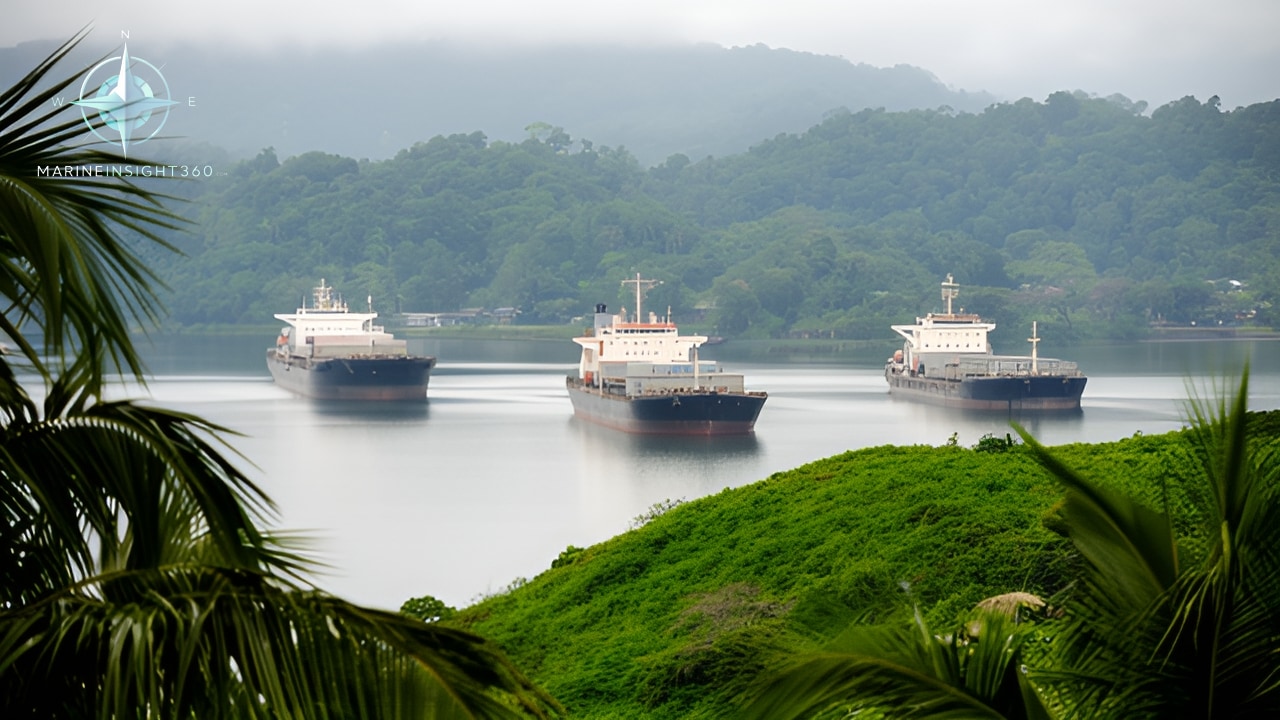
The Panama Canal works by lifting ships about 26 m from sea level up to Gatun Lake, an artificial lake in the middle of the Isthmus of Panama, carrying them across the lake and through a cutting in the continental divide, and then lowering them back to sea level on the other side. The lifting and lowering is done in locks that fill and empty by gravity, with no pumps, using fresh water from the lake.
The canal is about 80 km long from deep water in the Caribbean to deep water in the Pacific.
Why the canal needs locks
A sea-level canal across Panama would have to be cut through the hills of the continental divide. A French company led by Ferdinand de Lesseps began work in 1881, at first on a sea-level design, and collapsed in 1889 after years of landslides, disease and rising costs. The United States took over the project in 1904, and in 1906, after a debate between sea-level and lock designs, Congress approved a lock canal.
They dammed the Chagres River at Gatun to create Gatun Lake, which floods much of the route, and dug a cut through the divide to join the lake to the Pacific side. The canal opened on 15 August 1914.
The two oceans are close to the same mean level, so a difference in sea level is not why the locks exist. The difference that does show is tidal. The Pacific end has a tidal range of several metres, while on the Caribbean side the range is well under a metre, so the lift in the Pacific locks varies through the day.
The route through the canal
The canal runs roughly north-west to south-east, so a ship going from the Atlantic to the Pacific ends up further east than where it started. The canal authority calls this direction southbound.
- From Limón Bay near Colón, the ship enters the Gatun Locks (or the newer Agua Clara Locks) and is raised in three steps to Gatun Lake.
- It crosses Gatun Lake along a buoyed channel.
- It passes through the Culebra Cut, once officially named the Gaillard Cut, the narrow excavation through the continental divide.
- In the original lane, Pedro Miguel Locks lower it one step to the small Miraflores Lake, and Miraflores Locks lower it two more steps to the Pacific. In the new lane, the Cocolí Locks lower it in three steps.
- It leaves through the Pacific entrance at Balboa, near Panama City.
How a lock chamber fills and empties
Each lock is a series of concrete chambers with gates at both ends. Large culverts run through the side walls, and in the original locks through the centre wall between the two parallel lanes as well. Openings in the chamber floor connect the chamber to the culverts, and valves control the flow.
To raise a ship, it enters the lower chamber and the gates close behind it. Valves open between the chamber and the culvert fed from the level above, and water flows in under gravity until the levels match. The gates ahead then open and the ship moves up into the next chamber. Lowering a ship is the same process in reverse, with water draining from the chamber to the level below and, at the last step, to the sea.
The original locks use mitre gates: pairs of hollow steel leaves that meet in a shallow V pointing upstream, so the pressure of the higher water pushes them tighter shut. They are designed to open only when the water is level on both sides. The original chambers are 33.5 m (110 ft) wide and have a usable length of about 305 m (1,000 ft), which set the dimensions of the Panamax ship.
The locomotives
In the original locks, ships are handled by electric locomotives known as mules, which run on rails along the lock walls. Wires from the locomotives to the ship's bow and stern keep it centred in a chamber that may leave only a little over half a metre of clearance on each side. The ship uses its own engine at low power, and the locomotives steady it, slow it and keep it straight.
Larger ships need more locomotives, spread on both walls.
The Neopanamax locks
An expansion programme opened a third lane on 26 June 2016, with new locks at Agua Clara on the Atlantic side and Cocolí on the Pacific side. Each has three chambers about 427 m long, 55 m wide and 18.3 m deep.
The new locks differ from the old ones in three ways. They use rolling gates, which slide sideways into recesses in the lock wall. Ships are handled by tugs, one ahead and one astern, in place of locomotives. And each chamber has three water-saving basins alongside it.
As a chamber empties, part of its water is let into the basins and kept there to refill the chamber next time, which lets the locks reuse about 60 percent of the water in each operation.
The Panama Canal Authority (ACP) allows ships up to 370.33 m long and 51.25 m in beam through the Neopanamax locks, with an extra tug and a working bow thruster required above 367.28 m. The maximum draught is 15.24 m in tropical fresh water, but the permitted draught is lowered when Gatun Lake is low. Our article on Panama Canal locks and ship transits covers the Panamax and Neopanamax size limits in more detail.
Where the water comes from
All the water used to lift and lower ships comes from rainfall stored in Gatun Lake and Alajuela Lake upstream. A commonly cited figure is that each ship through the original locks uses about 200 million litres (some 50 million US gallons) of fresh water, which flows out to sea. The same lakes supply drinking water to Panama City and Colón.
That makes the canal dependent on the rainy season. During the drought of 2023 and 2024 the ACP cut the number of daily transits and the permitted draught to save water, and ships queued at both ends or diverted to other routes. Draught limits are still set according to the lake level and published in ACP advisories.
What a transit involves for the ship
Ships book a transit slot in advance or join the queue on arrival. Before entering, the ship is inspected by canal boarding officers. Panama Canal pilots then board; they are compulsory and, unusually, take full navigational control of the vessel for the transit. A transit of the canal itself typically takes 8 to 10 hours, and waiting time at anchor can add much more.
Tolls depend on the ship type, and for most ships are based on Panama Canal tonnage or, for container ships, on container capacity.
Panama is one of several canals that changed world shipping routes. Our list of famous canals around the world compares it with the others, and the length of the Suez Canal is worth comparing: Suez is far longer but has no locks, because the land it crosses is low and flat.
Recommended Reading
Panama Canal Locks and Ship Transit Guide
"Have you ever crossed the Panama Canal?". One of the many questions we seafarers face when dealing with land-based thieves is. "Where do they sleep on…
Top Flag States in Shipping: Panama, Liberia and More
The world's biggest flag states, from Panama and Liberia to the Marshall Islands, Singapore, Hong Kong, Malta and the Bahamas, and why owners register ships there.
What is the 10 Most Famous Canal in the World?
A famous canals is a waterway specially constructed along a major seawater route to allow the passage of ships. In most cases, these canals are…