
How Much Money a Marine Biologist Makes
How much money a marine biologist makes: US federal wage data, entry to senior pay bands, and the employers and qualifications that actually move the number.
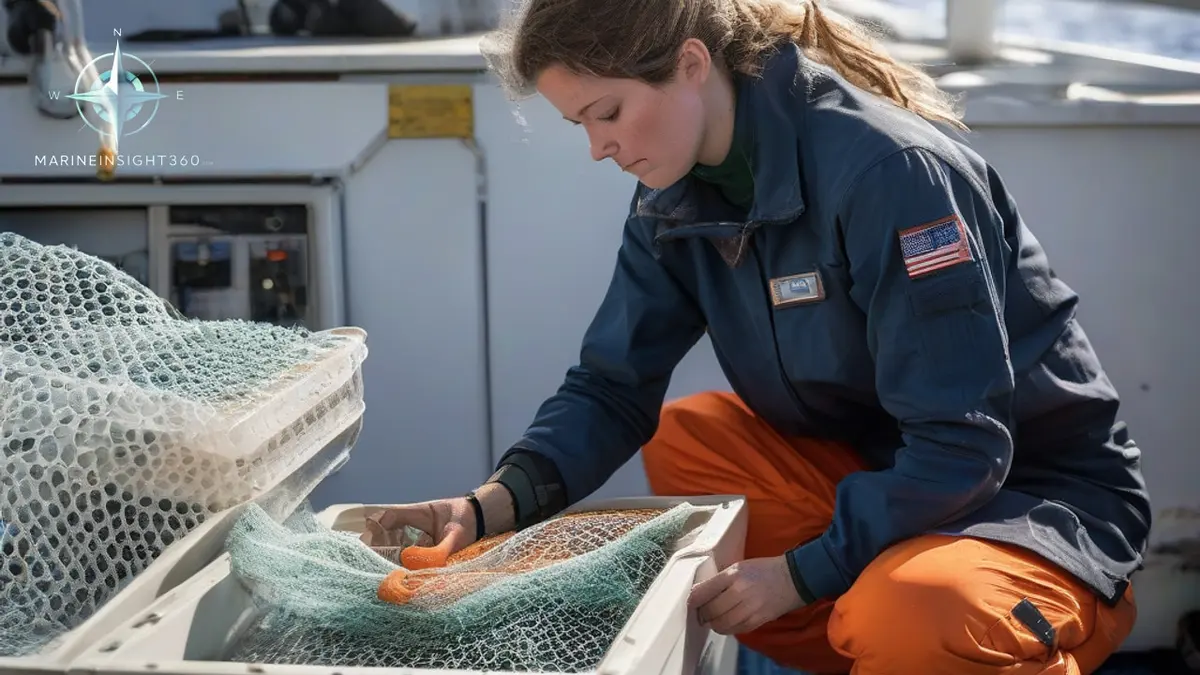
In the United States, the occupational group that contains marine biologists, zoologists and wildlife biologists, had a median annual wage of $72,860 in May 2024 according to the Bureau of Labor Statistics. The lowest paid tenth earned under $48,240 and the highest paid tenth earned more than $113,350. A marine biologist's pay therefore sits mostly between about $48,000 and $113,000, with employer type and qualification level deciding where in that band an individual lands.
That range is wide for a reason. The job title covers an aquarium keeper, a fisheries stock assessor, a university lecturer, an offshore wind environmental consultant and a federal marine mammal specialist, and those five people are not paid remotely alike.
Why the official data has no marine biologist line
National statistical agencies do not track marine biology as a separate occupation. The US Bureau of Labor Statistics folds it into zoologists and wildlife biologists, and the same pattern holds in the United Kingdom, Canada and Australia, where marine scientists are counted among biological scientists generally.
The practical consequence is that any single figure quoted as a marine biologist salary comes from either a broad occupational group or a self-reported salary survey. Treat both as an order of magnitude, then look at the specific employer, sector and grade, because those are what an actual offer is built from.
What pay looks like at each career stage
Career guides and employer listings show a fairly consistent progression across English-speaking markets, converted to USD:
- Entry level , typically research technician, aquarist, field assistant or fisheries observer roles taken with a bachelor's degree: roughly $35,000 to $50,000.
- Mid career , such as fisheries scientist, environmental consultant or laboratory manager, usually with a master's degree and several years of field work: roughly $55,000 to $80,000.
- Senior , covering principal investigators, program managers and policy leads, generally requiring a doctorate or long agency service: commonly above $90,000, with federal and senior private sector roles running higher.
Employment in the wider group is projected to grow about 2 percent between 2024 and 2034, which is slower than the average across all occupations. Competition for funded research posts is correspondingly hard, and the field is known for a long tail of short-term contract positions before a permanent role appears.
Employer type moves the number more than the job title
Four employer categories account for most marine biology work, and they pay very differently.
- Government agencies such as NOAA in the United States, the Centre for Environment, Fisheries and Aquaculture Science in the UK, Fisheries and Oceans Canada, and the Australian Institute of Marine Science. Pay follows published grade scales, which makes it predictable, and pension and leave provisions are usually the strongest available.
- Universities and research institutes. Postdoctoral salaries are modest relative to the qualification required, and the route to a permanent academic post is long.
- Aquariums, zoos and conservation charities. The most competitive entry, and generally the lowest pay in the field.
- Private consultancy and industry. Consistently the best paid, and the fastest growing source of demand.
Where marine biology pays like an industry job
The strongest earnings in this field are increasingly attached to commercial marine activity rather than pure research. Offshore wind development alone generates sustained demand for benthic survey specialists, marine mammal observers, passive acoustic monitoring operators and environmental impact assessment leads, because consent for a project depends on that evidence.
Shipping regulation supplies another route. The Ballast Water Management Convention and the IMO biofouling guidelines created a compliance market around invasive species, sampling and hull husbandry advice. Aquaculture, from salmon in Norway, Scotland and Chile to shellfish and emerging offshore systems, hires biologists into operational health and production roles that carry commercial responsibility and commercial salaries.
Marine mammal observer work on seismic and construction vessels is contract-based, often paid at a daily rate, and combines high day rates with irregular utilization.
What raises earnings fastest
Three things move a marine biology salary more reliably than years of service.
- A quantitative skill nobody else on the team has. Statistical modeling in R, stock assessment methods, GIS, acoustic analysis or machine learning applied to survey data all convert directly into higher grades.
- Field certification. Commercial or scientific diving qualifications, small boat handling, sea survival, offshore medicals and vessel-based observer accreditation open roles that a purely laboratory-based biologist cannot take.
- Willingness to work offshore. Sea-going and rotational roles carry allowances, and the experience is what consultancies hire for.
A graduate degree matters, but mostly as a gate rather than a raise. A master's degree is close to standard for consultancy and agency work; a doctorate is required to lead research and is rarely worth the time cost for someone heading into industry.
The trade-off worth understanding before committing
Marine biology attracts far more graduates than the sector employs, which holds entry pay down and keeps early careers contract-based. Anyone weighing it against a sea-going career should compare it honestly: a deck or engineering cadetship leads to a licensed profession with defined salary steps, while marine biology leads to a competitive scientific labor market where the good outcomes concentrate in consultancy, agencies and industry-linked work. Both use the sea. Only one has a fixed ladder.
The Careers section covers merchant navy pay scales and certification routes if you want that comparison in detail.
Sources and further reading
- Zoologists and Wildlife Biologists, Occupational Outlook Handbook (U.S. Bureau of Labor Statistics)
- Occupational Employment and Wages: Zoologists and Wildlife Biologists (U.S. Bureau of Labor Statistics)
- Marine Biologist Salary, Career Path and Education
What to read next
Recommended Reading

How Much Money Does A Marine Biologist Make
How Much Money Does A Marine Biologist Make: career, certification and hiring context for US, UK, Canada, Australia, Singapore and European maritime...
How Much Do You Get Paid as a Marine Biologist?
Marine biologist pay in the US, UK and Australia, why federal data has no separate category, and which offshore and consultancy roles pay the most.
How Much Do Merchant Mariners Make? Pay by Rank and Trade
US merchant mariner pay by rank, with federal wage medians, day-rate math, rotation effects, union scales and how UK sea pay compares.