
Blue Holes: How Marine Sinkholes Form and Where the Deepest Ones Hide
What a blue hole is, how ice-age limestone made these marine sinkholes, famous ones from Belize to Mexico's 420 m record, and why divers respect them.
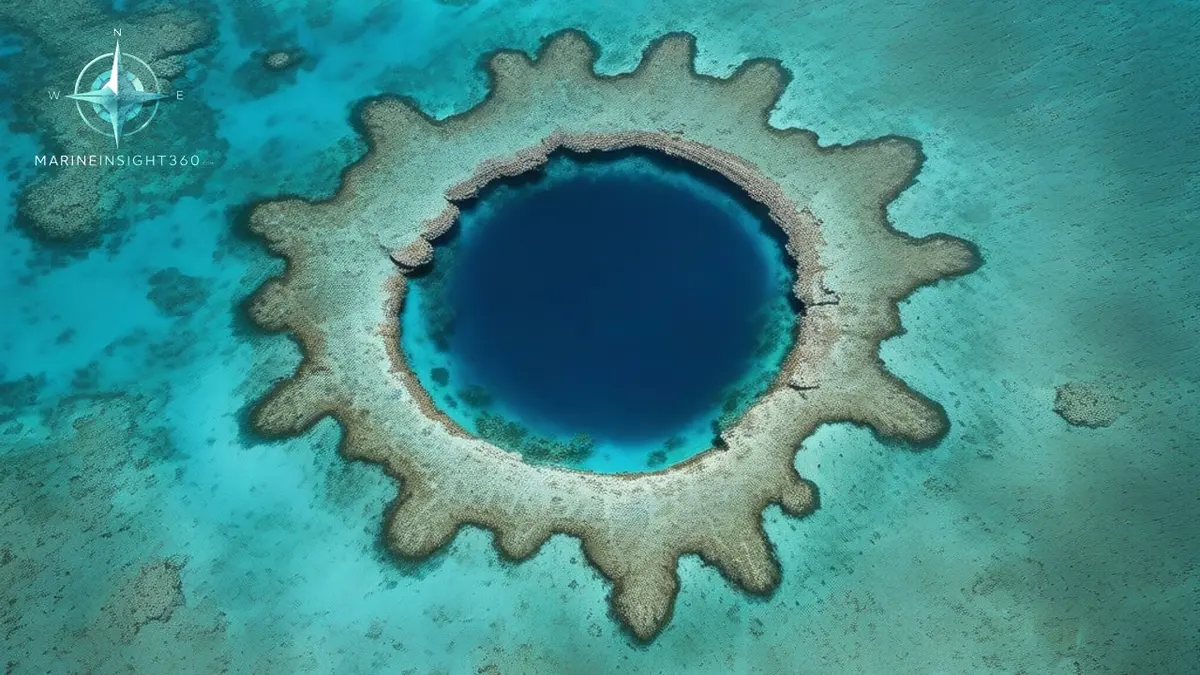
A blue hole is a marine sinkhole: a steep, roughly circular underwater cavern that plunges far below the surrounding seabed. Seen from above, the shallow turquoise water around it frames a disk of deep indigo, which is the entire name explained in one glance.
These formations fascinate scientists and divers for the same reason: they are vertical time capsules. Their still, layered depths preserve sediment, chemistry and even fossils that the open ocean churns away.
How a Hole Ends Up in the Ocean
The recipe needs limestone and an ice age. During glacial periods, sea levels stood more than a hundred meters lower, exposing today's shallow banks as dry land. Rainwater, slightly acidic, ate down through the limestone over millennia, dissolving caves that eventually collapsed into open shafts. Sinkholes form the same way on land in Florida and Mexico's Yucatan. When the ice melted and the sea rose, it drowned those shafts.
The stalactites found deep inside several of them are the proof of the story, since stalactites only form in air.
The Famous Ones
- The Great Blue Hole, Belize: about 318 meters across and 124 meters deep. Jacques Cousteau explored it in 1971 and called it one of the world's great dive sites, and it has been the poster child ever since.
- Dean's Blue Hole, Bahamas: around 202 meters deep and steps from the beach, which made it the spiritual home of world-record freediving.
- Dragon Hole, South China Sea: measured near 300 meters, long the deepest known.
- Taam Ja', Mexico: the current record holder in Chetumal Bay, measured in 2024 to at least 420 meters, with instruments yet to find the bottom.
- The Blue Hole, Dahab, Egypt: famous and infamous, a Red Sea site whose arch has claimed many technical divers.
What Science Finds Down There
Below a certain depth, many of these shafts turn hostile in an interesting way. Poor circulation lets the water stratify. Beneath a chemical boundary layer the water holds no oxygen, sometimes with a fog of hydrogen sulfide marking the line. Nothing complex lives below it, which is precisely the appeal for researchers. Undisturbed, anoxic sediment stacks up in annual layers like tree rings. The layers archive hurricanes, droughts and climate shifts for thousands of years.
Cores pulled from the Belize site have reconstructed centuries of Caribbean storm history. The bacteria thriving in the oxygen-free zones give biologists a window on early-Earth style life.
Visiting and Diving One
Recreational divers can enjoy the upper walls of most famous sites within normal limits. The Belize site is a staple day trip for travelers from the United States. Many pair it with a scenic flight that shows the formation whole. The deep parts belong to technical divers with training, gas planning and redundancy, because depth, overhead rock and sulfide layers stack risks quickly. Snorkelers get their share too.
At Dean's, the drop-off starts in wading depth, and watching freedivers slide down the line is a spectacle of its own.
Blue Hole, Cenote, Sinkhole: Sorting the Family
The three words describe one geological process in different settings. A sinkhole is the umbrella term for any collapse in soluble rock, wet or dry. A cenote is the freshwater, land-locked version, the Yucatan's famous swimming caves, formed the same way and often connected to vast flooded cave systems. The marine member of the family is the one this article covers. The shaft now lies in the sea, filled with salt water.
Some hold a fresh layer floating over salt where groundwater still seeps in. That layering, called a halocline, produces the shimmering blur divers photograph where the two waters meet.
The boundaries blur in interesting places. Taam Ja' sits in an estuarine bay, part way between cenote and open-sea shaft, which is one reason it hid from science for so long. Some inland cenotes connect underground to the coast, so tides pulse gently through pools miles from the shore. Cave divers treat the whole family with the same respect: fixed lines, redundant gas, and the rule that the exit is never assumed. For travelers, the practical difference is simple.
Cenotes are a swim, the marine sites are a boat trip, and both photograph best under a midday sun.
What to do next
The ocean has more strange places, and these guides tour them:
Recommended Reading
Who Owns the Gulf of Mexico? Territorial Waters, EEZs and the Doughnut Holes
Who owns the Gulf of Mexico: how the US, Mexico and Cuba divide it under the Law of the Sea, what the doughnut holes are, and what the naming dispute changes.
Top 5 Ports in Canada - Most Famous & Largest Ones
Canada is one of the leading destinations for both air and seaborne trade. Stretching from the Atlantic to the Pacific, this North American country has…
What Is The Deepest Part of the Ocean?
The ocean, the world's largest body of water, is deep, dark, and shrouded in mystery, and many things remain unseen in its depths. One of the most…