
How to Read the Draft of a Ship: Marks, Corrections and Costly Errors
Read metric and imperial draft marks correctly, take all six readings, apply list and trim corrections, and avoid the errors that skew a draft survey.
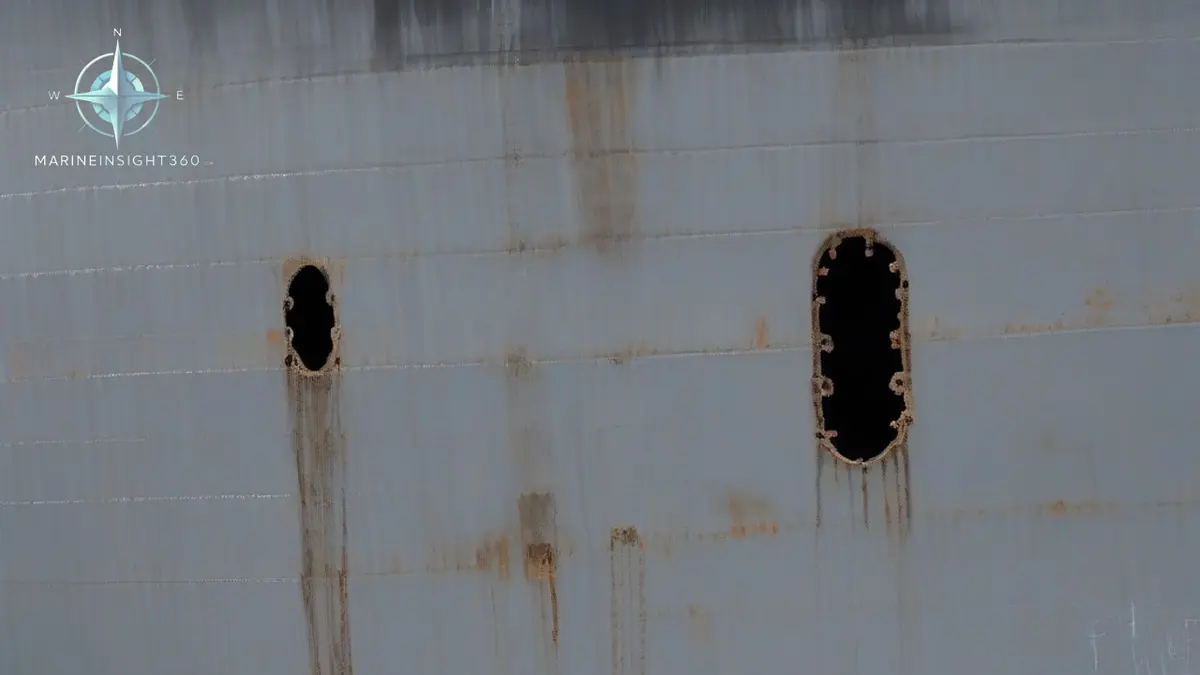
To read the draft of a ship you take the water level against the draft marks painted at six positions: forward, midship and aft, on both the port and starboard sides. On metric marks the figures are 10 cm high with a 10 cm gap between them. The bottom edge of each figure is the draft that figure represents. If the water sits level with the bottom of the figure 8 below the 10M mark, the draft is 9.80 m.
Halfway up that figure is 9.85 m, and the top edge is 9.90 m. The same six readings underpin every draft survey at bulk terminals from Newcastle and Vancouver to Rotterdam. They also back the under-keel clearance figures a USCG or AMSA boarding officer may ask you to justify.
That single reading is only the start. A usable draft, the one that goes into a stability calculation, a draft survey or an under-keel clearance check, needs all six marks, a correction for list and trim, and an allowance for hull deflection.
Reading the marks: metric and imperial
Metric marks
Metre marks are shown as the numeral followed by M, for example 8M, 9M, 10M. Between them, even decimetres appear as 2, 4, 6 and 8, meaning 20 cm, 40 cm, 60 cm and 80 cm above the metre mark. Because each numeral is 10 cm tall and the gaps are also 10 cm, a mark occurs every 20 cm and you interpolate the 5 cm steps by eye.
Read at the lower edge of the figure the water touches. Reading the top edge instead of the bottom is the single most common error, and it puts every reading out by 10 cm.
Imperial marks
Older tonnage and many US-built vessels carry marks in feet. Figures are 6 in (152 mm) high with 6 in gaps, so each foot is marked and the top edge of a numeral is that foot plus six inches. Some ships carry metric marks forward and aft with imperial amidships or on the opposite side. Confirm which system you are reading before you write anything down, and never average a metric and an imperial reading.
Why six readings, not one
A ship at a berth is rarely upright and never perfectly level. Port and starboard readings at the same station differ if the vessel has a list, and the correct figure for that station is the mean of the two. Forward and aft readings differ by the trim. Midship readings differ from the average of forward and aft if the hull is hogging or sagging, which loaded bulk carriers and tankers commonly do.
The standard treatment is the quarter mean, sometimes called the mean of means. Take the mean of forward drafts, the mean of aft drafts and the mean of midship drafts, then apply the accepted formula that weights the midship reading six times against one each for forward and aft. That weighting is what corrects for deflection of the hull girder, and skipping it is the fastest way to lose several hundred tonnes of accuracy on a draft survey.
From observed drafts to true drafts
Marks are painted on the shell plating and are rarely exactly at the forward and after perpendiculars. The ship's stability or draft survey booklet gives the distance of each mark from its perpendicular and a correction table. Apply those draft mark corrections before any trim calculation, because the trim you measure between the marks is not the trim between perpendiculars.
The rest of the sequence runs as follows:
- Correct each observed draft for the position of the marks relative to the perpendiculars.
- Apply the first trim correction, using the longitudinal centre of flotation from the hydrostatic tables.
- Apply the second trim correction where the booklet requires it, which matters on large trims.
- Apply the density correction, using an actual sample of dock water rather than an assumed value.
Take the water sample from mid-depth alongside, not from the surface where fresh run-off collects, and read the hydrometer at the same temperature the tables assume.
Reading marks in a swell or an awkward berth
Water is never still. Watch several wave cycles, note the highest and lowest water level against the marks, and take the mean. Where fitted, a draft tube or stilling well gives a far steadier reading than the shell plating. If the marks are obscured by fenders, a barge or a mooring, read from a launch on the offshore side rather than guessing, and note in the survey which marks could not be read directly.
Remote draft gauges are useful for a running check but they measure pressure and drift with fouling and calibration. Treat them as an indication and the painted marks as the record.
Checking the load line while you are down there
The load line marks amidships give you a second, independent check. The disc is 300 mm in diameter with a horizontal line through its centre, and the upper edge of that line is the summer saltwater load line. The seasonal marks alongside, tropical, summer, winter, winter North Atlantic, fresh and tropical fresh, define the maximum draft for the zone and season the ship is entering. Always read to the upper edge of the relevant line.
Water lapping over a line means the ship is overloaded for that zone, which is an immediate detention risk.
Where the draft figure is used once you have it
- Under-keel clearance. Static draft plus squat plus wave response, checked against charted depth and predicted tide.
- ECDIS settings. The safety depth and safety contour on the bridge should reflect the actual sailing draft, not a default left over from the previous voyage.
- Draft survey. Cargo quantity by displacement difference, with deductions for ballast, fuel, fresh water and constant.
- Pilot card and port declarations. Arrival and departure drafts, air draft and trim.
Errors that cost real money
Reading the top edge of a figure. Averaging port and starboard when only one side could be seen. Failing to apply the draft mark correction and then calculating trim from raw readings. Taking readings before ballast has settled and the ship has stopped moving alongside. Recording a density from the port handbook instead of sampling. Each of those individually can shift a draft survey result by a cargo parcel worth more than the survey fee.
Build the habit of writing all six readings, the time, the sea state and the dock water density in the deck log every time. Our Shipboard Operations section covers draft surveys, stability checks and cargo calculations in more detail.
Sources and further reading
- Ship Draft Explained: Marks and Calculations Guide
- Draught Marks and Surveying
- Ship Draft: What It Is, Why It Matters, and How It Is Measured
- Introduction To Ship Load Lines
What to read next
Recommended Reading
How to Read Draft Marks on a Ship Accurately
Draft marks are read where the waterline meets the bottom of a figure. Metric and imperial marks, the six reading positions and draught survey corrections.

What Are Loadline Marks & Draft Markings?
What Are Loadline Marks & Draft Markings?: safety, training and compliance context for US, UK, Canada, Australia, Singapore and European maritime readers.
What Are Plimsoll Lines? Reading a Ship's Load Line Marks
Plimsoll lines mark how deep a ship may legally load. How to read the circle, the TF to WNA scale, and why freeboard keeps ships alive at sea.