
Life Raft Drills on Ships: What They Involve
What a life raft drill covers on a merchant ship: SOLAS drill intervals, launching and boarding a raft, righting a capsized raft and the immediate actions.
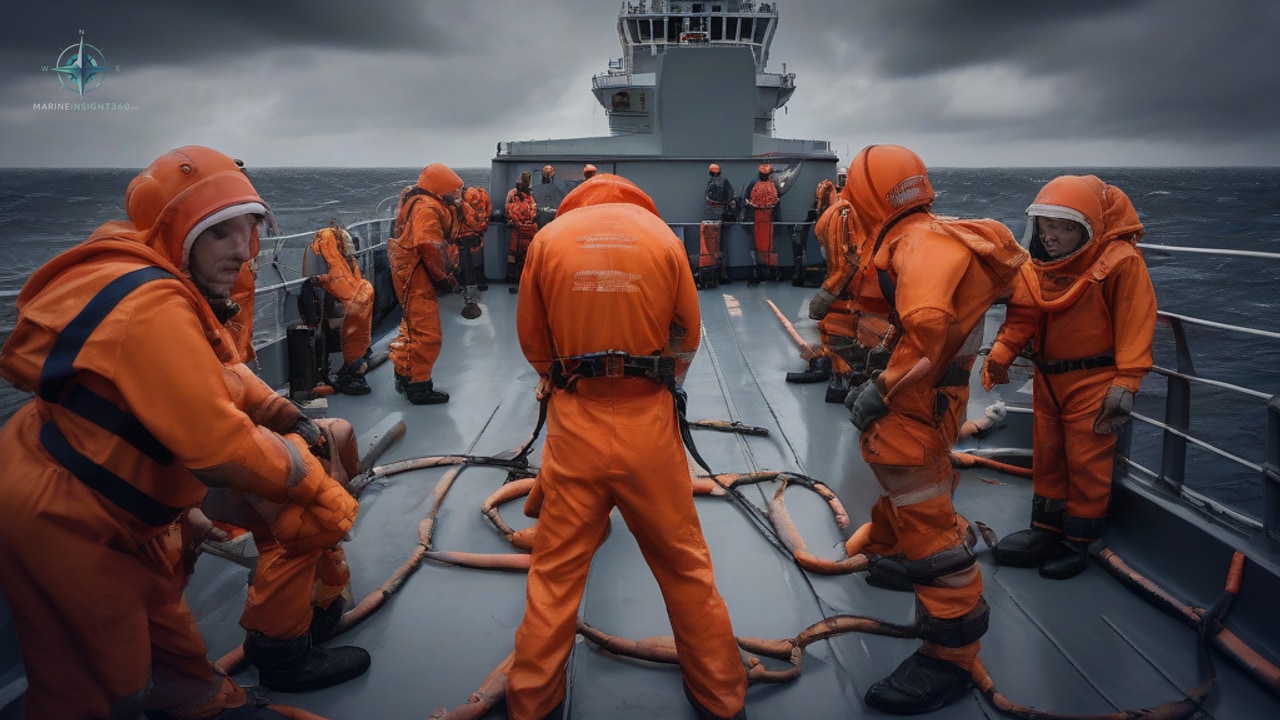
A life raft drill is the part of a ship's abandon ship training that deals with getting the life rafts into the water and the people into them. Almost every seagoing merchant ship carries life rafts, usually inflatable ones, and some smaller cargo ships carry them instead of lifeboats, so the crew need to know how to launch and board one.
How often drills are held
SOLAS Chapter III, Regulation 19, sets the frequency for all ships. Every crew member takes part in at least one abandon ship drill and one fire drill every month. If more than 25 per cent of the crew have not taken part in a drill on that ship in the previous month, the drills are held within 24 hours of the ship leaving port.
Passenger ships hold an abandon ship drill and a fire drill every week under Regulation 30; not every crew member attends each one, but each still does one of each a month. Passengers who have just embarked must be mustered before or immediately on departure, so they know where to go and how to put on a life jacket.
Ships fitted with davit-launched life rafts must give on-board training in their use at intervals of not more than four months, including the inflation and lowering of a raft whenever practicable. A raft kept only for training, clearly marked and not part of the ship's life-saving equipment, may be used for this.
The date of each drill and what it covered are recorded in the ship's log.
What a drill covers
Throw-overboard life rafts are not normally inflated at a routine drill: each one is packed in a sealed canister, and once inflated it has to go to an approved service station to be repacked. Instead the crew go through each step at the raft stowage.
Mustering and life jackets
The general alarm is sounded and the crew muster at their stations in warm clothing with life jackets on. The muster list is checked, and each person's life jacket is checked to see that it is worn correctly.
Launching the raft
For a throw-overboard raft, the crew are shown how the canister is secured in its cradle, how to release the lashing, and how to check that the painter line is made fast to a strong point on the ship before the canister goes over the side. In the water, the raft is inflated by pulling the painter until the gas cylinder fires. The crew also look at the hydrostatic release unit, which frees the raft automatically if the ship sinks before anyone can launch it.
Where davit-launched rafts are fitted, each abandon ship drill includes operating the davits used to launch them. Inflating and lowering an actual raft is part of the four-monthly training described above.
Boarding
The safest way into a raft is dry, straight from the ship or from an embarkation ladder. People who have to enter the water go down a ladder or rope rather than jumping, and nobody jumps onto the canopy, which can injure those already inside. Once aboard, people spread their weight evenly around the raft.
Righting a capsized raft
A raft can inflate upside down. One person swims to the side where the gas cylinder is fitted, climbs onto the bottom and stands on the cylinder, takes hold of the righting strap and leans back to pull the raft over, ideally with the wind helping. This is practised in the personal survival techniques part of STCW basic training, usually in a pool.
The first actions on board
The immediate actions are printed inside every raft, in this order:
- Cut the painter and get clear of the ship.
- Look for and pick up other survivors.
- Make sure the sea anchor is streamed once clear of the ship.
- Close up the entrances.
- Read the survival instructions.
The survival instructions then cover the longer task of staying alive: keeping a lookout, taking anti-seasickness tablets, keeping the raft dry and the floor inflated, and rationing water. The drill goes through both and through the equipment pack.
A full SOLAS pack includes paddles, rocket parachute flares, hand flares and smoke signals, a safety knife and bailer, drinking water and food rations, a first-aid kit and thermal protective aids; the smaller pack carried on some short-voyage ships has fewer signals and no food or water.
Equipment checked during drills
Drills are also a chance to check the equipment around the rafts: the canister lashings and cradles, the hydrostatic release unit and its expiry date, the painter's attachment, the embarkation ladders and, for davit-launched rafts, the davit and release hook. The rafts themselves are serviced at an approved service station at intervals of not more than 12 months, which the flag Administration can extend to 17 months in some cases.
Why the drills are repeated
An abandonment may happen at night, in cold water, with the ship listing and little time to spare. Monthly drills make the steps familiar before that happens. A short review after each drill picks up problems, such as a stiff lashing or a crew member unsure of their station, so they can be corrected.
For the rest of the ship's survival equipment, see life-saving appliances on ships, and for the devices that help rescuers find a raft, the guides to the search and rescue transponder (SART) and the EPIRB.
Recommended Reading
Life-Saving Equipment (LSA): A Must-Have for Safety Officers
Maritime life-saving equipment (LSA) is the last barrier between crew survival and catastrophic loss during a maritime emergency.
What Are Prison Barges? How Do They Work?
A prison barge is a specialized vessel used as a correctional facility. These floating structures provide alternative or supplemental detention space,…

Understanding Ship Fin Stabilizers and How They Work
Fin stabilizers are located at the bottom of the hull and their function is to resist excessive rolling of the ship in any direction.