
The Biggest Aircraft Carrier: Inside USS Gerald R. Ford
USS Gerald R. Ford is the biggest aircraft carrier afloat at 1,106 ft and over 100,000 tons. Her size, EMALS catapults and how merchant ships meet her.
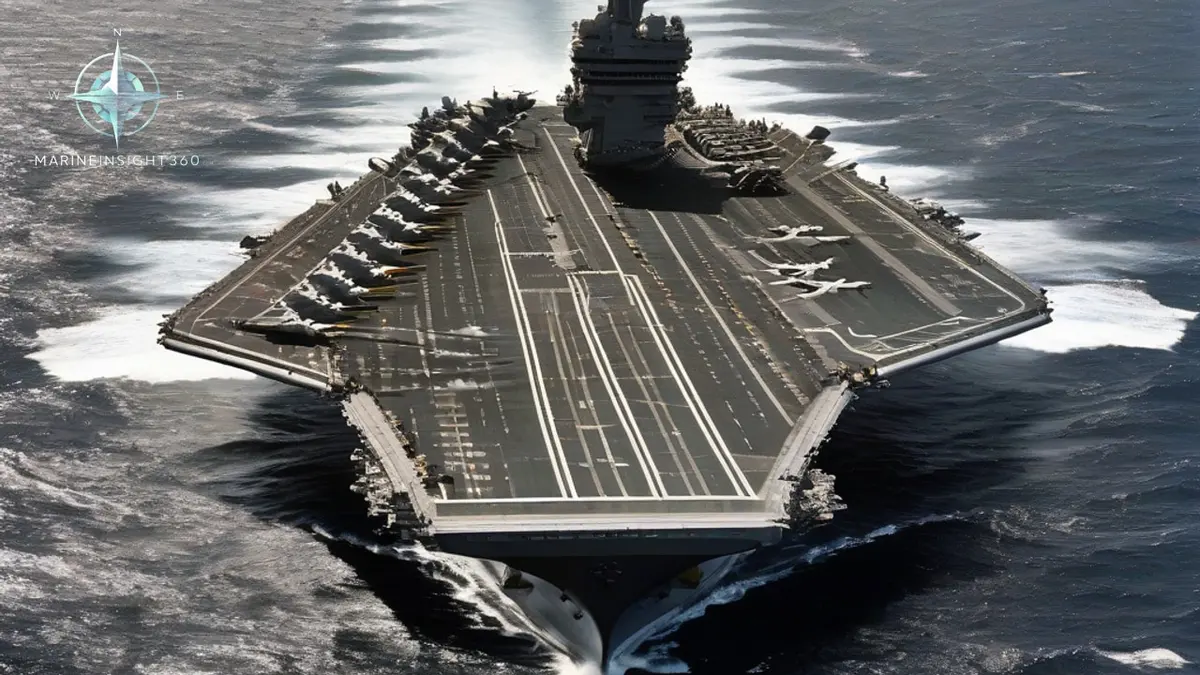
Why USS Gerald R. Ford is the biggest aircraft carrier afloat
The biggest aircraft carrier Gerald R Ford, hull number CVN-78, runs about 1,106 ft (337 m) long and displaces more than 100,000 tons at full load. She is nuclear powered and was commissioned in 2017 as lead ship of the Ford class. No larger warship has ever been built. The class is meant to replace the Nimitz carriers one for one as those ships reach the end of their service lives.
Size alone is not what distinguishes her. A Nimitz class carrier is close to the same length and displacement. The difference is in electrical generation, deck layout and launch and recovery equipment, and those changes are what the extra sortie output comes from.
How she compares with a Nimitz class carrier
The Ford class was designed around a target of higher sortie generation with a smaller ship's company.
- Sortie rate : up to around 25 percent more sorties per day than a Nimitz class ship, with a surge capacity reported at up to 270 launches in high intensity operations.
- Electrical capacity : substantially greater generating capacity, which is what makes electromagnetic launch and future high-draw systems possible.
- Crew size : reduced through automation, which lowers the through-life cost that dominates a carrier's budget.
- Flight deck arrangement : the island is set further aft and to starboard, opening more usable deck for aircraft handling and refuelling.
- Weapons handling : redesigned magazines and advanced weapons elevators using linear motors rather than cables.
EMALS and the end of the steam catapult
The most visible technical change is the Electromagnetic Aircraft Launch System. EMALS replaces the steam catapult with a linear synchronous motor about 300 ft (100 m) long, essentially a series of magnetic coils that accelerate a shuttle and the attached aircraft along the deck.
The operational advantage is control. Launch energy can be tuned to the weight of each aircraft, so a light unmanned aircraft and a fully loaded strike fighter each get the force they need rather than a compromise setting. That reduces airframe stress, which extends aircraft service life, and it widens the range of types the ship can operate.
Steam catapults also consumed fresh water and required a large steam plumbing system through the ship; removing them frees volume and simplifies maintenance. Recovery uses Advanced Arresting Gear, which works on a similar principle of controlled energy absorption.
Biggest warship is not the same as biggest ship
This distinction gets confused constantly, and the numbers make it clear. Gerald R. Ford is the largest warship, at roughly 337 m and over 100,000 tons displacement. She is not close to the largest ship afloat. The biggest container ships exceed 400 m in length and carry in the region of 24,000 TEU, and the largest crude tankers carry deadweight far beyond a carrier's displacement figure.
The comparison is also not like for like. Warship displacement is the actual weight of water displaced. Merchant ships are usually described by deadweight tonnage, which is cargo carrying capacity, or by gross tonnage, which is a measure of enclosed volume rather than weight. A carrier's true distinction is what fits on and inside her, not raw size: an air wing, its fuel, its ordnance, a hospital, and a reactor plant that removes the need to bunker.
Where merchant crews actually encounter a carrier
Carrier strike groups transit the same ocean routes as commercial traffic and exercise in defined areas that appear in navigational warnings. Three practical points apply.
- Read the warnings. Naval exercise areas and firing ranges are promulgated through NAVAREA, HYDROLANT and HYDROPAC broadcasts and local notices. Plan around them at the appraisal stage rather than diverting at short notice.
- A carrier conducting flight operations is restricted in her ability to manoeuvre. Under the collision regulations, a vessel engaged in launching or recovering aircraft falls into that category, which changes the give-way relationship. She will also be steadying on a wind-driven course and speed that has nothing to do with her destination.
- Respect naval vessel protection zones. In United States waters a 500 yard protection zone applies around naval vessels, with a 100 yard exclusion zone that no vessel may enter without permission from the naval vessel or the Coast Guard. Approaching without clearance draws an immediate and forceful response.
Communicating with a warship
Warships monitor VHF Channel 16 and will normally call you first if your closest point of approach concerns them. Answer promptly, state your intentions clearly and make any alteration early and large enough to be obvious on radar. Small incremental alterations are the standard cause of confusion in these encounters. If a naval escort directs a course or speed change in an exercise area, comply and record it.
What comes after Ford
The Ford class continues with follow-on ships of the same design, so the arrangement described here will be the pattern for United States carrier aviation for decades. For merchant operators the takeaway is unchanged: these ships are fast, nuclear powered, frequently constrained by flight operations, and surrounded by escorts that will act on an unexplained approach. The Marine Insight 360 Ships and Vessels section covers vessel type comparisons in more depth.
The ship's failures are as well documented as her capability. Ford was commissioned in 2017 with most of her eleven advanced weapons elevators unfinished, and the last was not certified until December 2021, which limited how fast ordnance could reach the flight deck. Pentagon operational test reports and Government Accountability Office reviews have repeatedly recorded launch and arresting gear breakdowns well above the design rate.
For merchant traffic the enforcement is concrete. The US Coast Guard administers the naval vessel protection zone in American waters and prosecutes intrusions, so an unanswered approach becomes a legal matter as well as a tactical one. COLREG Rule 3 is the other text that matters: it places a vessel launching or recovering aircraft in the restricted in ability to manoeuvre category, which is why the carrier holds her course.
Sources and further reading
- USS Gerald R. Ford, Britannica
- Gerald R. Ford-class Nuclear-Powered Aircraft Carriers, Naval Technology
- USS Gerald R. Ford (CVN-78) Nuclear-Powered Supercarrier, Military Factory
What to read next
Recommended Reading
USS Gerald R. Ford Explained: What the Largest Aircraft Carrier Means for Merchant Traffic
Size, propulsion and strike group makeup of USS Gerald R. Ford, its Middle East deployment, and what a carrier group means for nearby merchant ships.
Typhoon Class Submarine: The Biggest Boats Ever Sent Under the Sea
The Soviet Typhoon class submarine remains the largest ever built: twin pressure hulls, 20 missile silos, and why nothing since has matched its size.
China Is Testing a Mysterious Aircraft Carrier: What the Flat-Deck Ship Tells Us
China is testing a mysterious aircraft carrier with three islands and a full flight deck. What analysts think it is, and how the PLA carrier fleet compares.