
The Plimsoll Line on a Ship: Purpose, Importance and How to Read It
What the Plimsoll line on a ship is for: how to read the load line marks, why freeboard and reserve buoyancy matter, and how the seasonal zones work.
The Plimsoll line on a ship is the load line mark showing the maximum depth to which the hull may legally be immersed, and its purpose is to guarantee a minimum freeboard so the ship retains enough reserve buoyancy to survive heavy weather. Its importance is blunt: overloading was the largest single cause of merchant ship losses in the nineteenth century, and this mark is what stopped it.
Every merchant ship on international voyages must carry these marks under the International Convention on Load Lines, 1966, which was adopted on 5 April 1966 and entered into force on 21 July 1968.
How to read the Plimsoll line and load line marks
The marks are painted amidships on both sides of the hull, and there are three parts to them.
- The deck line. A horizontal band 300 mm (about 12 in) long and 25 mm thick, marking the upper surface of the freeboard deck at the ship's side. Freeboard is measured down from here.
- The load line disc. A ring 300 mm in outside diameter with a horizontal line 450 mm (about 18 in) long through it. The upper edge of that line is the Summer load line, the datum for everything else. The initials of the assigning authority sit either side of the disc, for example LR for Lloyd's Register or AB for the American Bureau of Shipping.
- The load line scale. A vertical line with horizontal marks forward of the disc, each 230 mm (about 9 in) long, lettered for the condition in which each applies.
Reading the scale from the top down, the letters are TF for tropical fresh water, F for fresh water, T for tropical, S for summer, W for winter, and WNA for winter North Atlantic. The fresh water marks sit higher because fresh water is less dense than the 1.025 tonnes per cubic meter salt water assumed in the freeboard calculation, so the ship floats deeper in it.
Why freeboard, not draft, is the real subject
The limit is expressed as a draft, but the quantity being controlled is freeboard, and through it reserve buoyancy. Reserve buoyancy is the watertight volume above the waterline. It is what lifts the ship when a sea comes aboard and what keeps her afloat if a compartment floods.
The assigned minimum freeboard is calculated from length, block coefficient, depth, sheer, and the strength and weathertightness of closing appliances. That is why the technical annex to the convention covers hatch covers, doors, ventilators, air pipes, freeing ports and guard rails. The freeboard calculation assumes those items work. A hatch cover with failed gaskets makes the assigned freeboard a fiction.
Seasonal zones explain why there is more than one line
Annex II of the convention divides the oceans into zones and areas with seasonal periods, because the sea states a ship must survive vary with latitude and time of year. A ship may load to her Tropical mark in a tropical zone and must be at or above her Winter mark once she enters a winter zone.
The Winter North Atlantic mark applies only to ships of 100 meters (328 ft) or less in length while in the Winter North Atlantic area during the winter period. Smaller ships take a heavier relative beating from North Atlantic seas, so they are given extra freeboard.
Loading is planned against the zone the ship will occupy at the time she is there, not the zone she loads in. A ship loading in the tropics for a North Atlantic winter passage must be at her Winter mark by the time she crosses the boundary, allowing for fuel and stores burned on the way.
Timber load lines
Ships certified to carry timber deck cargo carry a second set of marks prefixed with L, running from LTF down to LWNA. A properly secured timber deck cargo adds buoyancy and protects the deck, so a smaller freeboard is permitted.
Fresh water allowance and dock water allowance
Ships rarely load in water of exactly 1.025 density, so two corrections are used daily.
- Fresh water allowance is the extra draft permitted when loading in fresh water. It is calculated as the displacement in tonnes divided by four times the tonnes per centimeter immersion, giving an answer in centimeters.
- Dock water allowance is the proportional correction for water somewhere between fresh and salt. The chief officer takes a hydrometer sample alongside and works the allowance from the measured density.
Getting this wrong is among the more common load line offenses. A ship loaded exactly to her marks in brackish dock water will be over her marks by the time she reaches the sea.
Samuel Plimsoll and why the Plimsoll line carries his name
Samuel Plimsoll was a British Member of Parliament who campaigned through the 1870s against overloaded and overinsured vessels, which he called coffin ships. The United Kingdom's Merchant Shipping Act 1876 made a load line mark compulsory on British ships, although owners were initially free to decide where to paint it. Later legislation moved that decision to the Board of Trade, and the international system followed in the twentieth century.
Enforcement, and what happens when the marks are submerged
A ship holding a valid International Load Line Certificate has been surveyed and assigned by a recognized organization on behalf of the flag state. The certificate runs for five years with annual endorsements.
Port state control officers check the marks as a matter of routine, because it takes seconds and tells them a great deal about how a ship is run. A submerged load line is a detainable deficiency under the Paris and Tokyo memoranda and under United States Coast Guard practice. It also gives underwriters grounds to argue about cover after a casualty, which is a far more expensive problem than the detention itself.
For deck officers, the practical point is that the mark is a legal limit, not a loading target. Marine Insight 360's Shipboard Operations section covers cargo planning and stability work in more detail.
Sources and further reading
- International Convention on Load Lines, 1966
- International Convention on Load Lines
- Do you know what Plimsoll lines on ships are?
What to read next
Recommended Reading
What Are Plimsoll Lines? Reading a Ship's Load Line Marks
Plimsoll lines mark how deep a ship may legally load. How to read the circle, the TF to WNA scale, and why freeboard keeps ships alive at sea.
What Is the Plimsoll Line? The Load Line Mark That Stops Overloading
What the Plimsoll line is, how to read TF, F, T, S, W and WNA load line marks, and how the 1966 Load Lines Convention keeps ships from overloading.
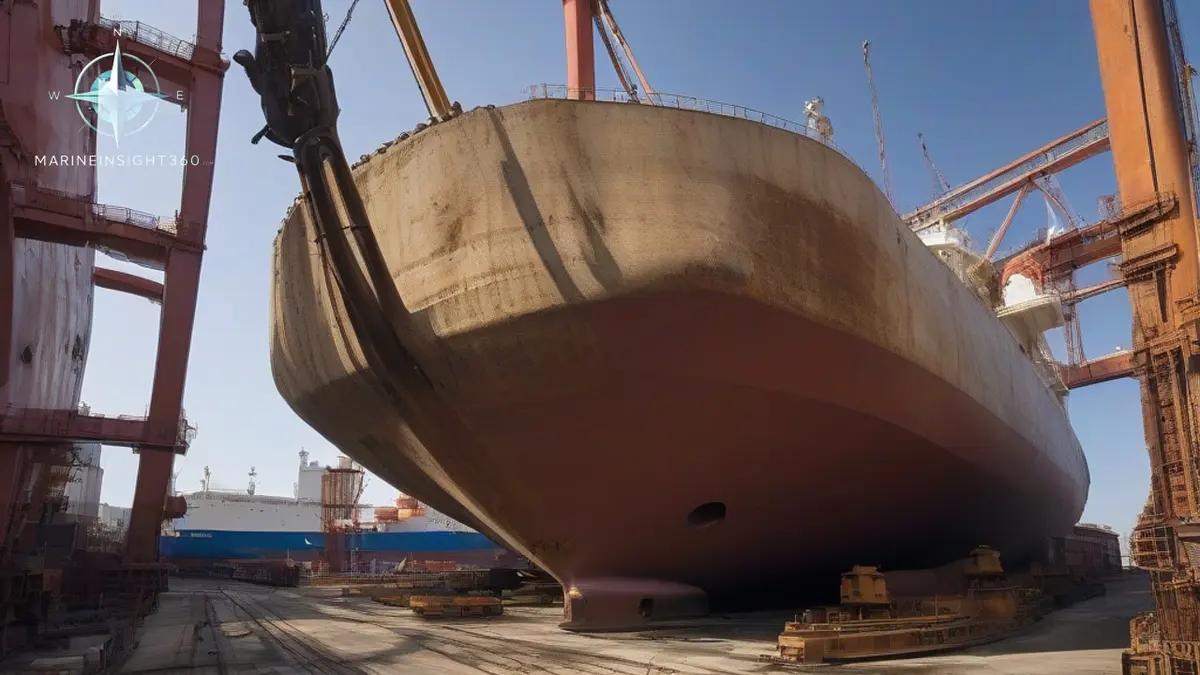
The Hull of a Ship: Purpose, Design and the Trade-offs Behind It
What a ship hull does, how naval architects shape it, and why block coefficient, bulbous bows, stern form and double hulls change fuel burn and survivability.