
What Are Volatile Organic Chemicals? VOC Control on Tankers
What volatile organic chemicals are, where VOC vapours come from on tankers, and how MARPOL Annex VI Regulation 15 and VOC management plans control them.
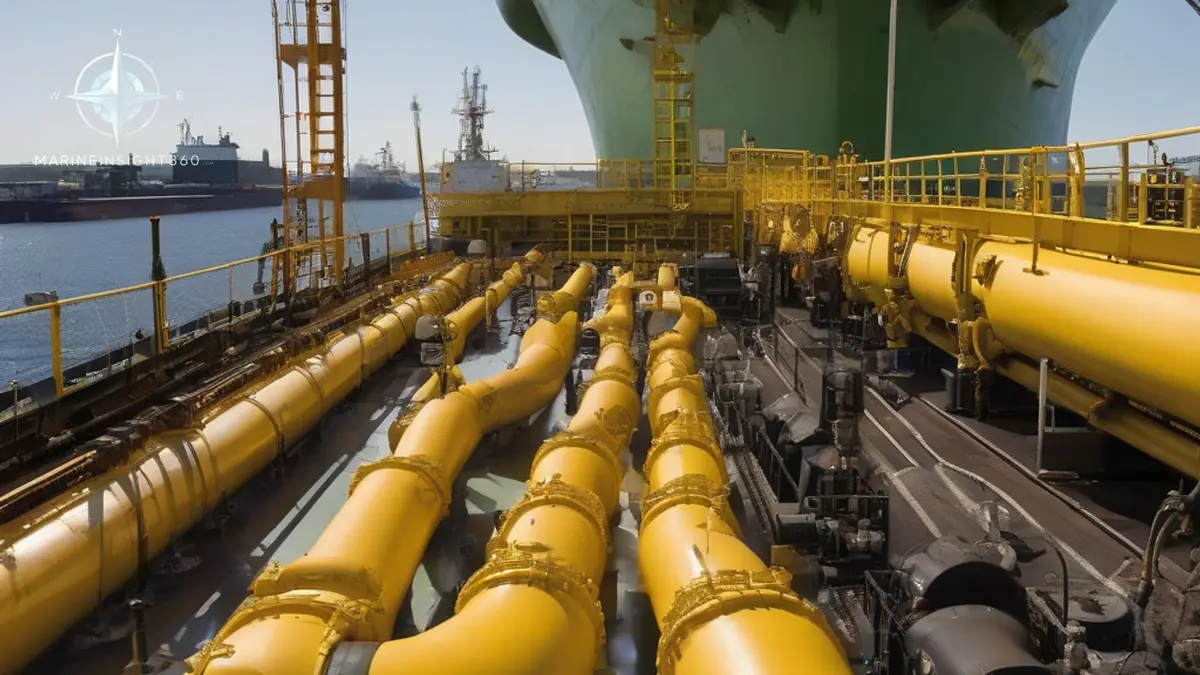
So what are volatile organic chemicals? They are carbon-based substances, usually called volatile organic compounds or VOCs, that evaporate readily at normal temperatures. On ships they matter most aboard tankers. Crude oil and similar cargoes release hydrocarbon vapours during loading, passage and discharge. MARPOL Annex VI Regulation 15 controls those emissions, and terminals in the US, the EU and Norway may require vapour return. Crude carriers must also work to an approved VOC management plan.
The subject sits at the junction of environmental compliance, cargo economics and crew safety, which is why tanker officers are examined on it and why terminals audit it.
Volatile organic chemicals defined
A VOC is any organic compound with a vapour pressure high enough to evaporate significantly at ambient temperature. Familiar examples include propane, butane, benzene, toluene and the lighter fractions of crude oil. Once airborne, VOCs react with nitrogen oxides in sunlight to form ground-level ozone, a component of smog, and some individual compounds, notably benzene, are directly harmful to people.
Crude oil is a mixture, and its lightest components leave first. Every time a cargo surface is disturbed, warmed or depressurized, some of the cargo becomes vapour.
Where VOCs come from on a tanker
- Loading: incoming cargo displaces the vapour-rich atmosphere in the tank, historically vented to the mast riser.
- Sea passage: cargo warms, evaporates and raises tank pressure until the pressure valves release.
- Crude oil washing and discharge: agitation and falling cargo levels generate fresh vapour.
Each release is lost cargo as well as pollution. Across a laden voyage the evaporation loss from a large crude cargo is a measurable fraction of the bill of lading figure, which gives owners and charterers a direct commercial reason to manage it.
Put arithmetic on that. One tenth of one percent evaporated from a 270,000 tonne crude cargo is 270 tonnes gone between load port and discharge, and because the light ends leave first, what remains is marginally less valuable per tonne.
How MARPOL Annex VI Regulation 15 controls VOC emissions
Regulation 15 of MARPOL Annex VI, the air pollution annex of the marine pollution convention, works on two fronts. First, governments may designate ports and terminals where tanker VOC emissions are regulated; ships trading there must be equipped to work with vapour emission control systems, which return cargo vapours ashore through a vapour collection line instead of venting them to atmosphere.
Second, under Regulation 15.6 every tanker carrying crude oil must have a ship-specific VOC management plan on board, approved by its flag administration and developed under the IMO guidelines in resolution MEPC.185(59). The plan sets written procedures for minimizing VOC release during loading, sea passage and discharge.
What crews actually do to cut VOC losses
- Optimized loading rates and correct use of vapour return where the terminal provides it.
- Pressure management on passage , keeping tank pressure as high as safely possible so vapour stays in the tank instead of venting early.
- Minimal splashing and free fall in the loading lineup.
- Honest monitoring and records , logging venting events so the plan can be audited and improved.
Pressure management repays the most attention. Cargo tank pressure/vacuum valves lift at a small positive pressure, a fraction of a bar; every time a tank reaches it, cargo leaves the ship as vapour. Running nearer the top of the permitted band, instead of bleeding pressure off early out of habit, keeps the light ends in the cargo rather than in the ullage space.
None of this requires exotic equipment on most ships. The plan's premise is that disciplined operation of existing systems prevents most avoidable emissions.
The safety dimension: VOCs and the people on deck
Hydrocarbon vapour is flammable in the right concentration and harmful in the wrong place. Benzene is the standard example: it is a known carcinogen, and tanker procedures control exposure with closed operations, gas measurement and personal monitoring where required. The same closed-loop habits that protect the atmosphere protect the person standing at the manifold.
Inert gas adds the explosion barrier, but inerting does not remove the health question, which is why gas-freeing and tank entry remain among the most procedure-bound jobs on a tanker.
Purging, gas freeing and tank entry
The largest deliberate vapour releases come at the end of the cycle, when tanks are emptied of hydrocarbon so people can work inside them. The order is not negotiable. On an inerted ship you purge first, displacing the hydrocarbon-rich inert atmosphere with more inert gas until hydrocarbon content falls below roughly 2 percent by volume. Only then do you admit air: purging first keeps the tank from passing through the flammable range on the way to a breathable atmosphere.
Gas freeing then runs air in until the atmosphere reads about 21 percent oxygen and hydrocarbon below 1 percent of the lower flammable limit throughout the space. Entry needs more: a permit, a bump-tested and calibrated multi-gas meter, readings at top, middle and bottom, toxic gases below the applicable exposure limits, ventilation kept running while people are inside, a standby man at the entrance and rescue gear rigged.
Benzene and hydrogen sulphide catch crews out: both are measured in parts per million rather than percent, and both can sit far below any flammability reading while remaining above a safe exposure level.
The failure modes are consistent: vapour left in the bottom of a tank because the fan was shifted too early, a meter zeroed in an already contaminated atmosphere, readings taken only at the hatch, ventilation shut down to run another job, or a tank re-inerted with people still inside. All five recur in published investigation reports.
What officers should take from this
Treat the VOC management plan as an operational document, not a shelf file: know which terminals on your run regulate VOC, keep venting records honest, and connect the plan to measurable outcomes such as reduced cargo loss. Vetting inspectors increasingly read it exactly that way.
For related coverage of MARPOL annexes and tanker systems, see the Shipboard Operations and Knowledge Base sections of Marine Insight 360.
Sources and further reading
- Amendments to MARPOL Annex VI for Volatile Organic Compounds - ABS
- MEPC.185(59) Guidelines for the development of a VOC Management Plan
- Volatile Organic Compounds (VOC) Management Plan on Ships - Marine Engineering Online
What to read next
Recommended Reading
VLCC and ULCC Tankers: Capacity, Size and How Supertankers Work
VLCC capacity in barrels, tonnes and meters: what separates a VLCC from a ULCC, how supertankers load at sea, and why giant tankers dominate crude shipping.
VOC Meaning in Shipping: Volatile Organic Compounds on Tankers
VOC means volatile organic compounds. What they are on a tanker, how MARPOL Annex VI Regulation 15 controls them, and what a VOC plan requires.
What Is VOC in Shipping? Volatile Organic Compounds on Tankers Explained
What VOC means in shipping: the cargo vapors controlled by MARPOL Annex VI, what the VOC Management Plan requires, and how tanker crews cut emissions.