
What Does Masts Mean on a Ship? Types, Parts and Modern Uses
Masts are the vertical spars or structures on a ship centerline. Traditional mast names, what modern masts carry, and the safety rules for going aloft.
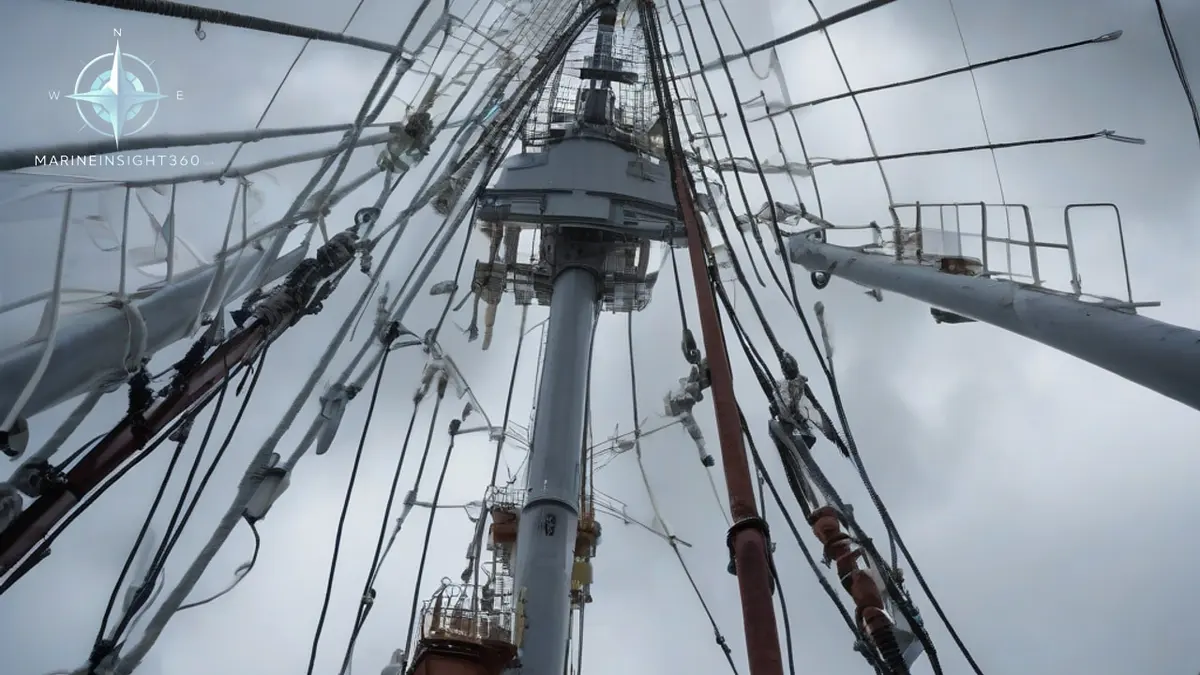
What does masts mean on a ship? The word covers the tall vertical spars or steel structures erected on or near the centerline of a vessel. On a sailing ship they carry the rig: the yards, sails and standing rigging that drive the vessel. On a modern merchant ship they carry equipment instead: radar scanners, navigation lights, antennas, the whistle, the anemometer and signal halyards.
The name survived the loss of the sails because the structural job stayed the same, which is to hold things high above the deck.
The word appears in the plural in most shipboard usage because a traditional rig has more than one, and each has a name that tells you where it sits.
The traditional mast names and what they tell you
On a three-masted vessel the arrangement runs fore to aft.
- Foremast: the forwardmost mast, carrying the fore sails.
- Mainmast: usually the tallest and the one carrying the largest sail area and the heaviest loads in strong wind.
- Mizzenmast: the aftermost mast on a three-masted vessel, generally shorter than the main.
Two-masted rigs are named by the relationship between the masts rather than by count. A ketch carries a mainmast forward and a shorter mizzen stepped forward of the rudder post. A yawl places the small after mast abaft the rudder post. A schooner has the taller mast aft. These distinctions are not pedantry: they change how the vessel balances and how it is handled short-handed.
The parts of a traditional mast
A tall mast is rarely one piece. Working upward, the lower mast is the heaviest section, stepped on the keelson or on deck, followed by the topmast and then the topgallant mast in a square rigger. The masthead is the top of a section, the crosstrees and the top spread the rigging, and the truck is the cap at the very summit. Standing rigging supports it laterally through shrouds and fore and aft through stays.
What masts do on a modern ship
A cargo ship generally carries a foremast on the forecastle and a main or radar mast above the bridge, plus a signal mast. Between them they hold nearly every sensor and signal the ship uses.
- Navigation lights: the masthead lights are carried on the masts, and their vertical separation and fore-and-aft spacing are prescribed by COLREG. A power-driven vessel underway shows a forward masthead light, and a second higher one aft is required for vessels of 50 meters (164 ft) or more in length, optional below that.
- Radar: scanners are mounted as high and as clear as practical, because height governs horizon range and because blind sectors caused by obstructions degrade collision avoidance.
- Communications and navigation antennas: VHF whips, GPS and AIS antennas, satellite communication domes and the ship whistle.
- Signal yard and halyards: for flag signals, the quarantine and pilot flags, the courtesy ensign and daytime shapes such as the anchor ball and the not-under-command shapes.
- Anemometer and weather sensors: mounted clear of the accommodation block so readings are not corrupted by turbulence.
Modern mast design is therefore an electromagnetic problem as much as a structural one. Antennas have to be sited so they do not shadow one another or the radar, and so radiation hazard zones do not fall where people work.
Air draft: the mast constraint that stops ships
Air draft is the height from the waterline to the highest point of the ship, and on most vessels that highest point is the top of a mast or an antenna on it. It decides whether a ship fits under a bridge.
Ships trading in the St Lawrence Seaway, the Great Lakes, European inland waterways and up rivers to berths above fixed bridges are commonly fitted with hinged or telescopic mast sections that can be lowered for the transit. Where masts are fixed, air draft has to be managed by ballasting the ship deeper to pass under, and the calculation must use the actual tidal height at the time of transit, not the charted clearance figure alone.
Going aloft: the controls that matter
Mast work is one of the higher risk jobs on a merchant ship because it combines working at height with live radio frequency and rotating machinery.
- Permit to work: a working aloft permit signed by the master or a designated officer, with the job, personnel and controls listed.
- Isolation: radar transmitters, satellite communication terminals and VHF and MF/HF transmitters isolated and locked off, with warning notices posted at the equipment and on the bridge. Radar antenna motors must be stopped as well as the transmitter, because a rotating scanner will knock a person off a mast.
- Fall protection: a full body harness with a fall arrest system, not a work belt, and an independent anchor point.
- Bridge awareness: the officer on watch informed and a standby man at the base of the mast for the duration.
- Tools and traffic: tools secured with lanyards and the deck below cordoned, and the job stopped if the ship motion increases.
The failure pattern in mast incidents is almost always an isolation that was assumed rather than verified. Confirm at the equipment itself that the transmitter is off, and confirm on deck that nobody can restore it while the job is running.
For deck equipment, lights and shapes, and working at height procedure, see the Shipboard Operations material in the Marine Insight 360 Knowledge Base.
The mast is inspected furniture, not decoration. Navigation light defects are among the deficiencies port state control officers under the Paris MoU record most often. A light out of position, or obscured by an antenna, is a finding whether or not the bulb works. USCG inspectors check the same arrangement, and class societies such as DNV approve the mast structure itself.
What fails on a mast is usually the fixing rather than the spar. Water tracks down cable glands and corrodes the deck seating from inside. Ladder rungs and platform gratings waste at the welds, and vibration slackens antenna clamps until a whip is lost overside. Surveyors look for rust staining below a masthead light long before they look at the light.
Sources and further reading
- Mainmast, Encyclopaedia Britannica
- Mizzenmast, Encyclopaedia Britannica
- Glossary of nautical terms (M to Z)
- Ketch
What to read next
Recommended Reading
What Does SS Mean on a Ship? Steamship, and Every Other Prefix Explained
SS on a ship means steamship, a vessel driven by steam engines. What the prefix tells you, why modern ships use MV instead, and what RMS, HMS and USS mean.
What Are Masts on a Ship? Purpose, Types and Modern Design
What masts are on ships: their purpose on sailing and motor vessels, common types and materials, and how modern mast design has changed.
Cheap Hydrogen Fuel Breakthroughs and What They Would Mean for Ships
Cheaper hydrogen would reshape marine fuel choices, but tank volume, bunkering and the missing safety code decide adoption. What ship operators should track.