
What Is A Bearing Scraper?
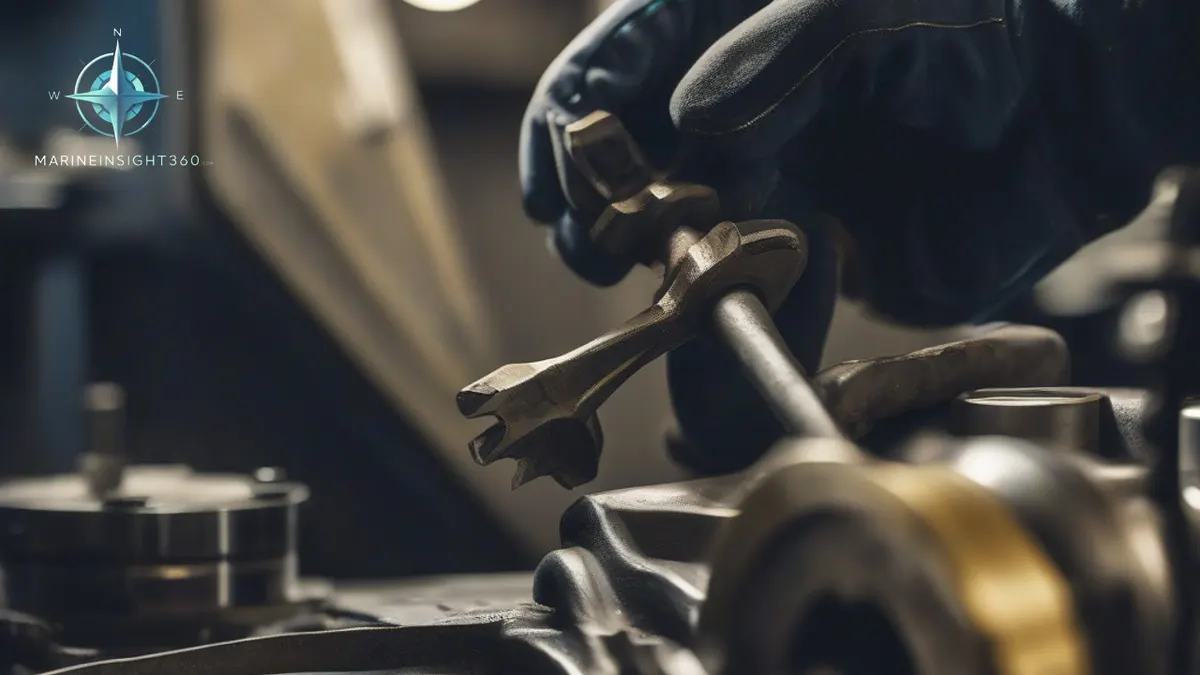
A bearing scraper is a precision tool with multiple sharp blades. It is used to manually smooth out raised areas on soft metal engine bearings.
What Is A Bearing Scraper?
A bearing scraperis a precision tool with multiple sharp blades. It is used to manually smooth out raised areas on soft metal engine bearings.
Scraping plays an important role, as flat, smooth bearings offer advantages over rotating components.
The skiving process aims to achieve correct geometric alignment by evenly distributing bearing contact points.
Scrapingis the only process capable of carving a flat surface uniformly across the length and width of the contact surface on cast iron (the material used for most machinery).
Marine bearings, including main bearings, upper bearings, lower bearings, thrust bearings, and pillow block bearings, are essential components of ships. They perform the following functions:
- Allow relative motion and ensure perfect alignment.
- Transmit heavy loads.
- Dissipate heat generated by friction.
- For Marine Engine Bearings
Why do marine bearings need to be skived?
Given the critical role marine bearings play in performing relative motion and maintaining alignment in rotating machinery, their maintenance is crucial.
Scraping is fundamental to marine bearing maintenance. Its importance lies in the following aspects:
Improves precision by improving process control and increasing machine rigidity.
Removing minimal metal from precision surfaces eliminates the high wear caused by rapidly fluctuating cyclic loads on bearings during high-speed operation, creating a smooth surface that ensures clean, well-lubricated, and well-supported bearings, thereby ensuring secure positioning of other rotating components.
Ensures easy assembly of machine components by providing a flat, precise bearing surface.
Increases the rigidity of machine tool joints by increasing the bearing contact area between mating surfaces.
Benefits of Bearing Scraping
The basic structure of a scraper includes:
Hook: A small hole in the top of the scraper that allows it to be stored upright in a toolbox or designated area.
Handle: The handle extends from the top to the edge of the shaft. The shaft is usually made of wood and is usually rounded for a comfortable grip.
Handle: A longitudinal, cylindrical metal part, usually made of tempered or hardened steel, extending from the edge of the handle to the blade.
Blade: The base of the scraper is the blade, which can be triangular or curved, depending on the type of scraping required and the scraper.
- What Is The Function Of An Eductor On A Ship?
- Top 7 Ports of Russia
- How Many Types of Piston Rings Are There and Ship Piston Ring Maintenance?
- What Is Dredging, and Why Is It Important?
- Top 10 Tallest Lighthouses
- Top 10 Best Mining Ships in the World
Types of Scrapers
Generally speaking, there are three main types of scrapers:
Flat-head or chisel-head scrapers: Also known as facing scrapers, these are shaped like a chisel. They have a sharp, slightly rounded end that faces the corners of the workpiece, removing scratches left by contact or engagement.
Triangular scrapers: Triangular scrapers are typically made of bronze or white metal. Their blades are triangular, with the three corners connected at a common point. At the tip of the blade, the edge is not perfectly straight but slightly curved. They are commonly used to remove burrs or holes from the inner surfaces of slotted bearings.
Curved scrapers: Curved scrapers have a raised base and a one-piece handle with a wooden grip for stability. These scrapers have a curved blade and two sharp cutting edges with a rounded tip. They are not typically used to remove deep grooves in babbitt or soft metals found in engine bearings, but they can easily perform light scraping even in thin-walled areas of engine bearings, crankshaft main bearings, or connecting rod bearings.
How to scrape a bearing?
Preparation before scraping:
Do not attempt to scrape more than 3 or 4 thousandths of an inch of metal over a wide surface.
High spots must be identified by a test fit before scraping. After replacing a camshaft bearing, a test fit can be performed by rotating the camshaft once.
The surface to be surfaced must be checked against the flat surface and, in the case of a bearing, against its mating surface due to its curved surface.
The surface to be scraped and the recessed surface must be thoroughly cleaned.
A thin layer of Prussian blue should be applied to the recessed surface. High spots can be identified by gently rubbing the workpiece against a blued reference surface, thereby determining the area to be scraped.
Before scraping with a file, remove any visible burrs.
Scraping Application or Method:
Scraping tools typically have a positive contact angle. When using a scraper, place your left wrist on the workpiece, or in pliers if the workpiece is stationary.
As you scrape, move your wrist or pull with your left hand to glide the scraper across the workpiece. This ensures a firm grip on the selected surface.
If precise two-handed support is not possible, use a scraper with a negative contact angle to prevent sagging and vibration.
After determining the area to be scraped and working with a curved support, reposition the workpiece on the reference surface until it is evenly coated with Prussian blue.
Scraping Tool Care
Scraping tools are small hand tools that require special care because they are used to abrade the surface.
They should not be stored with wrenches or files, but rather with an oiled rag to protect their edges from damage.
Sharpening tools should be sharpened regularly to maintain their sharpness.
First, sharpen the flat bottom of a fine-grinding wheel, then sharpen by hand or with an oilstone to achieve a sharp edge.
Removing grinding marks is crucial, as uneven edges and jagged edges can scratch the work surface.
Recommended Reading

Iran retaliates with missiles and drones, defying Trump’s warning
Answer: Iran’s recent launch of ballistic missiles toward Jordan and drones toward Bahrain, Kuwait and the United Arab Emirates creates an immediate…

Hapag-Lloyd Invests in APM Terminals Rotterdam to Drive Growth
Hapag‑Lloyd’s new stake in APM Terminals Rotterdam aims to expand capacity, improve hinterland links and enhance crew efficiency in Europe’s busiest port.

Saildrone Completes Missile Launch Test Aboard its Sail-Powered Surveyor
Saildrone’s autonomous vessel successfully launched a missile‑type payload, showing new possibilities for armed surveyors and implications for shipping operator