
What Is a Duct Keel? The Pipe Tunnel Inside a Ship's Double Bottom
A duct keel is a watertight pipe tunnel in a ship's double bottom. How it is built, what runs through it, and the enclosed space risks crews must manage.
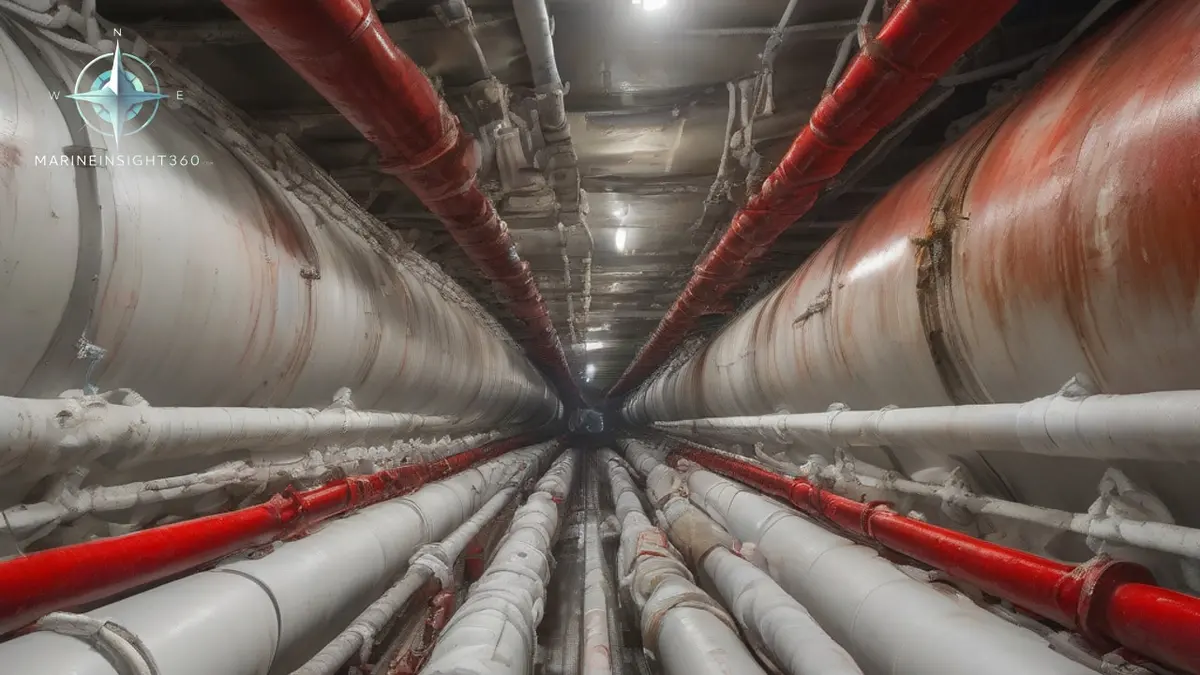
A duct keel is a watertight, box-shaped passage built into a ship's double bottom along the centerline. Two longitudinal girders take the place of the usual single center girder. The inner bottom plating forms the roof and the shell plating the floor. So what is duct keel construction for? It carries fore and aft piping and cabling. The crew can reach that pipework without entering a ballast tank.
Many designers and rule sets call the same structure a pipe tunnel or pipe duct. Lloyd's Register, DNV and ABS all set scantlings for it, and MCA and USCG surveyors treat the space as enclosed under SOLAS.
The idea solves a genuine problem. On a double bottom ship, the ballast, bilge and sounding lines running the length of the vessel would otherwise pass through the ballast tanks themselves, where a leaking flange cannot be found until the tank is emptied, gas freed and entered.
How it is built
Instead of one center girder on the centerline, the structure uses two girders spaced a short distance apart, typically limited by classification society rules to a maximum spacing in the region of three meters. The space between them becomes the duct. Plating in the duct is normally thicker than the adjacent double bottom plating, because the structure has to do two jobs at once: enclose a dry space and carry load.
The docking load is the reason for the extra scantlings. When a ship sits on the blocks in dry dock, the entire weight bears on a narrow strip along the centerline, exactly where the duct keel sits. The girders and the floors crossing them have to transmit that load into the keel without buckling, so the duct keel region is one of the most heavily stiffened parts of the bottom structure.
The duct is watertight to the tanks either side, so a leak in a ballast tank does not flood it, and a leak inside the duct does not contaminate ballast.
Where it runs and how you get in
A duct keel usually runs from the collision bulkhead aft to the forward engine room bulkhead. Access is normally from the engine room through a watertight door or a bolted manhole, with a second access or escape at the forward end so that anyone working inside is not relying on a single route out.
Inside you will typically find:
- Ballast main and branch lines with their valves, often remotely operated.
- Bilge suction lines from the forward spaces.
- Sounding pipes and air pipe runs.
- Hydraulic lines for remotely operated ballast valves.
- Electrical cabling to forward equipment such as the windlass, forward lighting and, on some designs, bow thruster control circuits.
- Fuel or heating lines on ships whose arrangement requires them forward.
Why it is worth the structural cost
The operational argument is maintenance access. A leaking ballast valve or a wasted pipe run inside a duct keel can be inspected, isolated and repaired at sea by two people with a work permit. The same defect inside a ballast tank requires deballasting, ventilation, atmosphere testing, tank entry procedures and often a port call.
There are structural benefits too. The duct provides a continuous longitudinal strength member on the centerline and adds a small amount of reserve buoyancy as a dry enclosed volume. And keeping pipes out of the ballast tanks means less pipework sitting permanently in salt water, which reduces external corrosion on the lines themselves.
Against that, the duct keel takes up double bottom volume that could otherwise hold ballast or fuel, it adds steel weight and construction cost, and it creates one more enclosed space that has to be managed for the life of the ship.
The enclosed space hazard
A duct keel is an enclosed space in the full regulatory sense, and it has the classic profile of the spaces that kill seafarers. It is long, narrow and poorly ventilated. Bare steel inside it rusts, and rusting consumes oxygen, so a duct keel that has been closed for weeks can hold an atmosphere that is deficient in oxygen while looking and smelling entirely normal.
Standard practice applies without exception. Ventilate before entry, test the atmosphere at several levels along the length rather than only at the entrance, use a permit to work, post a standby person at the access with communications, and have rescue equipment ready at the opening rather than in a locker four decks up.
SOLAS requires enclosed space entry and rescue drills, and a duct keel is a realistic space to run one in, because the confined geometry makes recovering a casualty genuinely difficult.
Leaked hydrocarbons are the other risk where fuel lines pass through. Any smell of oil in a duct keel is a defect report, not a nuisance.
Which ships have one
Duct keels are common on bulk carriers and general cargo ships with double bottoms, where the long run of ballast pipework and the benefit of dry access are both significant. They are generally avoided on oil tankers, where a dry, enclosed longitudinal void running under the cargo tanks would be a serious hazard if cargo ever leaked into it. Tankers instead run cargo piping on deck, with pump room arrangements handling the connections.
On ships without a duct keel, a single center girder, sometimes called the center keelson, runs the length of the double bottom, and the piping is routed through the tanks with the maintenance consequences that implies.
For more on how the bottom structure is put together and why it is arranged the way it is, the Ships and Vessels section covers hull construction, and the Maritime Safety section covers enclosed space entry procedures in detail.
Sources and further reading
- DNV Rules for Classification of Ships: hull structural design
- Double bottom structure, hull structures rules
- Rules and regulations for classification: hull structures
What to read next
Recommended Reading
Cadeler 20MW Wind Turbine Installation Vessel Keel Laid: Inside a Next-Generation WTIV
The keel laying of Cadeler's 20MW wind turbine installation vessel explained: crane capacity, deck area, jack-up limits and what the milestone means.
What Is the Bottom of a Ship Called? Keel, Bilge and Bottom Plating Explained
What is the bottom of a ship called? Keel, bilge, bottom plating, double bottoms and bilge keels explained in plain terms for working mariners.
Inside the Arleigh Burke Destroyer: What an 80th Keel Laying Represents
The US Navy lays the keel of its 80th Arleigh Burke destroyer. What a DDG-51 is, how Flight III differs, and how merchant crews should handle one at sea.