
What Is a TEU? The Unit That Measures Container Shipping
What is a TEU? How the twenty-foot equivalent unit measures containers, ships and ports, and how to read vessel sizes quoted in TEU.
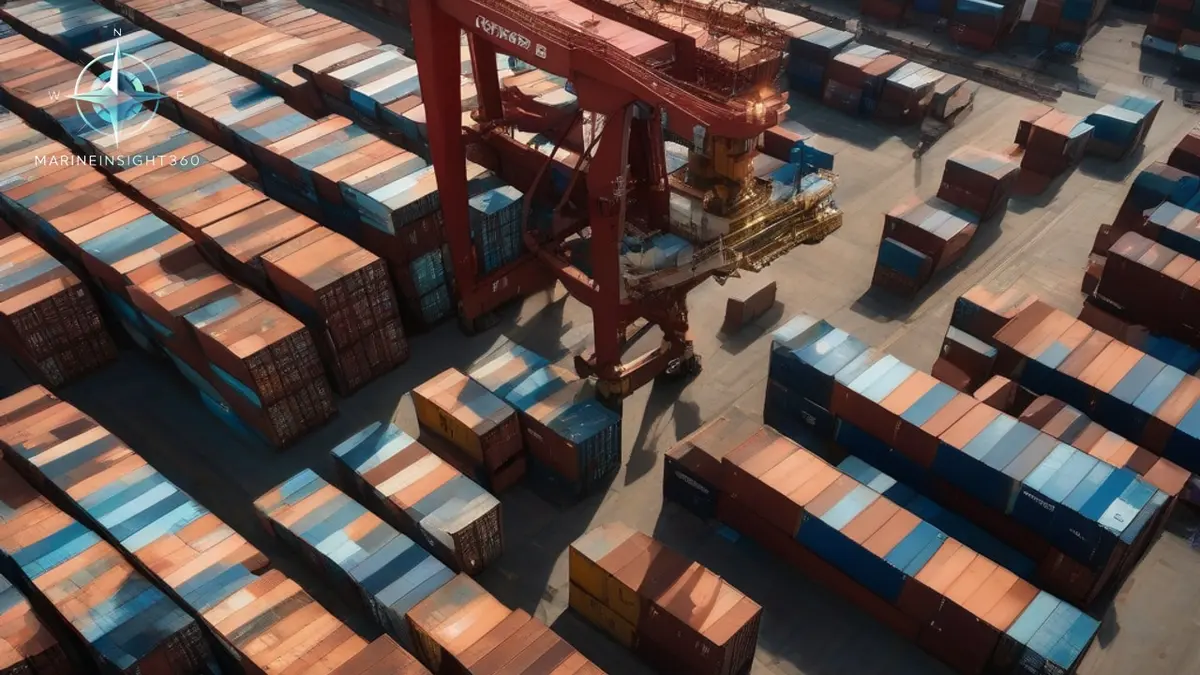
What is TEU shorthand for? Twenty-foot equivalent unit, the standard measure of capacity in container shipping. One TEU equals one standard 20-foot container, about 6.1 meters (20 ft) long and 2.4 meters (8 ft) wide. A 40-foot container counts as two TEU, so a vessel rated for 10,000 TEU can carry 5,000 forty-foot boxes.
The unit exists to make unlike things comparable. Ships, terminals, leasing fleets and entire national trades are all quoted in the same currency of twenty-foot slots, which is why the abbreviation turns up in nearly every shipping statistic you will read.
The exact definition of a TEU
The reference box is the ISO standard 20-foot container: 20 ft long, 8 ft wide and typically 8 ft 6 in tall, or roughly 6.1 by 2.4 by 2.6 meters. Capacity is calculated from length alone, so a taller high-cube box still counts the same as a standard one.
Inside, a twenty-foot box takes about ten standard pallets. Rated payload runs up to roughly 28 tonnes, though road weight limits at either end of the journey often cap the practical figure lower.
Volume decides as many bookings as weight does. A standard 20-foot box encloses roughly 33 cubic meters, a standard 40-foot box about 67, and a 40-foot high cube, which adds a foot of height, about 76. Light bulky cargo fills that cube long before it approaches the payload limit, which is why forwarders talk about a box cubing out or weighing out depending on which ceiling is reached first.
TEU and FEU: counting the 40-foot boxes
Most deep-sea cargo actually moves in 40-foot containers, counted either as two TEU or as one FEU, a forty-foot equivalent unit. Freight rates on the major trades are typically quoted per FEU, while capacity and throughput statistics stay in TEU. The mismatch trips up plenty of newcomers, so check which unit a figure uses before comparing numbers.
The economics behind the split are simple. A 40-foot box takes one crane lift, one chassis and one set of documents but carries close to twice the volume of a 20-foot box, so the cost per cubic meter moved is lower. The 20-foot box holds its ground for dense cargo such as steel, stone, tinned goods and machinery parts, where a 40-foot box would exceed its payload long before it filled.
How the unit describes ships, ports and trade
- Ships: a vessel's nominal figure states how many twenty-foot slots it offers. The largest container ships now exceed 24,000 TEU.
- Ports: annual throughput ranks the container hubs. Shanghai, the busiest, handles more than 50 million TEU a year.
- Trades: analysts size entire routes, such as Asia to Europe, in millions of TEU per year to track demand against fleet capacity.
Nominal capacity is not the same as usable capacity. Weight limits, stack heights, lashing rules and the mix of empty and laden boxes mean a ship rarely sails with every slot filled to its paper rating.
Why a ship rarely loads its nominal TEU
The nominal figure counts slots. What a ship actually lifts is decided by weight, stability and the securing arrangements, and the industry keeps a second number for exactly that reason: capacity at 14 tonnes homogeneous, meaning the number of boxes the ship can carry if every one of them weighs 14 tonnes. That figure always sits well below the nominal rating. The limits stack up in a predictable order.
- Deadweight. Cargo shares the deadweight with bunkers, ballast, fresh water and stores. A ship of 200,000 tonnes deadweight cannot load 20,000 boxes averaging 12 tonnes, because that is 240,000 tonnes of cargo before a drop of fuel is counted.
- Stability. Deck stacks sit high, so heavy boxes stowed on top cut metacentric height. Planners load heavy low and light high, which means a ship short of dense cargo can exhaust its usable low slots while deck space is still open.
- Stack and tier weights. The Cargo Securing Manual fixes a maximum weight per stack and per tier, set by the strength of the corner castings, twistlocks and lashing rods against the accelerations the ship will meet in a seaway.
- Specialised slots. Reefers need plugs, and the number of plugs is finite. IMDG cargo carries segregation rules that block neighbouring slots regardless of what the bay plan shows as free.
- Empties. Repositioning empty boxes fills slots with almost no weight, which flatters the TEU count and earns very little.
Ship size classes measured in TEU
Container vessel classes are named in capacity bands. Feeder ships run up to roughly 3,000 TEU and serve regional ports. Panamax tonnage, sized for the old Panama Canal locks, tops out near 5,000. Neo-Panamax designs fit the enlarged locks at around 14,000, and the ultra large container vessels continue beyond 24,000 TEU on the Asia-Europe trade.
Slot economics drive the growth. A bigger hull spreads fuel and crew cost across more boxes, provided the trade can fill it and the ports can work it fast enough. When either condition fails, the giants queue, and the savings evaporate at anchor.
Why one small box became the industry standard
Containerization standardized cargo handling around a box that fits a ship cell, a rail wagon and a road trailer without repacking. The 20-foot length was among the earliest ISO container standards, so it became the accounting unit even as the 40-foot box took over most of the actual cargo. The unit persists because every terminal crane, yard slot and ship cell is still laid out around those dimensions.
A practical habit for anyone new to the trade: treat the figure as a slot count, not a cargo weight. Two ports or two ships with identical ratings can move very different tonnages depending on what is in the boxes.
To see how these figures translate into real ships and port calls, the Ports and Shipping coverage in the Marine Insight 360 Knowledge Base is the place to continue.
The numbers on a stowage plan are policed. Under IMO requirements the shipper must declare a verified gross mass for every packed container before it is loaded, because planners cannot compute stability from box counts alone. Class societies including DNV, Lloyd's Register, ClassNK and Bureau Veritas approve the Cargo Securing Manual on behalf of the flag, and that manual fixes the stack and tier limits.
Enforcement at the quayside belongs to the port state. Officers inspecting under the Paris MoU and Tokyo MoU check lashing gear, container securing arrangements and the manual itself, and worn or missing twistlocks and lashing rods are written up as deficiencies. Investigations into container losses by the MAIB and comparable agencies keep finding misdeclared weights behind stacks that collapsed.
Sources and further reading
- Twenty-foot equivalent unit - Wikipedia
- Twenty-Foot Equivalent Unit (TEU) Definition - UPS Supply Chain Solutions
- Twenty-foot Equivalent Unit (TEU) - DHL Logistics of Things
What to read next
Recommended Reading

Container Tracking: How Shippers Actually Follow a Box Across the Ocean
How container tracking works, from free carrier lookups to visibility platforms: what each tool layer does, what it costs, and how to pick for your volume.
What Is TEU in Shipping? The Unit Behind Every Container Ship Figure
TEU means twenty-foot equivalent unit, the standard measure of container ship and port capacity. Here is how TEU works, how it differs from FEU, and its limits.
The Law and Practice of Container Shipping: A Working Guide
How container shipping law works in practice: which liability regime applies, package limitation, the one-year time bar, VGM duties and deck carriage risk.