
What Is Cold Ironing? Shore Power for Ships at Berth
What cold ironing means, how a ship connects to shore power at berth, the IEC 80005 standards, EU and California requirements, and the practical limits on OPS.
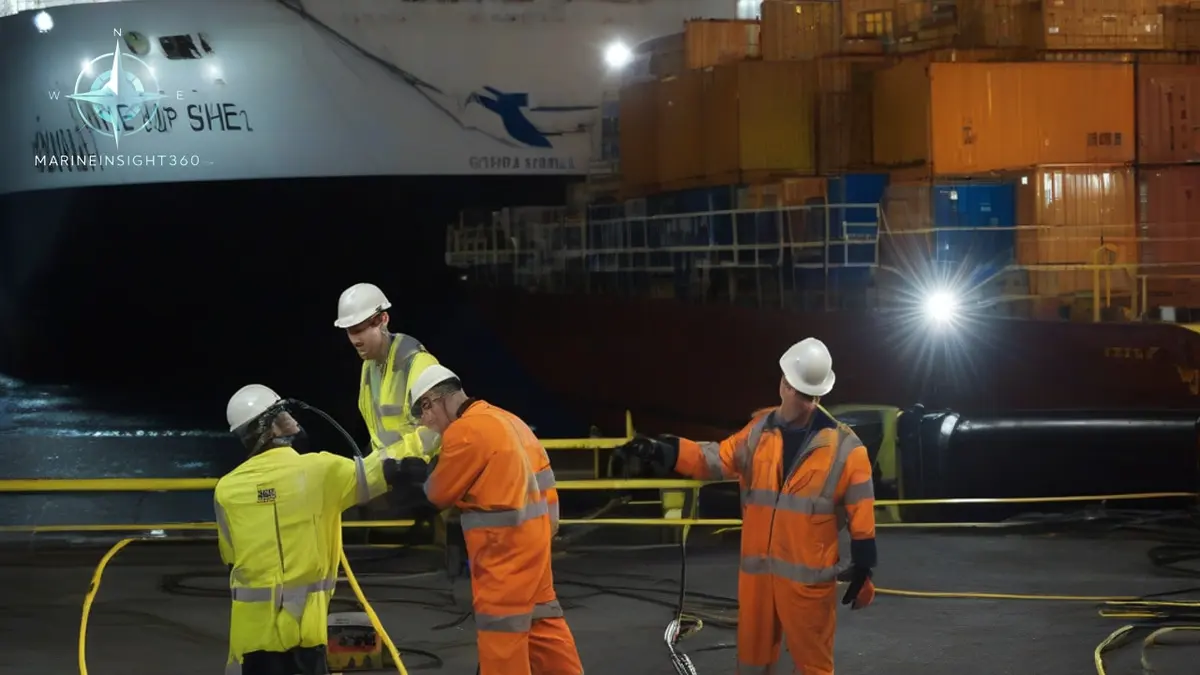
What is cold ironing? It means shutting down a ship's diesel generators while alongside and taking all electrical power from the shore grid instead. The same practice is called onshore power supply (OPS), shore-side electricity, alternative maritime power and high voltage shore connection, and the terms are interchangeable. The name is a leftover from the coal era, when a ship connected to shore services let her iron boilers go cold in port.
The reason it matters is straightforward. A ship alongside still needs several megawatts for hotel load, reefer plugs, ventilation, cargo pumps and cranes, and traditionally she generates that herself by burning fuel oil in auxiliary engines for the whole port stay. Those engines sit inside a city, running for hours or days, producing nitrogen oxides, sulfur oxides, particulate matter, carbon dioxide, noise and vibration exactly where people live.
What a shore connection has to match
Plugging a ship into a grid is not like plugging in an appliance. Three parameters have to line up before any breaker closes.
- Frequency. Ships built to US practice run at 60 Hz, while European grids supply 50 Hz. That mismatch is the single biggest technical obstacle, and it is solved with a shore-side frequency converter, which is expensive equipment that the port has to install and pay for.
- Voltage. High voltage connections are typically made at 6.6 kV or 11 kV, with a transformer on board or ashore stepping down to the ship's distribution voltage. Smaller vessels use low voltage connections at a few hundred volts.
- Power rating. A container ship with a full reefer load can need several megawatts. A large cruise ship can need well over 10 MW. Not every berth can supply that even where a connection exists.
The standards behind the plug
Shore connection is governed by the IEC, IEEE and ISO 80005 series, which is what makes a ship built in one country able to connect in another. Part 1 covers high voltage shore connection systems, part 2 covers data communication for monitoring and control between ship and shore, and part 3 covers low voltage systems. The standards define the connector, the cable management arrangements, the earthing and bonding scheme, the interlocks and the sequence of operations.
That standardization is what turned shore power from a bespoke installation into something a visiting ship can plan for. Without it, every berth would need a ship-specific solution.
How the connection is actually made
The physical work is handled by a cable management system, which may sit on the ship or on the quay. Ship-side systems carry their own cable reel and crane, which suits vessels calling at berths with minimal equipment. Shore-side systems keep the weight and maintenance ashore and suit dedicated terminals.
The sequence follows a fixed pattern. The cable is landed and connected to the ship's shore connection box, protective earth is established first, interlocks confirm the connection is complete and secure before any voltage is applied, and the shore supply is energized. Transfer of load then happens in one of two ways. A brief parallel operation synchronizes the shore supply with the running generators and ramps load across without interruption, which is preferable for vessels with sensitive systems.
Alternatively the ship accepts a short blackout, then restarts on shore power, which is simpler but requires the crew to manage the loss and restoration of essential services.
Disconnection reverses the sequence, and the generators must be running and stable before the shore supply is dropped. Crews consistently report that the risk window is the changeover, not the steady state.
The regulatory push
Cold ironing has moved from voluntary to mandatory in the major regulated markets. In the European Union, the Alternative Fuels Infrastructure Regulation requires ports on the core network to provide shore power for container and passenger ships, while FuelEU Maritime requires those same ship types to connect to shore power when moored for more than two hours at covered EU ports from 1 January 2030, subject to defined exemptions.
California's at-berth regulation already imposes emissions control at berth on several vessel categories calling at Californian ports, and China and other Asian states have introduced their own requirements.
The practical effect is that shore power readiness is now a newbuild specification and a retrofit project rather than an option, and charterers increasingly ask about it directly.
Where cold ironing pays and where it does not
The emissions case at the berth is unambiguous: local air pollution from the ship falls to essentially zero while she is connected. The wider case depends on two things that vary enormously by location.
- Grid carbon intensity. Shore power moves emissions from the quay to the power station. Where the grid is largely renewable or nuclear, total carbon dioxide falls sharply. Where the grid is coal-heavy, the local air quality benefit is real but the climate benefit is small.
- Price. The comparison is the delivered cost of shore electricity, including port tariffs and grid charges, against the cost of marine gas oil burned in an auxiliary engine. Electricity tariffs, demand charges and connection fees decide whether a master is choosing shore power or being required to use it.
Time is the other constraint. Connecting and disconnecting consumes part of the port stay, so short calls can spend a meaningful fraction of the alongside period on the changeover.
What crews should prepare
Before arrival, confirm berth compatibility on voltage, frequency and available power, and exchange the ship and shore compatibility documentation with the terminal. Confirm who supplies and operates the cable. Brief the engine room on the load transfer method, and agree what happens if the shore supply fails during cargo operations, particularly with reefers connected.
The Ports and Shipping section covers terminal infrastructure and port emissions rules, and the Marine Engineering section covers the ship's electrical distribution arrangements that a shore connection has to integrate with.
Approval of the ship side installation runs through class. DNV, Lloyd's Register and ABS each publish rules and class notations for high voltage shore connection equipment. The rules cover the connection box, cable handling gear, earthing and the interlock logic that blocks energizing before the connection is proved. Flag administrations lean on that survey rather than inspecting the plug themselves.
Ashore the obligation is enforced by national authorities rather than by the IMO, and EMSA publishes technical guidance supporting EU implementation. Carry the ship to shore compatibility documents to the berth. A terminal that cannot verify voltage, frequency, earthing and available power will not close the breaker. A ship that arrives expecting to connect then burns fuel alongside anyway.
Sources and further reading
- Plugging into onshore power supply system innovation: standards, patents and port deployment
- Plugging into the future: onshore power supply guidelines
What to read next
Recommended Reading
What is Alternative Marine Power (AMP) or Cold Ironing?
What is Alternative Marine Power (AMP) or Cold Ironing?: ports, trade and shipping-market context for US, UK, Canada, Australia, Singapore and European...
How Big Is a Cruise Ship Propeller? Size, Pods and Power
Large cruise ship propellers run about 6 meters across. Oasis of the Seas uses three 6.1 m Azipod propellers at 20 MW each. What actually sets the size.
Amazon's Offshore Wind Power Deals and the Maritime Work Behind Them
Amazon has contracted most of the output of a German offshore wind farm. What corporate power deals mean for offshore vessels, ports, crews and navigation.