
Why Are Portholes Round? The Structural Reason Behind the Shape
Portholes are round because square corners concentrate stress in a working hull. How side scuttles, deadlights and bridge windows differ, and what fails.
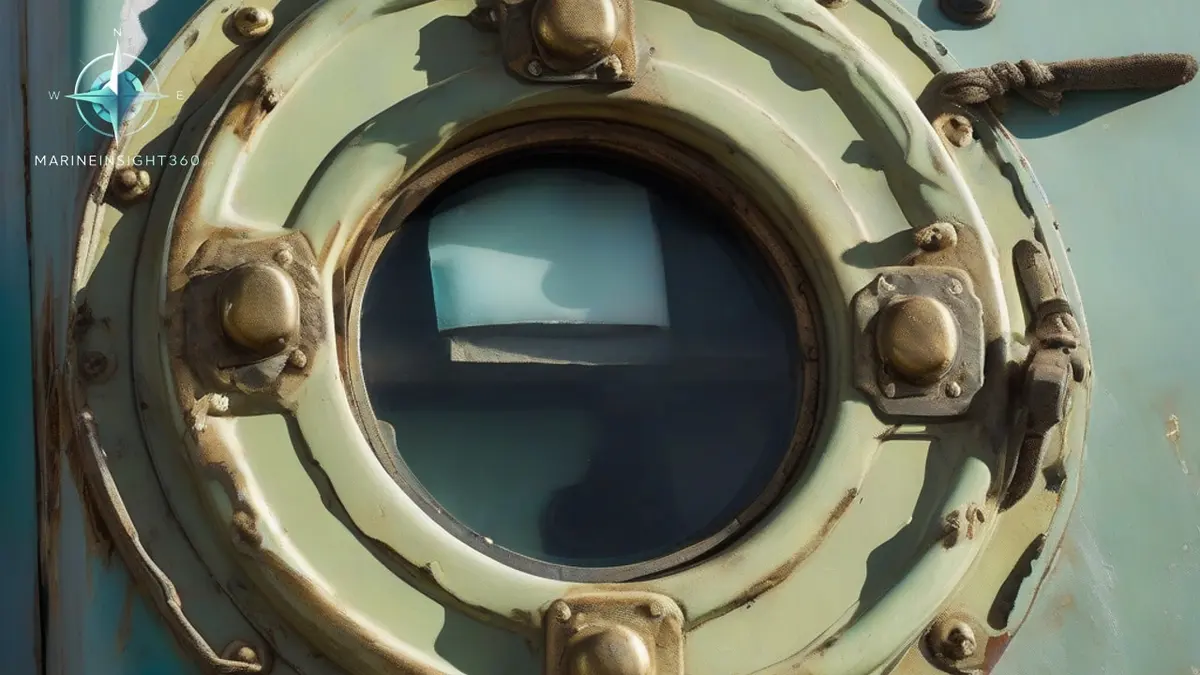
Why are portholes round? A circular opening spreads load evenly around its edge, while a square or rectangular opening concentrates it at the corners. A hull is a working structure that flexes continuously in a seaway, and a sharp corner in a stressed plate is where a fatigue crack starts. Remove the corners and you remove the initiation site. Everything else follows from that first decision: the thick glass, the heavy frame, the closely spaced dogs.
Class rules from Lloyd's Register, DNV and ABS, and the Load Line Convention as the MCA and USCG enforce it, all treat the opening as a regulated side scuttle.
The correct term in the statutory documents is a side scuttle, not a porthole. That matters because side scuttles are regulated openings in a watertight or weathertight boundary, and their design, position and closing arrangements are covered by load line and subdivision requirements rather than left to the shipyard's preference.
How stress concentration works in a hull plate
A ship in waves behaves like a very long beam. It hogs when a crest sits amidships and sags when the crest is at the ends, and the shell plating in the topsides carries tension and compression as that cycle repeats several times a minute for the whole life of the vessel. Cut a hole in that plating and the stress has to flow around it.
Around a circle, the flow is smooth and the peak stress rises by a predictable, modest factor. Around a sharp corner, the flow crowds into a very small radius and the local stress can multiply several times over. A structure that would never fail under a single overload will still crack at a corner after enough cycles. Fatigue does not need an extreme event, only repetition.
The clearest illustration outside shipbuilding is aviation. Early pressurized jet airliners with near-square cabin windows suffered catastrophic fatigue failures that started at the window corners, and the industry moved to rounded window openings as a direct result. The physics is identical to a hull plate cycling in a seaway.
Why round also makes for a better seal
A circular gasket compresses uniformly. Tighten the dogs evenly around a round frame and the sealing pressure is the same at every point on the circumference, which is what keeps a side scuttle weathertight when a boarding sea slams into it.
A rectangular gasket does not behave that way. Corners are the last part to compress and the first to take a permanent set, and the flat runs between clamping points can lift under pressure. Circular geometry also makes the hardware simpler: a single hinged deadlight swings clear on one pivot, and the dogs can be spaced at equal intervals with no awkward corner detail.
What the deadlight is for
The glass in a side scuttle is not the only barrier. Side scuttles below a defined line, and those serving spaces below the freeboard deck, are fitted with hinged internal deadlights: solid steel covers that swing across the opening and dog down independently of the glass.
The deadlight restores the strength and watertightness of the plating when the glass is not needed. In heavy weather, or before entering a lock or a berth where a wash is expected, the deadlights on the lower accommodation are closed and secured. On many ships they are also closed and logged before commencing a ballast or cargo operation that lowers the freeboard.
Where square windows are legitimate, and why
Bridge windows and the windows in upper accommodation blocks are rectangular, and that is not an inconsistency. Those openings are in the superstructure, well above the main hull girder, where the plating carries far lower cyclic stress. The design trade also changes: the bridge team needs an uninterrupted field of view, so the window area is dictated by visibility requirements rather than by structural convenience.
The penalty is paid in the details. Bridge windows use thick toughened or laminated glass in heavy frames, the surrounding structure is locally stiffened, and forward-facing windows on many ships are raked and fitted with wipers, clear-view screens and heating. Bridge front windows are also among the more common heavy weather damage points on ships that take green water forward.
What actually goes wrong with side scuttles on board
- Perished gaskets. Rubber hardens with age, ultraviolet exposure and repeated overtightening. A gasket that has taken a permanent set will not seal no matter how hard the dogs are hove up.
- Painted dogs and hinges. Successive coats of deck paint seize the threads and the hinge pins, so the deadlight cannot be closed quickly in the one situation where speed matters.
- Overtightening. Crews frequently crush gaskets by hammering the dogs. Even pressure all round, hand tight then a quarter turn, seals better than brute force on two dogs.
- Open side scuttles at sea. Cabin scuttles left hooked open on a fine day are a recurring finding, and they are one of the simpler ways for progressive flooding to reach accommodation spaces in an incident.
- Cracked or crazed glass. Toughened glass that has been chipped at the edge is on borrowed time and should be renewed rather than monitored.
What to check on a routine inspection
- Operate every dog and hinge by hand and free anything that has seized before it becomes a deficiency.
- Inspect the gasket for hardening, splits and permanent set, and renew rather than dress it.
- Confirm the deadlights on lower accommodation can be closed and secured by one person without tools.
- Check the surrounding plating for cracks, deformation and wastage, particularly at the frame welds.
- Log closure of scuttles and deadlights before heavy weather, and include them in the pre-departure watertight integrity check.
For more on the shipboard closures that keep watertight integrity intact, work through the Shipboard Operations section on Marine Insight 360.
Sources and further reading
What to read next
Recommended Reading
What Are Portholes? Purpose, Construction and the Rules Behind Ship Side Scuttles
What portholes are, why they are round, how side scuttles are built with toughened glass and deadlights, and the strength grades rules require at sea.

Amazon's Offshore Wind Power Deals and the Maritime Work Behind Them
Amazon has contracted most of the output of a German offshore wind farm. What corporate power deals mean for offshore vessels, ports, crews and navigation.

Are Sea Serpents Real? The Animals Behind Sailors Sightings
No verified sea serpent has ever been documented, but oarfish, giant squid, decaying carcasses and sea mirages explain most sightings. Here is the evidence.