
Are Sea Serpents Real? The Animals Behind Sailors Sightings
No verified sea serpent has ever been documented, but oarfish, giant squid, decaying carcasses and sea mirages explain most sightings. Here is the evidence.
No Verified Sea Serpent Has Ever Been Documented
Are sea serpents real? Not as a distinct species. No specimen, skeleton or verified photograph of a giant marine snake has ever reached a museum, and no described animal matches the classic account of a many humped serpent overhauling a ship. What is real is the set of animals, carcasses and optical effects that have produced those reports for centuries. Several of them are stranger than the legend they inspired.
That distinction matters for anyone standing a bridge watch. Sightings of large unidentified objects at sea are worth recording accurately, because most of them turn out to be either a real animal worth reporting to fisheries scientists or a navigational hazard worth broadcasting.
The Oarfish Accounts for a Large Share of Sightings
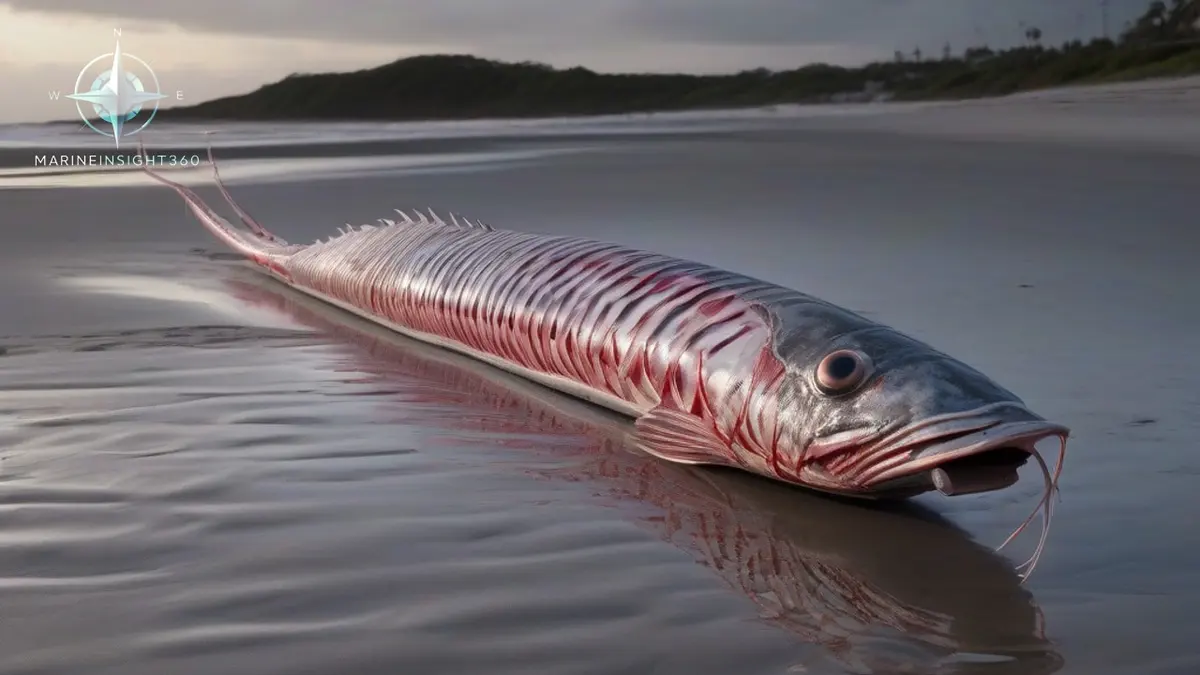
The giant oarfish, Regalecus glesne, is the longest bony fish known. It has a silver ribbon shaped body, a red dorsal fin running its entire length and a crest of elongated rays over the head. It lives in the mesopelagic zone, roughly 200 to 1,000 meters down, across all major ocean basins. Documented specimens exceed 8 meters (26 ft), and NOAA notes lengths well past 20 feet.
The detail that closes the case is its posture. Oarfish swim head up in a near vertical attitude, undulating the dorsal fin rather than the body. A sick or dying oarfish at the surface, partly vertical, silver, ribbon thin and topped with a red crest, matches the classic sea serpent description almost point for point. Because oarfish only reach the surface when they are ill or dying, sightings are rare and memorable, which is exactly the pattern folklore feeds on.
Giant Squid and the Kraken
The giant squid, Architeuthis, reaches around 13 meters (43 ft) in total length including its two long feeding tentacles. It was known only from carcasses and from the sucker scars found on sperm whales until it was first photographed alive in the early 2000s and filmed in its deep water habitat in 2012.
A giant squid at the surface presents eight arms and two much longer tentacles moving independently. Seen from a deck in poor light, that reads as a mass of writhing coils, which is precisely how kraken accounts describe it. The animal exists. The ship sinking behavior does not.
Decomposing Carcasses Make Convincing Monsters
Basking sharks decay in a way that produces a repeatable illusion. The gill arches, the lower jaw and the fins detach early, leaving a small braincase attached to a long stretch of exposed vertebrae with paired remnants that look like flippers. The resulting shape is close enough to an extinct marine reptile that biologists have a standing term for it: the pseudo plesiosaur.
Carcasses of this type have been reported as new species, and later identified from tissue analysis, more than once.
Whale carcasses do something similar. As blubber sloughs off, long trailing strips follow the body and the exposed vertebral column reads as a neck. Anything that has been in the water for weeks stops looking like the animal it was.
What Conditions at Sea Do to Human Judgment
Experienced, sober observers report things that were not there, and the reasons are physical rather than personal.
- No scale reference. With no fixed object on the water, size and distance cannot be separated. A 2 meter object at 40 meters and a 20 meter object at 400 meters subtend the same angle to the eye.
- Superior mirage and looming. A temperature inversion over cold water refracts light and stretches distant objects vertically. A line of dolphins surfacing in sequence, viewed through an inversion, merges into a single humped body.
- Interacting wave trains. A swell crossing a wake or running into a tide rip produces a moving line of regular humps that holds its shape for a surprisingly long time.
- Watch fatigue and expectation. The end of a night watch is where perception is weakest and where a crew already talking about sea monsters is most likely to see one.
What Might Genuinely Still Be Undescribed
Large marine animals are still being confirmed. New beaked whale species have been described within the last decade from strandings and genetic work, and much of the deep ocean has never been surveyed at high resolution. Skepticism about sea serpents is not skepticism about discovery.
The constraint is biological. An air breathing animal large enough to match the reports would need to surface regularly, would strand occasionally like every other large marine vertebrate, and would leave bones on beaches and in fishing gear. None have appeared. A fish or invertebrate of that size would need an enormous prey base to sustain it, and that base would show up in survey data.
What to Do if You See Something You Cannot Identify
Record it properly and the sighting becomes useful instead of anecdotal.
- Fix position and time, and note sea state, visibility, water temperature and whether there is a haze layer over the water.
- Photograph or video it with the horizon in frame, and if possible with a vessel or buoy of known size for scale.
- Note behavior rather than shape: does it blow, does it dive, is the motion vertical like a whale or lateral like a fish, is there a dorsal fin.
- Report it to the national fisheries or marine mammal authority, which usually runs a sightings scheme.
- If the object is solid and afloat, treat it as a hazard. Semi submerged containers, logs and carcasses have holed small craft, and a report through the coast station puts out a navigational warning to other traffic.
An unidentified object report has a formal destination. In US waters the USCG issues a broadcast notice to mariners once a hazard position is confirmed, and in UK waters the report goes to HM Coastguard under the MCA. What fails is the reporting itself: a sighting logged without position, time or scale reference cannot be actioned, and hesitation over what looks like a false alarm is how a genuine person in the water or an upturned hull gets left.
The hazard behind the folklore is more mundane than a serpent. Semi submerged containers, waterlogged timber and large carcasses sit almost awash and return a poor radar echo, and contact with one at speed has holed small craft and damaged rudders and propellers on larger ships. Casualty investigators such as the MAIB and the NTSB have looked at contacts with unidentified floating objects more than once, and the recurring finding is that nobody reported the object beforehand.
Sources and further reading
- The Giant Oarfish - NOAA Fisheries
- Oarfish: harmless fish or deadly sea serpent?
- Mythical creatures: sea serpents - Natural History Museum
What to read next
Recommended Reading
The Devil's Sea: Real Hazards Behind Japan's Dragon Triangle
The Devil's Sea south of Tokyo has a mythical reputation and a real hazard list: submarine volcanoes, the Kuroshio Current, typhoons and pumice rafts.

Amazon's Offshore Wind Power Deals and the Maritime Work Behind Them
Amazon has contracted most of the output of a German offshore wind farm. What corporate power deals mean for offshore vessels, ports, crews and navigation.

The Real Titanic: What Actually Happened and What It Changed at Sea
What the real Titanic was, why her watertight compartments failed, and how the 1912 loss produced SOLAS, lifeboat rules and the Ice Patrol.