
How a Ship's Engine Works: Inside the Marine Two-Stroke
How a ship engine works, from air charge and fuel injection to scavenging, turbocharging and direct drive to the propeller on a slow-speed two-stroke.
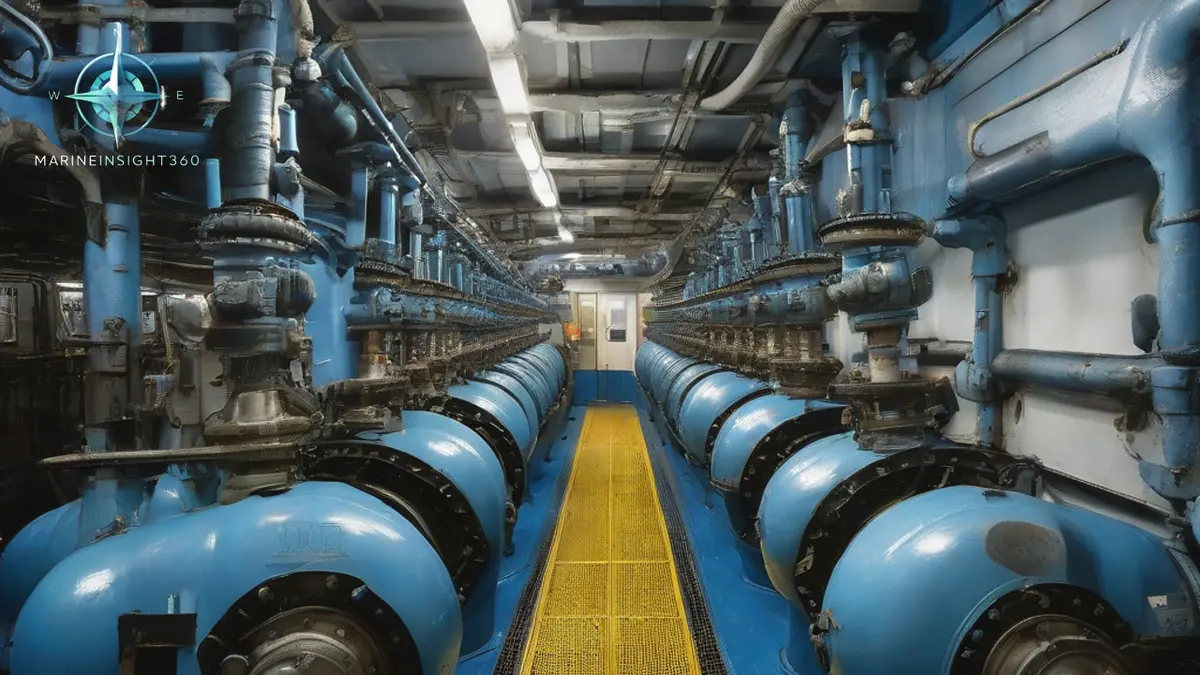
Most merchant ships are driven by a slow-speed two-stroke crosshead diesel. The engine sits on the tank top and couples directly to the propeller shaft. Air is compressed inside the cylinder until it is hot enough to ignite fuel sprayed in near the top of the stroke. The burning gas forces the piston down. Because the cycle completes in one crankshaft revolution, every revolution is a power stroke.
That cycle is how a ship engine works, and the layout is close to universal. Engines of this type, built to MAN and WinGD designs, drive most of the tonnage calling at Rotterdam, Long Beach and Singapore. Class societies such as Lloyd's Register and ClassNK survey them on a fixed cycle.
The direct-drive arrangement has survived because it removes parts. No gearbox, no clutch and no reduction gear sit between the crankshaft and the propeller, so the engine turns at propeller speed and the losses stay low.
One power stroke per revolution
A four-stroke engine spends two full revolutions on intake, compression, power and exhaust. A two-stroke engine folds gas exchange into the bottom of the same stroke. As the piston nears bottom dead center it uncovers scavenge ports cut around the liner. The exhaust valve in the cylinder head is already open, and pressurized air sweeps upward through the cylinder, pushing burnt gas out ahead of it.
That upward sweep is uniflow scavenging, and it is why these engines run a valve in the head rather than exhaust ports in the liner. The piston then rises and the ports and valve close. The trapped charge is compressed to a high enough temperature for compression ignition, fuel is injected, and the cycle repeats.
Turbocharging is where the power comes from
Scavenge air has to arrive above atmospheric pressure or the cylinder cannot be cleared and refilled. Exhaust gas leaving the cylinder drives a turbine. The turbine drives a compressor on the same shaft, which forces fresh air through a charge air cooler and into the scavenge receiver.
Cooling that air matters as much as compressing it. Denser air means more oxygen per stroke, more fuel that can be burnt cleanly, and lower thermal load on the exhaust valve and piston crown. At low load the exhaust energy is too weak to keep the turbocharger spinning fast enough. Electrically driven auxiliary blowers then cut in automatically and shut down once load rises. Hearing them start during maneuvering is normal.
Why the crosshead exists
In a car engine the connecting rod attaches directly to the piston and the rod swings, pressing the piston sideways against the liner. A large marine engine cannot tolerate that side load, and it cannot tolerate combustion products mixing with crankcase oil either.
The crosshead design splits the running gear. A long piston rod runs straight down from the piston through a stuffing box into a guided crosshead, and only below that point does the connecting rod swing. The stuffing box separates the two worlds, which allows two entirely different lubrication regimes:
- Cylinder oil injected into the liner at timed intervals, alkaline so it can neutralize the sulfuric acid formed when fuel sulfur meets combustion moisture.
- System oil circulated to bearings, crosshead guides and piston cooling, kept clean by purifiers and reused.
Feed rate on the cylinder oil is a live operational decision. Too little and the liner scuffs; too much and the cost mounts while deposits build on the piston crown ring land.
Fuel, injection and electronic control
These engines were built to burn heavy fuel oil, a residual product that is nearly solid at room temperature. It has to be settled, purified, then heated to reach the correct injection viscosity before it reaches the pumps. The global sulfur cap tightened to 0.50 percent mass by mass in 2020, with 0.10 percent inside emission control areas. Most ships now run very low sulfur fuel oil or marine gas oil instead.
Many carry dual-fuel engines burning LNG, methanol or ammonia alongside a pilot fuel.
Older engines time injection and exhaust valve opening from a camshaft. Electronically controlled engines replace the camshaft with a high-pressure servo oil system and solenoid valves. Injection timing, injection pressure and valve timing can then be reset by software for each load point. That flexibility is what allows tuning for part-load operation, which matters because slow steaming keeps many ships well below their original design point.
Starting, reversing and stopping
There is no starter motor. Compressed air at around 30 bar is admitted to the cylinders in firing order through starting air valves, turning the engine until it picks up on fuel. Air bottles are sized so a set number of consecutive starts is always available, which is why the chief engineer watches bottle pressure closely during pilotage.
With a fixed pitch propeller, going astern means stopping the engine and restarting it in the opposite direction of rotation. Injection and starting air timing shift accordingly. A controllable pitch installation instead keeps the engine turning ahead and swings the blades, which is faster and easier on the machinery.
Why the engine turns so slowly
Merchant main engines run roughly between 60 and 120 revolutions per minute. That is not a limitation; it is the point. A big, slow propeller is efficient, so the engine is designed to match it directly. Bore sizes on the largest container ship engines reach nearly a meter and outputs exceed 50,000 kW. The bore-to-stroke ratio is so long that the piston travels several meters each cycle.
What the engineer of the watch is actually watching
Routine watchkeeping tracks a short list of indicators that reveal combustion and gas exchange health. Exhaust gas temperature deviation between units comes first, then scavenge air pressure and temperature against load. Cylinder peak pressures and turbocharger revolutions follow. Jacket cooling water and piston cooling outlet temperatures matter, and so does scavenge space condition seen through the inspection doors.
A single unit running hot with normal peak pressure suggests a fuel injector or timing problem. All units running hot with low scavenge pressure suggests a fouled turbocharger or air cooler. Deposits and oil in the scavenge space point to piston ring or stuffing box wear, and they carry a real fire risk. For the machinery downstream of the crankshaft, the Marine Machinery section covers shafting, stern tube systems and propeller matching.
Sources and further reading
- The marine diesel prime mover: the two stroke plant (Dieselduck)
- Propulsion Systems (Oceans Technology Higher Education)
- MAN B&W Two-Stroke Slow-Speed Diesel Engines
What to read next
Recommended Reading
Cashew in the Bunkers: Why Ships in Singapore and Rotterdam Hit Engine Failures
Ships bunkering in Singapore and Rotterdam hit sludging, injector and turbocharger failures traced to cashew nutshell liquid blended into marine fuel.
Cadeler 20MW Wind Turbine Installation Vessel Keel Laid: Inside a Next-Generation WTIV
The keel laying of Cadeler's 20MW wind turbine installation vessel explained: crane capacity, deck area, jack-up limits and what the milestone means.
What Is a Duct Keel? The Pipe Tunnel Inside a Ship's Double Bottom
A duct keel is a watertight pipe tunnel in a ship's double bottom. How it is built, what runs through it, and the enclosed space risks crews must manage.