
How an Engine Room Explosion Sank the Russian Cargo Ship Ursa Major
The Russian ship Ursa Major sank after an engine room explosion. What causes engine explosions at sea, how they sink ships, and the defenses that work.
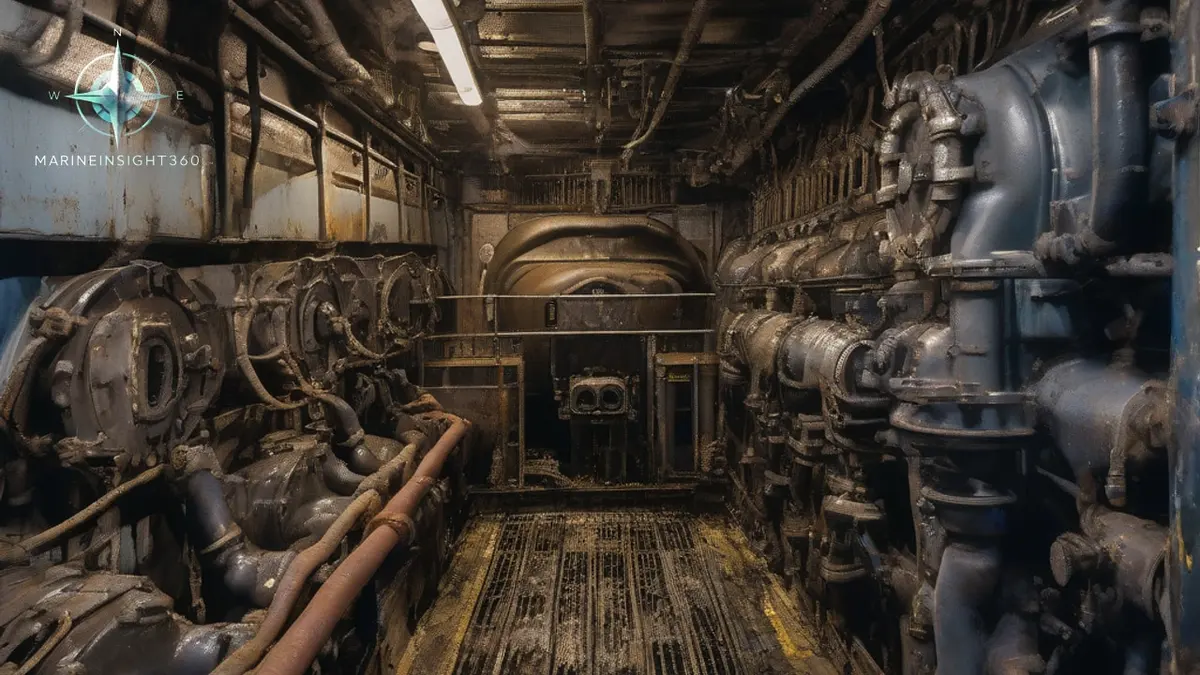
What happened to the Russian ship that sank after an engine explosion
The Russian general cargo ship Ursa Major sank in the Mediterranean between Spain and Algeria in December 2024 after an explosion in the engine room. Spain's Salvamento Maritimo lifted fourteen of the sixteen crew from a lifeboat and landed them ashore, and two were reported missing. A Russian warship later took charge of the scene. When a Russian ship sinks after engine explosion damage, the blast is seldom what puts her under; flooding through a breached machinery space is.
That is why USCG inspectors and Paris MoU port state control officers keep returning to crankcase relief valves, oil mist detectors and watertight boundaries.
The ship had sailed from St Petersburg on 11 December carrying two port cranes of 380 tonnes each. She was routed to Vladivostok. Her owner was SK-Yug, a subsidiary of Oboronlogistika, a company set up under Russia's defense ministry and listed under US and EU sanctions. The interesting question for engineers is not the politics but the mechanism. Why does an explosion in the machinery space so often end with the ship on the bottom?
Why an engine room explosion sinks ships that a fire alone would not
An explosion is a structural event, not just a thermal one. That distinction decides the outcome.
- Overpressure can distort or breach shell plating, seawater piping and sea chest connections. That opens the hull to the sea at the lowest point of the ship.
- The blast usually takes the switchboard or the generators with it. A blackout stops the bilge and fire pumps, the steering gear and the main engine at the moment they are needed most.
- The machinery space is the largest single compartment below the waterline on most cargo ships. Many hulls survive one-compartment flooding, but the engine room is the worst compartment to lose.
- Water building across a wide flat tank top produces a large free surface effect, which erodes stability before the ship has visibly settled.
- Progressive downflooding through vents, cable trunks and doors that cannot be closed against smoke or heat finishes what the initial breach started.
Crews abandon early in these casualties for a rational reason. Without power there is no way to fight the flooding, and the interval between an explosion and a lost ship is often measured in hours.
The three explosion mechanisms engineers actually see
Crankcase explosion
A hot spot, usually a running bearing or a seizing piston skirt, vaporizes lubricating oil. The vapor condenses into a fine white oil mist that is within its explosive range. Ignition gives a primary explosion and the relief valves lift. The real danger follows: if air is drawn back into the crankcase through an open door or a failed valve, the secondary explosion is far more destructive than the first.
That is why crankcase doors are never opened straight after a mist alarm or an abrupt slowdown.
Scavenge and exhaust gas fires
Unburnt fuel, cylinder oil and carbon accumulate in the scavenge spaces of two-stroke engines. The same deposits build in exhaust gas economizer tube nests. Both can ignite, raise pressure and temperature rapidly, and damage adjacent systems. Economizer soot fires are notorious for restarting hours after the crew believe they are out.
Fuel oil spray on a hot surface
Heated fuel escaping from a fractured high pressure pipe or a loosened flange atomizes and finds an exhaust manifold or turbocharger casing. SOLAS requires surfaces above 220 degrees C (428 F) to be insulated or shielded. High pressure fuel lines must be jacketed with a leak alarm, precisely because this sequence has destroyed so many engine rooms.
The defenses that actually prevent the casualty
- Oil mist detectors and bearing temperature monitoring that are proved on test, not silenced because they nuisance-alarm.
- Crankcase relief valves with clean flame arresters and correct spring settings, checked at survey rather than assumed.
- After an oil mist alarm: stop, do not open, and wait until the engine has cooled, typically at least 20 minutes, before approaching the crankcase.
- Jacketed high pressure fuel pipes with functioning leak alarms, and no temporary repairs on a fuel line under any commercial pressure.
- Lagging kept dry, complete and free of oil, and reinstated properly after every job. Oil-soaked insulation is a slow fuse.
- Quick closing valves, remote pump stops and ventilation closures tested on schedule, so a fixed firefighting release is not defeated by an open damper.
- Watertight integrity discipline: shell valves, bilge alarms and the emergency bilge suction known, clear and reachable in the dark.
What the rescue says about abandonment
Fourteen survivors in one lifeboat is a reminder that a blackout abandonment is a drill you either practiced or did not. Davit brakes are gravity operated for this reason. Crews still need to muster, launch and clear the side without deck lighting, without a working PA and with the ship listing. Drilling launch under simulated blackout is worth more than another walk-through in daylight. So is rehearsing the route from the engine room to the muster station in darkness.
Why it matters
Engine room explosions remain one of the few casualty types that can take a sound modern hull to the bottom within hours. Almost every mechanism behind them is detectable before it happens. The maintenance items above belong on the planned maintenance system, not in a post-incident report. Our Marine Machinery section covers crankcase safety and fuel system integrity in more detail.
Sources and further reading
- Russian ship under US sanctions sinks after engine room blast
- Russia says two missing after cargo ship sinks in Mediterranean
- Russian Military Sealift Ship Sinks After Engine Room Explosion
- Russian cargo ship sinks in the Mediterranean, leaving 2 crew missing
What to read next
Recommended Reading
Cargo Barges: Every Major Type and What Each One Carries
The main types of cargo barges, hopper, deck, tank, crane and more, what each carries, and how tug-and-tow economics move bulk freight on inland waterways.
7 Major Types of Cargo Transported Through the Shipping Industry
7 Major Types of Cargo Transported Through the Shipping Industry: ports, trade and shipping-market context for US, UK, Canada, Australia, Singapore and...
Cashew in the Bunkers: Why Ships in Singapore and Rotterdam Hit Engine Failures
Ships bunkering in Singapore and Rotterdam hit sludging, injector and turbocharger failures traced to cashew nutshell liquid blended into marine fuel.