
How Big Is the Largest Submarine Ever Built? Typhoon Class Facts
The Soviet Typhoon class is the largest submarine ever built: 175 m long, 23 m beam, 48,000 tonnes submerged. Why it was that size and what replaced it.
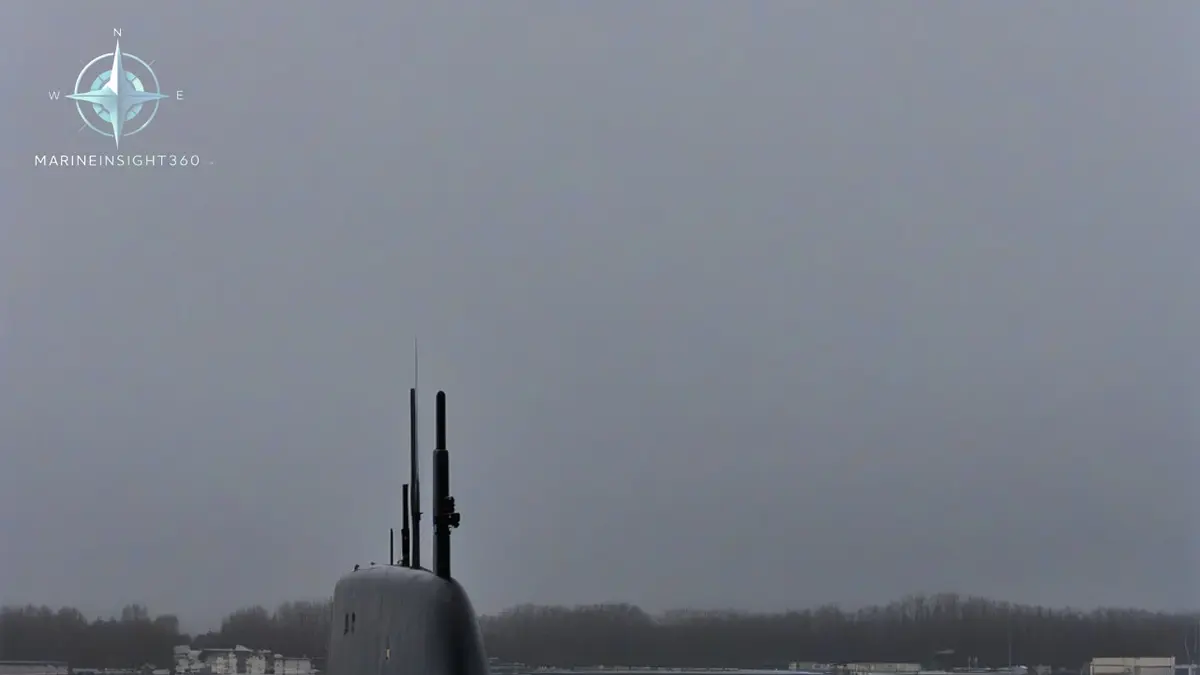
How big is the largest submarine ever built? The record belongs to the Soviet Typhoon class, known in Russian service as Project 941 Akula. Each boat is 175 meters (574 ft) long with a beam of 23 meters (75 ft 6 in) and a draft of 12 meters (39 ft 4 in), displacing 23,200 tonnes on the surface and 48,000 tonnes submerged. Nothing built before or since comes close on displacement.
Six were built between 1976 and 1989, the first commissioning in 1981, they served from 1981 to 2023, and each carried a crew of about 160.
To put 48,000 tonnes submerged in merchant terms, that is comparable to the full-load displacement of a mid-size product tanker, packed into a hull the length of a handysize bulk carrier. The beam is what makes the difference. At 23 meters across, a Typhoon is roughly as wide as a small container feeder ship, and that width is the direct result of how the boat was designed internally.
Why the Typhoon class ended up this large
The size was driven by the missile, not by ambition. The boats were designed around 20 RSM-52 submarine-launched ballistic missiles, a large solid-fuel weapon that needed correspondingly large launch tubes. Rather than mount them abaft the sail in the usual arrangement, the designers placed the missile tubes forward of the sail, in two rows between the hulls.
That layout only works with an unusual structure. Instead of a single pressure hull inside a light outer casing, the Typhoon uses multiple pressure hulls: two long pressure hulls lying parallel, a third smaller pressure hull above them protruding just below the sail, and two further pressure hulls housing torpedoes and steering gear. The whole assembly sits inside one wide outer hull. The catamaran-like arrangement is what produced the beam, and the beam is what produced the displacement.
There were operational benefits. The multi-hull layout provided redundancy and reserve buoyancy, the boats were built to operate under the Arctic ice and to surface through it, and the volume allowed crew facilities that were unusual for a submarine of that era. Soviet crews spent long patrols under ice, and habitability was treated as a mission requirement rather than a luxury.
A naming confusion worth clearing up
Typhoon is the NATO reporting name. The Soviet and Russian designation is Project 941, with the name Akula, meaning shark. Confusingly, NATO separately applied the reporting name Akula to Project 971, a much smaller nuclear attack submarine. A reference to an Akula submarine can therefore mean either the giant missile boat or the attack boat, depending on whose naming system is being used.
How the Typhoon compares with other large submarines
- Typhoon class (Project 941): 175 m long, 23 m beam, 48,000 tonnes submerged.
- Ohio class, United States: about 170 m long and roughly 18,750 tonnes submerged, carrying its missiles in a conventional single-hull arrangement abaft the sail. Longer boats can still displace far less.
- Borei class, Russia: the current Russian ballistic missile submarine, at a similar length to the Ohio but with substantially greater submerged displacement, and still well short of the Typhoon.
The comparison with the Ohio class is the instructive one. The two designs are almost the same length, yet the Typhoon displaces more than twice as much submerged. Length grabs headlines, but submerged displacement is the honest measure of how big a submarine actually is, because it accounts for the full enclosed volume including everything inside the outer casing.
Why nobody builds submarines this big any more
Three reasons, all practical. Missile technology improved, so equivalent range and payload no longer require a weapon the size of the RSM-52. Cost scales brutally with displacement, in construction, in the shore infrastructure needed to support and dock a hull that wide, and in the reactor plant required to move it. And acoustic performance, which is the currency of submarine survivability, does not improve with size.
Support infrastructure deserves particular mention. A 23 meter beam limits which dry docks, basins and approach channels can take the boat, and specialized handling facilities had to exist wherever the class operated. That constraint follows a design through its whole service life.
What happened to the Typhoons
All six boats have left service. The last active unit, Dmitry Donskoy, was decommissioned on 6 February 2023, ending 42 years of Typhoon class operation. In March 2025 it was announced that the boat would be preserved as a museum ship in Saint Petersburg, under the Central Naval Museum, which would make the largest submarine ever built accessible to the public rather than scrapped.
The numbers at a glance
- Length: 175 m (574 ft 2 in)
- Beam: 23 m (75 ft 6 in)
- Draft: 12 m (39 ft 4 in)
- Surfaced displacement: 23,200 tonnes
- Submerged displacement: 48,000 tonnes
- Crew: about 160
- Armament: 20 RSM-52 ballistic missiles plus six torpedo tubes
- Built: six boats, 1976 to 1989; in service 1981 to 2023
For more on submarine structure, pressure hull design and naval architecture, see the Knowledge Base section of Marine Insight 360.
Nothing about a naval submarine is verified by an outside body. The operating navy certifies its own boats, so displacement and depth figures reach the public through defence ministries rather than through survey. Civilian submersibles work the other way: DNV, Lloyd's Register and ABS publish rules for underwater vehicles, and a classed vehicle carries a certificate stating the depth its pressure hull was approved for.
The class was not defeated by any structural fault. Its missiles ran out first, because production of the RSM-52 ended and the remaining rounds reached the end of their certified life, leaving hulls with nothing to carry. The 23 meter beam then limited which docks could take them, and the boats sat alongside for years awaiting defueling while corrosion did the rest.
Sources and further reading
- Typhoon-class submarine - Wikipedia
- Unveiling the World's Biggest Submarines and Their Secrets - Naval Technology
- How Large Is The Typhoon Class Submarine - Covert Shores
What to read next
Recommended Reading
Typhoon Class Submarine: The Biggest Boats Ever Sent Under the Sea
The Soviet Typhoon class submarine remains the largest ever built: twin pressure hulls, 20 missile silos, and why nothing since has matched its size.
Largest Submarine: Typhoon Class
Find the exact size, displacement and fate of the Typhoon‑class, the world’s largest submarine, and see how it stacks up against US Ohio and other classes.
Who Owns the Seawise Giant? The Full Ownership History of the Largest Ship Ever Built
The Seawise Giant was scrapped in 2010, so no one owns her today. Trace every owner of the largest ship ever built, from C.Y. Tung to her final voyage.