
How Do Ship Stabilizers Work? Fins, Tanks, Gyros and Bilge Keels
How do ship stabilizers work? Active fins, anti-roll tanks, gyros, bilge keels and rudder roll damping, and the trade-offs behind each choice.
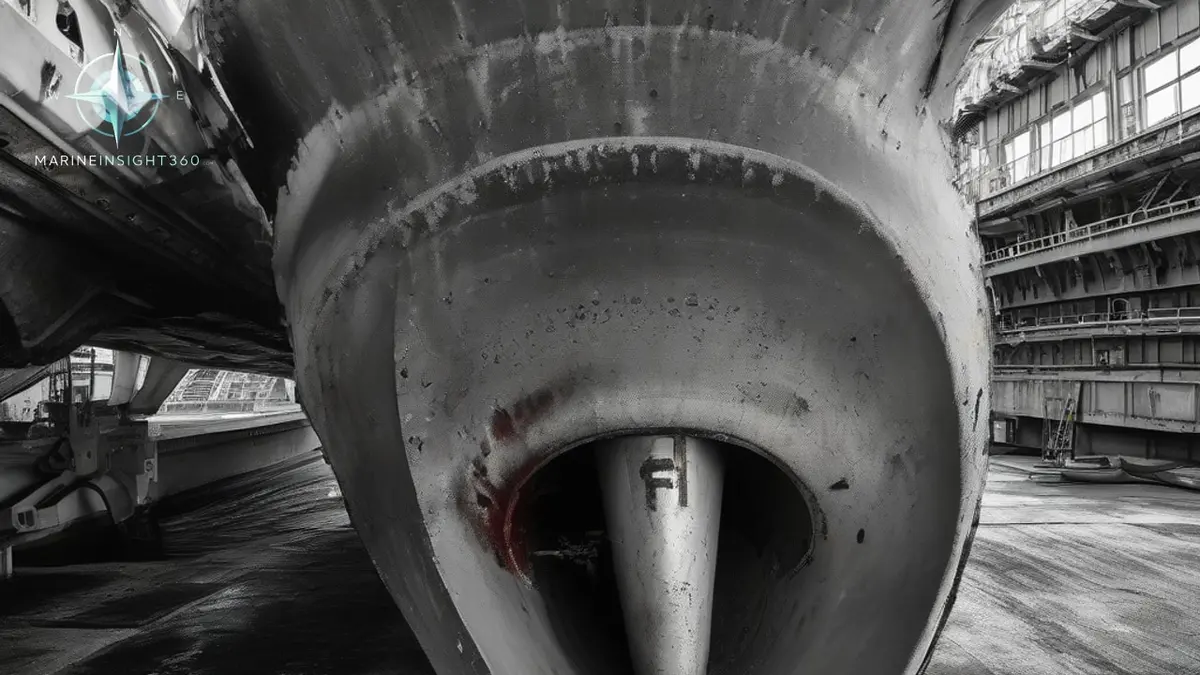
How do ship stabilizers work? Every system creates a force that opposes the roll the sea imposes on the hull. Active fin stabilizers use hydrodynamic lift from small underwater wings. Anti-roll tanks move water across the ship out of phase with the roll. Gyroscopic units resist roll with a spinning flywheel. Fins are the most effective at sea speed. Tanks, gyros and bilge keels keep working when the ship is stopped.
On MCA, USCG and AMSA certificated passenger ships, roll performance also decides whether a scheduled sailing goes at all.
Roll is the motion that costs money. It parts lashings, injures crew, ruins passenger comfort, forces speed reductions and pushes deck stows toward their design limits. Every stabilization system attacks the same problem: taking energy out of the roll cycle faster than the waves put it in.
How active fin stabilizers generate a righting moment
A fin is mounted low on each side of the hull, usually near the turn of the bilge close to midships. Each fin is a short, stubby wing driven by a hydraulic actuator. Sensors read roll angle and roll rate many times a second, and the controller sets each fin to a different angle of attack.
Because the ship has headway, water flowing past the angled fin produces lift. One fin is pushed up, the other down, and the pair creates a moment about the ship's longitudinal axis that opposes the roll. Good control laws work primarily on roll rate rather than roll angle. That makes the force lead the motion and damp it, instead of arriving late and fighting it.
Why fins lose authority at low speed
Fin lift rises roughly with the square of speed through the water. Halve the speed and the available roll moment falls to about a quarter of what it was. At anchor or drifting, a conventional fin produces almost nothing. Zero-speed fin systems get around this by flapping the fin, generating force from the fin's own motion rather than from the ship's headway.
Control of zero-speed fins has been an active research subject, and the systems are now common on yachts and offshore support vessels that need stability while stationary.
Anti-roll tanks: buying damping with moving water
A passive anti-roll tank is a partly filled tank, or a pair of wing tanks joined by a duct, tuned so the water sloshes at close to the ship's natural roll period. Tuning matters more than volume. The aim is for the water mass to arrive on the high side about a quarter of a cycle behind the roll, so the shifting weight always opposes the motion.
Passive U-tube tanks need no power and have no moving parts, which is why they appear on research vessels, ferries and naval ships. Controlled tanks add air valves or pumps so transfer can be timed or switched off. The penalties are real: the tank occupies volume that could carry cargo or fuel, and its free surface reduces effective metacentric height.
Bilge keels and gyroscopic stabilizers
Bilge keels are the cheapest roll damping fitted to any ship. They are long, narrow plates welded along the turn of the bilge over a substantial part of the ship's length. As the hull rolls, the keels shed vortices and drag water with them, turning roll energy into turbulence. They cost nothing to run and cannot fail, but they add appendage resistance and cannot be tuned or switched off.
Gyroscopic stabilizers use a heavy flywheel spinning inside a gimballed frame. When the vessel rolls, the gyro precesses and the reaction torque opposes the roll. Gyros work at zero speed, add no hull appendages and cannot be damaged alongside. Against that, they draw serious electrical power, need time to spin up, and their mass grows quickly with vessel size. That limits them mainly to yachts, patrol craft and smaller workboats.
Rudder roll damping and combined systems
A rudder mounted below the roll axis produces a heeling moment as well as a turning moment. Rudder roll stabilization exploits this by superimposing small, fast rudder movements on the steering order. It needs no new hardware beyond adequate steering gear capacity and control software. The limits are steering gear rate, added drag and unwanted yaw, so it is normally blended with fins rather than used on its own.
What stabilizers cost the operator
- Fuel. Retractable fins tuck into a hull box; non-retractable fins add resistance permanently, every mile of every voyage.
- Space and deadweight. Anti-roll tanks take usable volume, and fin boxes intrude into machinery or tank spaces.
- Maintenance. Fin shaft seals, hydraulic power packs and bearings are drydock items. A leaking fin seal is a hull penetration, not a nuisance job.
- Damage exposure. Deployed fins are vulnerable alongside, in locks, in ice and when tugs work close to the hull. Retraction discipline matters more than the hardware.
What bridge teams should watch
Stabilizers reduce roll; they do not replace seamanship. A well-tuned fin system can mask a developing stability problem by smoothing the slow, heavy roll that would otherwise warn the bridge that GM has fallen. In following and quartering seas, parametric roll can build far faster than any stabilizer responds, and the correct answer is a change of course or speed rather than more fin angle.
Two practical habits are worth enforcing. Confirm fins are housed before pilotage, canal transits and berthing. And check that the control system reverts to a defined safe state on loss of hydraulic pressure or power, rather than leaving a fin hard over.
For related hull and machinery topics, the Marine Machinery and Shipboard Operations sections of Marine Insight 360 cover the systems that keep these installations reliable at sea.
Sources and further reading
- Stabilizer (ship)
- Gyroscopic stabilizer
- Experimental study on the control form of fin stabilizer at zero speed
What to read next
Recommended Reading
The Bilge on a Ship: What Collects There and How It Is Managed
What the bilge is, how bilge water collects and is pumped, and the MARPOL Annex I rules on oily water separators and the 15 ppm discharge limit.
What Is the Bottom of a Ship Called? Keel, Bilge and Bottom Plating Explained
What is the bottom of a ship called? Keel, bilge, bottom plating, double bottoms and bilge keels explained in plain terms for working mariners.
Sounding on Ships: How Crews Measure Tanks and the Sea Floor
Sounding means measuring depth: of liquid in a ship's tanks with a tape, or of water under the keel with an echo sounder. How both work and why they matter.