
How Red Sea Cargo Diversions Squeeze the Holiday Shipping Season
Red Sea cargo diversions add 10 to 14 days to Asia-Europe voyages. How the Cape reroute reshapes peak season capacity, cost and shipboard operations.
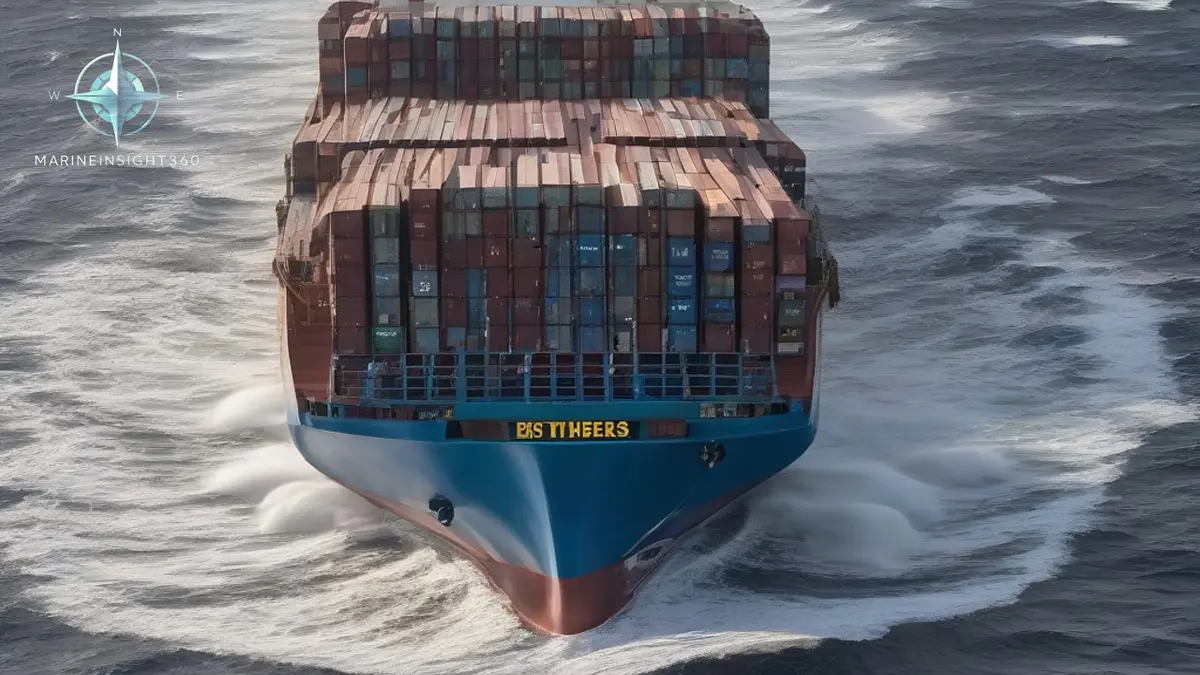
The question of whether Red Sea cargo diversions could affect 2024 holiday shipping was settled by arithmetic, not forecasting. Routing around the Cape of Good Hope instead of transiting the Suez Canal adds roughly 10 to 14 days to the Asia to Europe voyage. The same fleet therefore delivers fewer boxes per year, and capacity that exists on paper stays locked up at sea.
For a European or North American retailer ordering Christmas stock, the order cut-off moves forward by about two weeks, and the freight bill rises before a single container is late.
The diversions followed attacks on merchant shipping in the southern Red Sea and the Bab el-Mandeb strait, which pushed most major container lines and many tanker owners onto the longer route. The Red Sea corridor normally carries a substantial share of Asia to Europe container traffic, so taking it out of the network is not a marginal scheduling adjustment.
How much time the Cape route actually adds
The penalty varies by trade lane. The U.S. Energy Information Administration compared a Persian Gulf to Amsterdam-Rotterdam-Antwerp voyage at about 19 days via Suez against close to 35 days via the Cape of Good Hope. On the main Asia to North Europe container loops, published estimates cluster around 10 to 14 additional days, or roughly a 30 percent increase in transit time.
That time has to come from somewhere. A carrier either accepts a longer round trip and a less frequent service, or adds ships to keep weekly sailings intact. Most chose to add ships, which is why analysts have put the capacity absorbed by the longer routing at close to 9 percent of the effective global container fleet.
Why a peak season is more fragile than an average month
Peak season compresses a year of retail risk into about ten weeks of sailings. Three things break at once when transit times stretch.
- The booking window closes early. Goods that would normally have sailed in late September must now leave in early September to make a pre-holiday shelf date.
- Rolled cargo compounds. When a sailing is full, containers roll to the next one. On a weekly loop with an extra fortnight of transit, a single roll can miss the season entirely.
- Buffer stock disappears. Inventory strategies built around predictable Suez transits leave no slack for a two-week shift, so shippers pay for premium services or air freight to close the gap.
The knock-on hits trades that never touch the Red Sea. Vessels redeployed to cover Asia to Europe come out of other loops, so Transpacific and Latin American services feel the tightness too.
The cost stack behind the freight quote
Rate increases during the diversions came from several separate lines, not one surcharge. Published analysis has put the added cost of the Cape routing in the region of 200 to 400 US dollars per twenty-foot equivalent unit in normal conditions, with peak-period figures quoted as high as 1,000 dollars per unit once scarcity was priced in.
- Bunkers. A longer voyage burns more fuel, and carriers often raise service speed to defend the schedule, which raises consumption disproportionately.
- Suez canal dues avoided. A genuine saving, but far smaller than the added fuel and charter cost.
- Charter hire. Extra ships to maintain weekly frequency have to be chartered in, tightening the charter market and raising rates for everyone.
- Working capital. Two extra weeks of cargo at sea is two extra weeks of capital tied up in inventory, a cost carried by the shipper rather than the carrier.
- War risk and crew. Vessels still transiting the high risk area pay war risk premiums and additional crew compensation.
What the diversion changes on board
The Cape route is a genuinely different voyage, not just a longer one. Masters and superintendents planning around it deal with several practical shifts.
Bunkering strategy moves to Durban, Algoa Bay, Walvis Bay, Mauritius or Las Palmas, and those ports get congested when the whole trade reroutes at once. Weather planning becomes serious: the Agulhas Current runs southwest along South Africa's east coast, and where it meets a strong southwesterly swell it can generate abnormally steep seas off the Wild Coast. Routing advice for that stretch is not optional.
Crew changes need rethinking, because the ports that suited a Suez rotation are no longer on the track and contract expiry dates start landing mid-ocean. Provisioning, spares delivery and stores planning all stretch to match the longer leg. Lashing checks matter more, since a heavier motion regime over a longer period is exactly the condition in which container stacks fail.
Reading the next disruption early
Diversions are a network decision, and the signals appear before the rate does. Watch daily Suez transit counts, carrier network and blank sailing announcements, war risk premium movements from the London market, and schedule reliability figures for the affected loops. Shippers who track those and pull their order deadlines forward keep their season. Those who wait for a rate announcement are already two weeks behind.
The routing decision leaves a paper trail. Masters transiting the region report their movements to UKMTO, which runs the voluntary reporting scheme for the area and issues the incident advisories owners weigh against a Cape routing. The listed areas that drive war risk premiums are maintained by the Joint War Committee of the London insurance market, so an underwriter's revision moves the cost of the Suez option before any carrier announces anything.
On board, the diversion is documented as much as sailed. Flag administrations and the ship's insurers expect the passage plan, the security level in force and the reporting messages to be logged, because a war risk deviation is argued from that record. Where the charter party carries a war risk clause, the right to deviate and the party paying the added premium are settled by the clause, not by the advisory.
Sources and further reading
- Red Sea attacks increase shipping times and freight rates (U.S. Energy Information Administration)
- The Impacts of the Red Sea Shipping Crisis (J.P. Morgan Global Research)
- The Red Sea Crisis: Impacts on global shipping (International Transport Forum, OECD)
- Weight of Freight: Red Sea diversions resume (Argus Media)
What to read next
Recommended Reading
Great Lakes Shipping Companies: Who Moves Cargo on the Lakes
Who the Great Lakes shipping companies are, what lakers carry, how the Soo Locks and the nine-month season shape operations, and what the jobs are like.

What Are Shipping Manifests? The Ship's Master Cargo Record
What shipping manifests are, what they list, how they differ from bills of lading, and the advance filing rules such as the US 24-hour rule and EU ENS.
What Is CDC in Shipping? Certain Dangerous Cargo Explained
CDC in shipping means Certain Dangerous Cargo under US Coast Guard rules. What is on the list, the notice of arrival duties, and how it changes a port call.