
Iran's Strait of Hormuz Maritime Zone Claim and What It Means for Shipping
Iran claims regulatory control over the Strait of Hormuz. Here is what transit passage law says, how traffic has collapsed, and what masters should do.
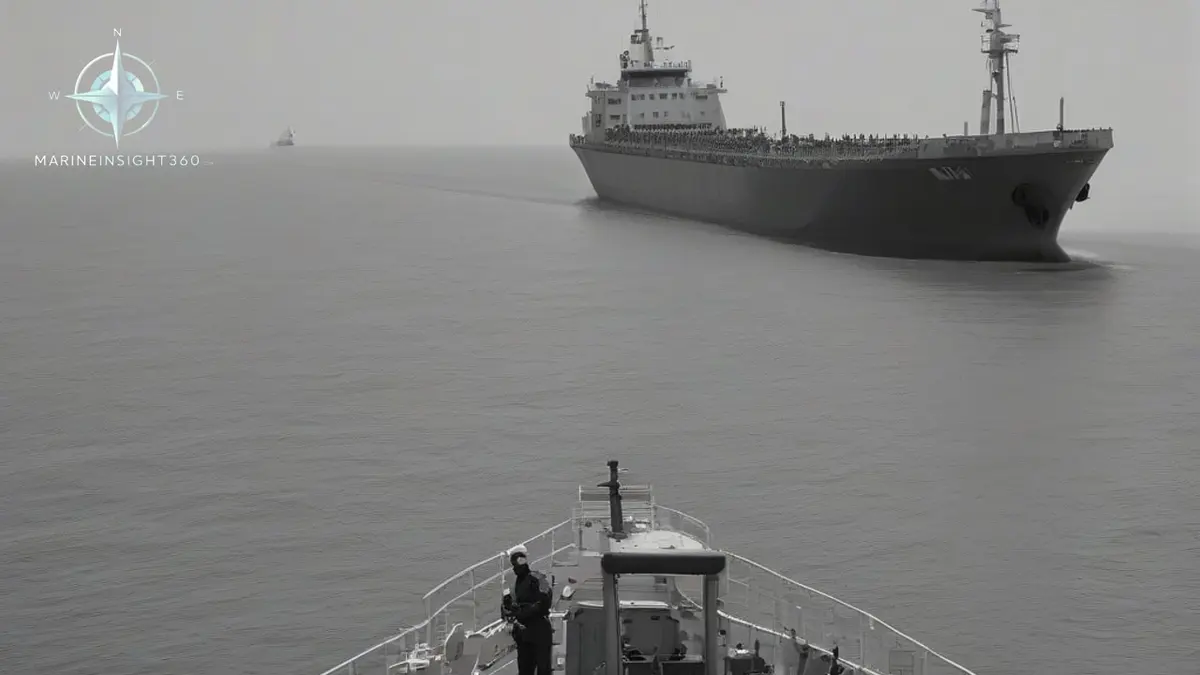
Iran's Strait of Hormuz claim does not remove the right of merchant ships to pass. It is presented as a new maritime zone carrying regulatory control over transits. Hormuz is an international strait. The transit passage regime that applies there cannot be suspended or impeded by the states on either shore. What Iran asserts is a narrower version of that right. It is enforced by naval units and routed through a traffic scheme of its own drawing.
The gap between the claim and the convention is the operating problem. Owners and masters are being asked to satisfy two authorities at once: a flag state that follows transit passage, and a coastal state issuing instructions on VHF with armed craft in company. The traffic figures show how the market has answered that question so far.
Why the two legal positions do not meet
The Strait of Hormuz satisfies the test for an international strait because it links one exclusive economic zone to another and is used for international navigation. In that situation the law of the sea grants transit passage, a continuous and expeditious right of passage in the normal mode of operation that the coastal state may not suspend, even in wartime. Ships must proceed without delay and refrain from any threat or use of force against the bordering states.
Iran signed the UN Convention on the Law of the Sea but never ratified it. On signing, Iran declared that it would extend transit passage only to states that had themselves ratified the convention, and would apply the older 1958 Geneva Convention on the Territorial Sea and Contiguous Zone to everyone else.
That older instrument supports innocent passage, which is a weaker right: it can be suspended temporarily, and Iran reads it as requiring foreign warships to coordinate access with its authorities.
The United States is also not a party to the 1982 convention, but treats transit passage through international straits as customary international law binding on all states. Most flag administrations in Europe, Asia and the Commonwealth take the same view. A merchant master therefore sails under one legal reading while the patrol craft alongside operates under another.
The traffic separation scheme sits in Omani water
This is the detail that turns a legal argument into a navigational one. The traffic separation scheme recognized by the International Maritime Organization and printed on the charts lies inside Omani territorial water, on the southern side of the strait. Iran has promoted an alternative routing scheme lying wholly in Iranian water, and has stated that it has mined parts of the strait.
A ship that follows the charted scheme is doing what the chart, the passage plan and the collision regulations expect. A ship that accepts an instruction to shift into an Iranian scheme has left the internationally recognized route, may fall outside the terms of its war risk cover, and has no charted assurance about what is in the water.
Neither option is free of consequence, which is why the decision belongs to the owner and the flag state rather than to a bridge team under challenge at 0300.
How shipping has voted with its keel
Transit volumes give the clearest picture of confidence. Before the strikes on Iran, roughly 130 ships a day used the strait. CNBC reported in August 2026 that the five-day average had fallen to around 13 transits, close to 90 percent below the pre-conflict norm and near a three-month low. Inbound movements have fallen hardest, which is the signal that matters: owners are declining new fixtures into the Gulf rather than simply clearing ships already inside.
Lloyd's List Intelligence has tracked a parallel shift in behavior, with close to 70 percent of observed tanker transits made dark, up from 55 percent the week before and 42 percent two weeks earlier. Producers have adjusted around the chokepoint as well, with Saudi Arabia pushing volume through the Yanbu terminal on the Red Sea coast to bypass Hormuz entirely.
What owners and masters should settle before the voyage
The mistake is treating this as a bridge problem. It is a chartering, insurance and flag state problem that lands on the bridge.
- Get the flag state position in writing. Ask the administration directly what it expects if the ship is ordered to alter into Iranian water, and carry the answer on board.
- Check the war risk clauses before fixing. Confirm the listed areas, the notice period for additional premium, and whether an ordered deviation affects cover.
- Brief the crew on the difference between a challenge and an attack. A radio challenge is answered and logged. Weapons fired without challenge is a security incident that goes straight to the reporting chain.
- Log everything. Times, positions, VHF channel, exact wording, craft descriptions. War risk claims, charterparty disputes and flag state inquiries all turn on the deck log and the bell book.
- Decide the AIS policy ashore. Switching off AIS is a security judgment with regulatory and insurance consequences, and it should be a company instruction rather than an officer's improvisation.
For crews joining ships trading east of Suez, the practical next step is to read the current company transit orders alongside the flag state circular before signing on, and to raise any conflict between the two with the Designated Person Ashore before the ship approaches the strait.
Two bodies give a master something concrete. UKMTO runs the voluntary reporting scheme covering the Gulf of Oman and the approaches to the strait. A registered transit is what lets a coalition warship respond to a distress call. The IMO adopted the traffic separation scheme printed on the chart, and it stays the recognized route until the IMO amends it.
MARAD issues numbered maritime advisories for the Gulf and the Gulf of Oman. They state what United States flag operators are expected to do, and they name the threat, the geography and the reporting contacts. Read alongside the UKMTO advisory notes, they give a company something firm to attach to a written transit order instead of a verbal instruction.
Sources and further reading
- Transit Passage Rights in the Strait of Hormuz (American Society of International Law)
- The Strait of Hormuz, shipping, and law (Chatham House)
- Legal and Operational Issues in the Strait of Hormuz: Transit Passage Under Fire (Just Security)
- Strait of Hormuz ship traffic near three-month low (CNBC)
What to read next
Recommended Reading
Iran Imposes New Shipping Rules in the Strait of Hormuz: What Transit Now Requires
Iran now demands 48 hours notice, insurance proof and a 40 question form to transit the Strait of Hormuz. How the rules clash with UNCLOS transit passage.
Iran's New Strait of Hormuz Rules: What Transiting Ships Now Face
Iran now wants transit requests 48 hours ahead plus a 40 question ownership and cargo form for Strait of Hormuz passage. What operators and masters must weigh.
Strait of Hormuz Blockade: What Closure Really Means for Merchant Ships
How a blockade of the Strait of Hormuz actually stops merchant traffic: war risk insurance, UKMTO reporting, AIS decisions and the pipelines that bypass it.