
MAN B&W ME Engines: How Electronically Controlled Two-Stroke Engines Work
How MAN B&W ME engines work: hydraulic power supply, HCU and FIVA valve, engine control units, ME-C, ME-B and ME-GI variants, and common faults.
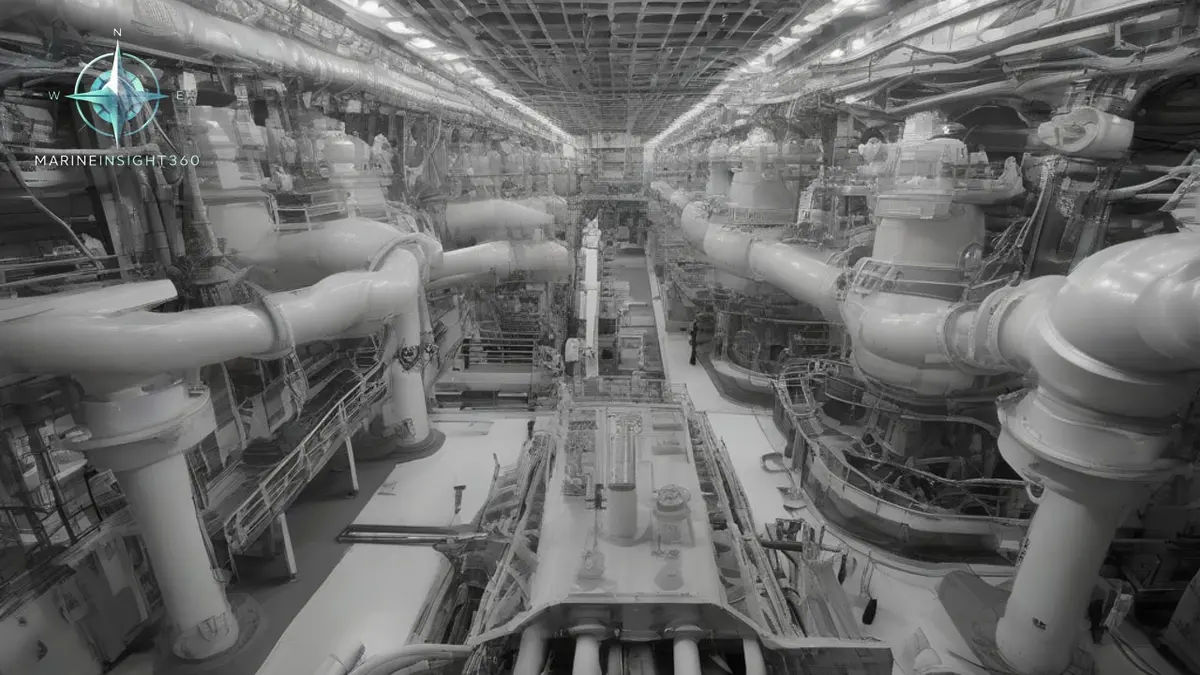
An ME engine is MAN Energy Solutions' electronically controlled two-stroke marine diesel engine. It does the same job as the older MC engine, driving the propeller directly at low speed, but it has no camshaft for fuel injection. Instead, a computer decides when and how much fuel each cylinder gets and when each exhaust valve opens, and hydraulic oil at high pressure carries out those decisions.
This guide explains how the system is built, the main ME variants, what it changes for engineers on board, and the faults that come up most often.
ME versus MC: what changed
| MC / MC-C (mechanical) | ME-C (electronic) | |
|---|---|---|
| Fuel injection timing | Fixed by cam profile; adjusted by VIT and mechanical settings | Set electronically for every cycle; can change with load and running mode |
| Exhaust valve | Cam-driven hydraulic push rod | Hydraulically actuated, timing set electronically |
| Fuel pump | Cam-driven jerk pump per cylinder | Hydraulic fuel booster per cylinder |
| Starting air distributor | Mechanical | Electronically controlled starting valves |
| Cylinder lubrication | Mechanical or Alpha lubricator | Alpha lubricator, electronically controlled |
The gain is flexibility. Because injection and valve timing are no longer fixed by a cam, the engine can be optimised for fuel economy at part load, switched to a lower-NOx emission mode, and run more steadily at very low speed.
The main parts of the system
Hydraulic power supply (HPS)
Servo oil, taken from the main lubricating oil system and finely filtered, is pressurised by engine-driven and, on many engines, electrically driven pumps. Electric pumps build pressure before starting; engine-driven pumps take over once the engine is running. The oil is supplied at high pressure to every cylinder; the working pressure is set by the engine maker and given in the instruction manual.
Hydraulic cylinder unit (HCU)
Each cylinder has an HCU mounted on a common rail. It contains accumulators that smooth the pressure, the fuel booster that raises fuel to injection pressure, and the exhaust valve actuator. On current engines, a single FIVA valve (fuel injection valve actuation) controls both fuel injection and exhaust valve movement; earlier engines used two separate valves, ELFI for fuel and ELVA for the exhaust valve.
Engine control system (ECS)
The ECS is a network of identical multipurpose controllers, each loaded with software for its role:
- Engine interface control unit (EICU): the link to the bridge, the engine control room and the remote control system.
- Engine control units (ECU): run the engine-level functions such as speed control and running modes; there are two for redundancy.
- Cylinder control units (CCU): one per cylinder, firing the FIVA valve, the starting valve and the lubricator.
- Auxiliary control units (ACU): control the hydraulic pumps and auxiliary blowers.
Crank-angle sensors (the tacho system) tell the controllers the exact position of each piston, so injection and valve timing can be calculated every revolution.
Main operating panel (MOP)
The engineer's window into the ECS: a touch-screen in the engine control room, with a back-up, used to change running modes, view alarms, check cylinder data and cut cylinders in or out.
ME variants
- ME-C: the fully electronic version, with both fuel injection and exhaust valve under hydraulic control.
- ME-B: used on smaller-bore engines. Fuel injection is electronic, but a small camshaft is kept to work the exhaust valves, which makes the engine simpler and cheaper.
- ME-GI: a dual-fuel engine that injects natural gas at high pressure as well as running on oil, used on LNG carriers and container ships.
- ME-LGI: dual-fuel engines for liquid gas fuels such as methanol (LGIM) and LPG (LGIP).
- ME-GA: a newer dual-fuel version that admits gas at low pressure and burns it on the Otto cycle.
What it changes for the engine room
- Servo oil cleanliness is critical. The FIVA and booster valves have very fine clearances. Keep the fine filters in good order, watch the differential pressure, and treat lube oil contamination as an engine-control risk, not only a bearing risk.
- Accumulators need checking. Nitrogen pre-charge in the HCU accumulators drops over time; low pre-charge shows up as pressure fluctuation and alarms.
- Sensors become critical parts. A faulty tacho signal or pressure sensor can stop a cylinder or the engine. Carry spares and know the change-over procedure.
- Software is part of the engine. Parameter changes and software updates are controlled by the maker; record any change and never alter settings without authority.
- Running modes affect compliance. Economy and emission modes trade fuel use against NOx. Make sure the mode in use matches the ship's NOx Technical File and the area it is in.
Common faults
| Symptom | Common causes |
|---|---|
| Low hydraulic pressure alarm | Pump failure or wear, blocked filter, leaking HCU, low accumulator pre-charge |
| Cylinder cut out automatically | FIVA or ELFI fault, feedback sensor fault, CCU failure, leakage alarm |
| Engine will not start from bridge | Control-location mismatch, interlocks, tacho fault, starting air pressure |
| Uneven cylinder pressures | Fuel valve condition, booster wear, timing offsets after a sensor change |
Always follow the maker's instruction manual and troubleshooting tables for the specific engine; they differ between generations.
Frequently asked questions
What does ME stand for in MAN engines?
MAN uses "ME" for its electronically controlled two-stroke engines, as opposed to "MC" for the mechanically controlled camshaft engines. The letters after the bore and stroke in the engine designation (for example, 6G70ME-C) show the version.
Can an ME engine run if the control system fails?
The system is built with redundancy: two ECUs, duplicated networks and several hydraulic pumps. A failed CCU normally stops only its own cylinder, and the engine can run with that cylinder cut out at reduced load.
Is an ME engine more efficient than an MC engine?
Generally yes, mainly at part load, because injection and valve timing can be optimised across the load range rather than set for one design point.
Related guides
Recommended Reading
Exhaust Manifold on Marine Engines: What It Does and How It Fails
What the exhaust manifold does on a marine engine, wet versus dry designs, why raw-water cooling corrodes them, and the failures crews learn to catch early.
Guide to Dual Fuel Marine Engines and Their Benefits
Dual fuel marine engines have emerged as a promising solution to the growing demand for cleaner, more efficient, cost-effective propulsion systems in the maritime industry.
How Do Ship's Engines Work?
Ship engines are responsible for propelling ships from one port to another.