
What Are The Common Types of Valves on Ships?
Many people might be surprised at the sheer number of different types of valves used on ships. Without the right type, a ship cannot operate efficiently.
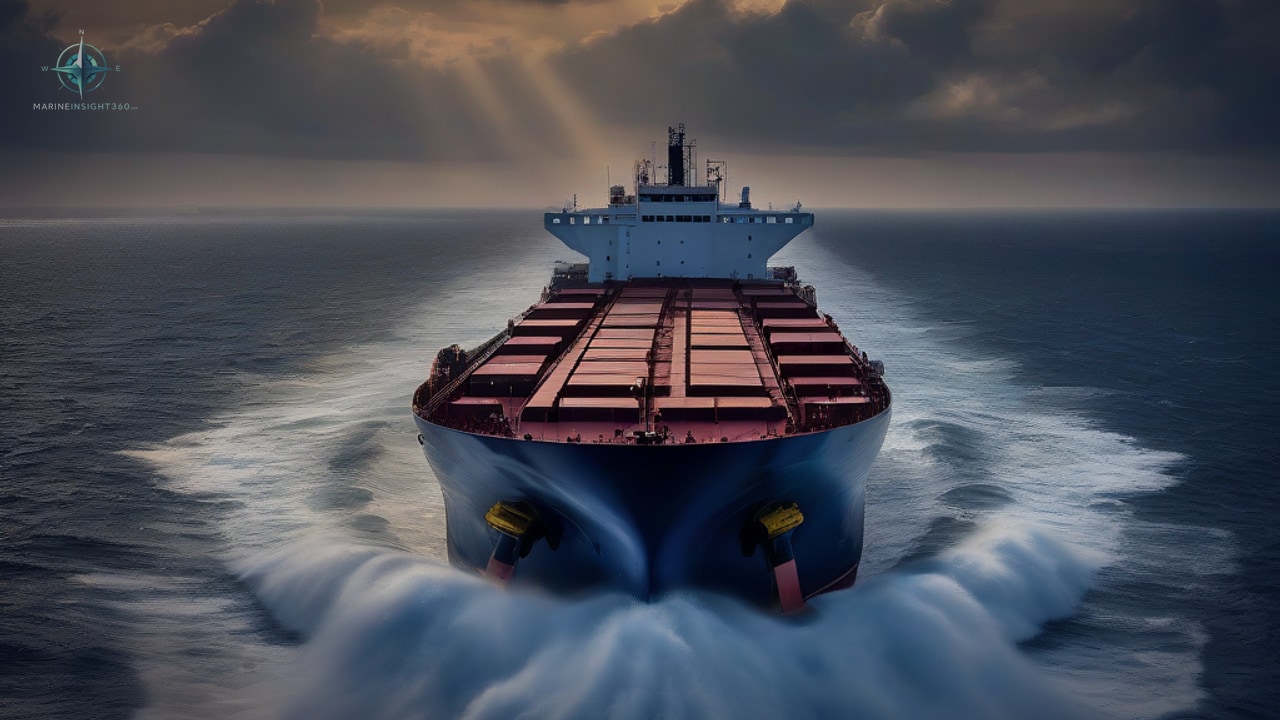
A merchant ship carries hundreds of valves, and the common types are ball, butterfly, gate, globe and check valves. Each suits a different job: some only open and shut a line, some throttle flow, and some stop it running backwards. Whether it is the ballast, bilge, fuel, cooling water or steam system, the right valve in the right place keeps the ship running smoothly.
This guide explains the types of valves used on ships and what each one does.
Some Common Types of Valves on Ships
Valves on ships control liquids, gases and steam. Ball valves, butterfly valves and gate valves are mostly used to isolate a line, globe valves to regulate flow, and check valves to prevent backflow.
Valves are commonly used for the following purposes:
- Regulate the flow of fluids
- Relieve pressure
- Start or stop a flow
- Increase or decrease flow
The ballast water system is one of the biggest users of valves on board. A ship takes seawater into its ballast tanks when it discharges cargo and pumps it out as it loads, so that it keeps enough draught, trim and stability to sail safely when it is light. Remotely operated butterfly valves, usually hydraulic, let the officer of the watch fill and empty each tank from the cargo control room.
The bilge system is a separate network. The bilges are the lowest spaces of the hull, where water and oil leaking from machinery collect, and bilge pumps draw them out through screw-down non-return valves that stop water flowing back into a compartment.
Marine valves are different from the basic valves used on land. They are made of materials that resist seawater corrosion, such as bronze, gunmetal and stainless steel, and valves on systems covered by class rules must be of a type approved by the classification society.
Floating Ball Valve
How does it work?
A ball valve controls flow with a ball that has a hole bored through it. Turning the handle 90 degrees (a quarter turn) lines the hole up with the pipe to open the valve, or turns it across the pipe to shut it. Ball valves can be operated by hand or by an actuator.
In a floating ball valve, the ball is not fixed on a trunnion. Line pressure pushes it against the downstream seat, which makes the seal. Ball valves are mainly used to isolate a line, though ball valves with V-shaped or specially profiled bores can also be used for control.
Ball valves are durable, open and shut quickly, and seal tightly with little leakage. Marine ball valves are made of corrosion-resistant materials to withstand seawater.
They are available in many sizes and are common on fuel, lubricating oil, compressed air and fresh water lines. Floating ball valves are compact and suit small and medium pipe sizes; larger valves and higher pressures usually call for trunnion-mounted balls.
Marine Butterfly Valve
How does it work?
A butterfly valve has a disc mounted on a shaft in the middle of the pipe. Turning the shaft a quarter turn swings the disc edge-on to the flow to open the valve, or across the bore to close it. These valves can be operated by hand, by gear, or by hydraulic, pneumatic or electric actuators.
In the common rubber-lined (concentric) design, the liner covers the inside of the valve body, so the fluid does not touch the body metal. The most popular types on ships are wafer and lug butterfly valves for general service, with double and triple eccentric (offset) designs for higher pressures and temperatures.
Butterfly valves are used for isolation and for throttling, and because they are short and light they fit into tight spaces where a gate or globe valve would not.
On ships they are the standard valve on large seawater cooling, ballast, fire main and fresh water lines, and on fresh water and chilled water systems. They are cheap, easy to install and maintain, and a good resilient seat gives tight shut-off. A butterfly valve does not prevent backflow, so it is fitted alongside a check valve where that matters.
Gate Valve
How does it work?
A gate valve is a linear motion valve. Turning the handwheel moves a flat or wedge-shaped gate down into the flow to close the valve or lifts it clear to open it. When fully open, the gate leaves a straight, unobstructed bore, so the pressure drop across the valve is very low.
Gate valves are used as isolating valves, either fully open or fully closed. They are not suited to throttling, because a part-open gate vibrates and its seats wear quickly. They are built for a wide range of pressures and are used on high-pressure steam and water lines as well as low-pressure services.
On ships, gate valves are fitted where a line has to be isolated but is rarely operated, such as some sea suction and main line isolating valves.
The two common designs are rising stem and non-rising stem gate valves. On a rising stem valve, the stem climbs out of the bonnet as the valve opens, so you can see at a glance whether it is open. A non-rising stem valve takes up less height, which makes it useful in the lower levels of the engine room and in tight spaces.
Globe Valve and Angle Globe Valve
How does it work?
If the system needs to regulate the flow of a fluid, a globe valve is usually the right choice. It is a linear motion valve: turning the spindle raises or lowers a disc onto a fixed seat. The valve body is roughly spherical, and an internal wall (the seat bridge) divides it into two halves so the flow has to pass up through the seat.
Because the disc moves at right angles to the seat, a globe valve throttles well, which ball and gate valves do not. The cost is a higher pressure drop than a gate or ball valve. In an angle globe valve, the outlet is at 90 degrees to the inlet, so the valve also replaces a pipe bend.
A globe valve is designed for flow in one direction, marked by an arrow on the body, with the fluid entering under the disc. Household taps work on the same principle. Large globe valves can be fitted with electric or pneumatic actuators and used as control valves.
Globe valves are the everyday valve of the engine room, found on steam, fuel oil, lubricating oil and cooling water lines.
A screw-down non-return (SDNR) valve is a globe valve whose disc is not fixed to the spindle. With the spindle wound open, the disc lifts with forward flow and drops onto its seat if flow reverses. These are fitted on bilge suctions and boiler feed lines to stop backflow.
Industrial check valves
How does it work?
The main purpose of a check valve is to prevent backflow. It lets fluid flow in one direction only and works on the pressure difference across it, with no handle or actuator. Check valves are often called "non-return valves."
A check valve opens when the pressure on the inlet side is higher than on the outlet side and closes when flow stops or reverses. The most common types are swing check valves, lift check valves, ball check valves and dual-plate (wafer) check valves.
On ships, check valves are fitted on pump discharges, so that a stopped pump is not spun backwards by a running one, as well as in hydraulic systems, fuel systems, fresh water generators and compressed air lines.
Their main job on board is to keep fluid from flowing back where it can do harm, such as seawater back into a bilge or contaminated water into a clean system. They are compact, simple to install and need little maintenance.
Conclusion
Every piping system on a ship depends on its valves. Ball, butterfly and gate valves isolate lines, globe valves regulate flow, and check valves stop backflow. Because they work in seawater and under class rules, marine valves are made of corrosion-resistant materials and built to approved designs.
Recommended Reading
10 Common Types Of Ocean Animals
Earth's oceans contain about 97% of the Earth's water, most of which is salty. There are five oceans on Earth: the Pacific, Indian, Atlantic, Arctic, and…
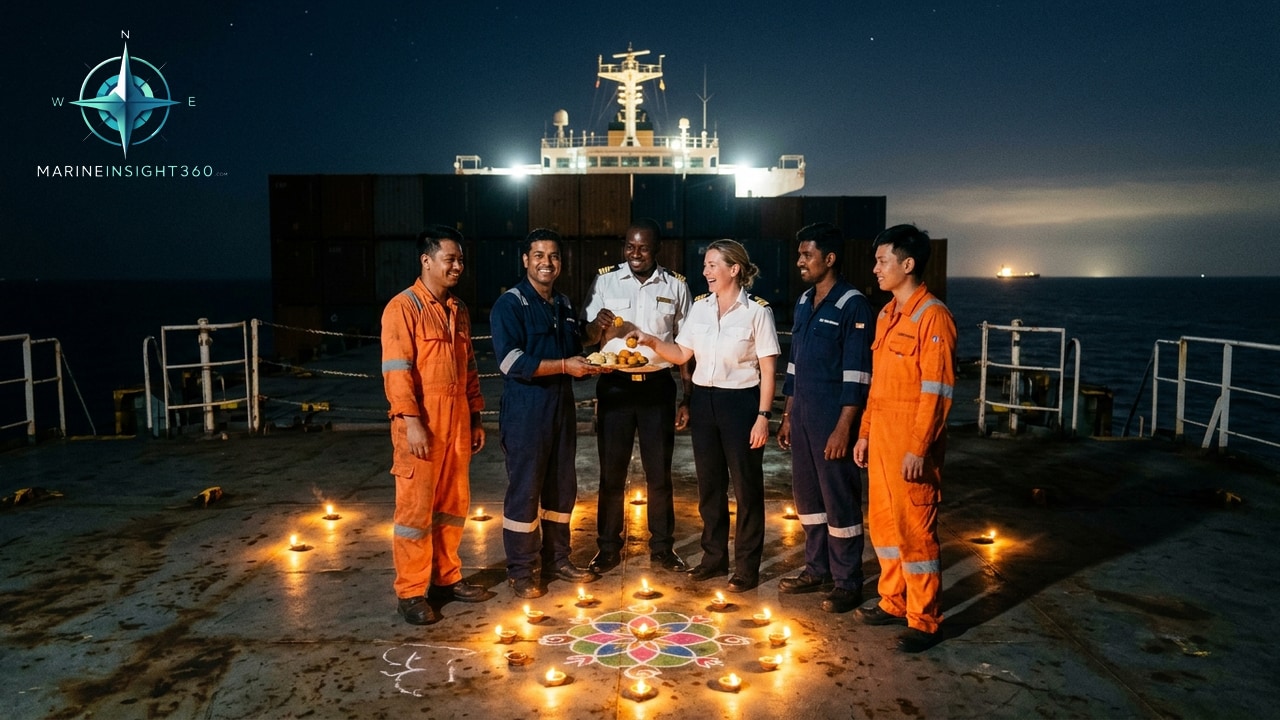
Diwali at Sea: Far from Home, Together as One Crew
What Diwali looks like on a merchant ship: a crew of different faiths and nationalities celebrating together, thousands of miles from home.
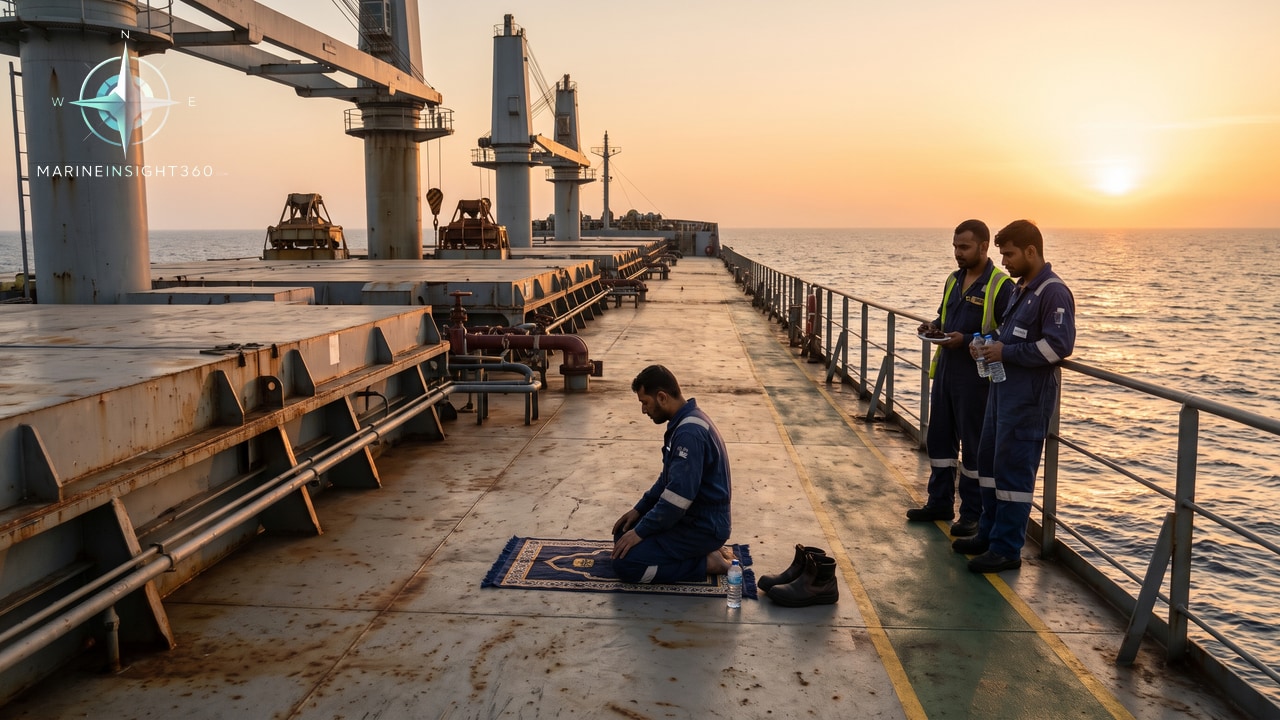
Ramadan at Sea: Fasting, Prayer and Watchkeeping for Muslim Seafarers
A practical guide to Ramadan on board: fasting and watchkeeping, rest hours, suhoor and iftar timings across time zones, galley, prayer and Eid.