
LNG Propulsion Systems: A Complete Technical Guide
How LNG-fuelled ships work: low- and high-pressure dual-fuel engines, fuel storage and supply under the IGF Code, emissions, methane slip and bunkering.
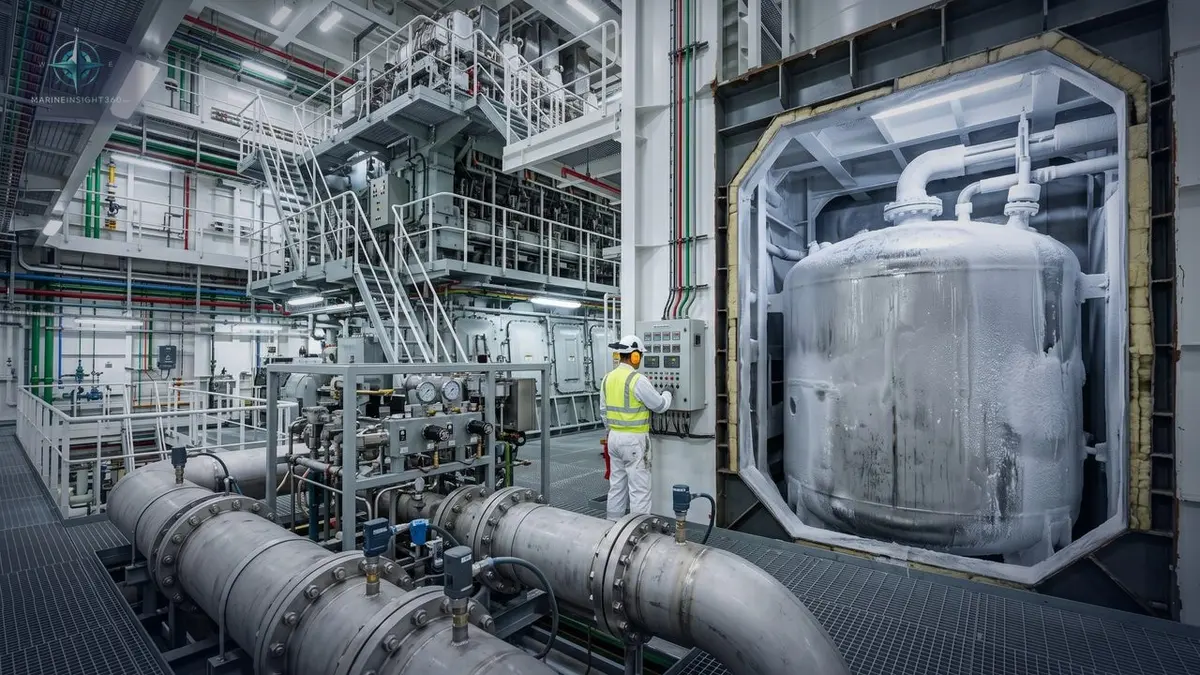
LNG propulsion systems are marine engines fuelled by liquefied natural gas. Most ships that use LNG have dual-fuel engines, which burn gas in normal service and can switch to diesel fuel when gas is unavailable or for certain operations. Whether such an engine meets the IMO Tier III limits for nitrogen oxides depends on its design and on which fuel it is running, as explained below.
LNG Propulsion Guide
Liquefied Natural Gas propulsion greatly reduces sulphur oxide emissions and, depending on the engine type, can also cut nitrogen oxide emissions sharply compared to heavy fuel oil. Modern dual-fuel engines can operate on either LNG or marine diesel, giving owners flexibility over fuel supply.
LNG is natural gas cooled to about −162 °C, at which point it becomes a liquid taking up roughly 1/600th of the volume of the gas. It is stored on board as a cryogenic liquid, then vaporised and heated by the ship's fuel gas supply system before it reaches the engines as gas.
Dual-Fuel Technology
Marine dual-fuel engines fall into two broad groups, and the difference matters for efficiency, emissions and cost.
Low-pressure dual-fuel engines work on the Otto cycle. Gas is mixed with air at low pressure and ignited by a small injection of pilot diesel fuel. Two-stroke engines such as WinGD's X-DF series and many four-stroke dual-fuel engines work this way. Running on gas, these engines can meet IMO Tier III NOx limits without exhaust after-treatment, but more unburnt methane can escape in the exhaust ("methane slip").
High-pressure dual-fuel engines operating on the diesel cycle inject gas directly at high pressure. This achieves diesel-like efficiencies and is used by systems like the MAN B&W ME-GI engine found on many large container ships and LNG carriers. Methane slip is very low, but to meet Tier III these engines need exhaust gas recirculation (EGR) or selective catalytic reduction (SCR), as do dual-fuel engines of either type when running on diesel.
Fuel storage and supply
Because LNG must be kept very cold, it is stored in insulated tanks. Smaller LNG-fuelled ships commonly use cylindrical IMO Type C pressure tanks, which can hold the boil-off gas by letting the pressure rise. Large ships, such as container ships with big fuel demands, may use membrane tanks built into the hull structure or independent prismatic (IMO Type A or B) tanks fitted inside the hull, which use the space better but need a way to deal with boil-off.
From the tank, the fuel passes through the fuel gas supply system and a gas valve unit to the engine, in double-walled piping or ventilated ducts wherever it runs through enclosed spaces. Gas detection and ventilation are fitted in the spaces where gas could leak.
On LNG-fuelled ships other than gas carriers, the design and operation of these systems are governed by the IMO's International Code of Safety for Ships using Gases or other Low-flashpoint Fuels (the IGF Code); LNG carriers burning their cargo come under the IGC Code.
Emissions
Natural gas contains almost no sulphur, so burning it practically eliminates sulphur oxide emissions and greatly reduces particulate matter. Carbon dioxide emissions are lower than from oil fuels for the same energy, because natural gas contains less carbon.
The climate benefit is reduced by methane slip. Methane is a far more potent greenhouse gas than carbon dioxide, especially over the short term, so unburnt methane in the exhaust offsets some of the CO2 saving and, in engines with high slip, can cancel it entirely. How much depends on the engine type and how it is operated, which is why methane slip has become a focus for engine makers and regulators.
Bunkering and safety
LNG can be delivered to a ship by truck, from a shore terminal, or from an LNG bunker vessel alongside. Ship-to-ship bunkering from dedicated bunker vessels has grown at major ports as the number of LNG-fuelled ships has increased.
The main hazards are the very low temperature of the liquid, which can cause cold burns and make ordinary steel brittle, and the flammability of the gas. Crews on ships covered by the IGF Code must complete specific training under the STCW Convention before they work with the fuel system.
Recommended Reading
Container Tracking Systems: A Comprehensive Guide
Searates container tracking is a big headache for most businesses. Fulfilling the global demand for quality goods means automating and improving the monitoring of all kinds of processes.
Ship Navigation Equipment: The 30 Systems on a Modern Bridge
The ship navigation equipment a modern bridge carries, grouped by job: position fixing, collision avoidance, charts, communications, safety recorders and more.
Marine Navigation Systems Ship Captains Use
Today, modern technology has made navigation in restricted waters a highly specialized profession. With the latest developments in navigation methods and…