
Oceangate Titan Submersible Implosion
Oceangate Titan Submersible Implosion: safety, training and compliance context for US, UK, Canada, Australia, Singapore and European maritime readers.
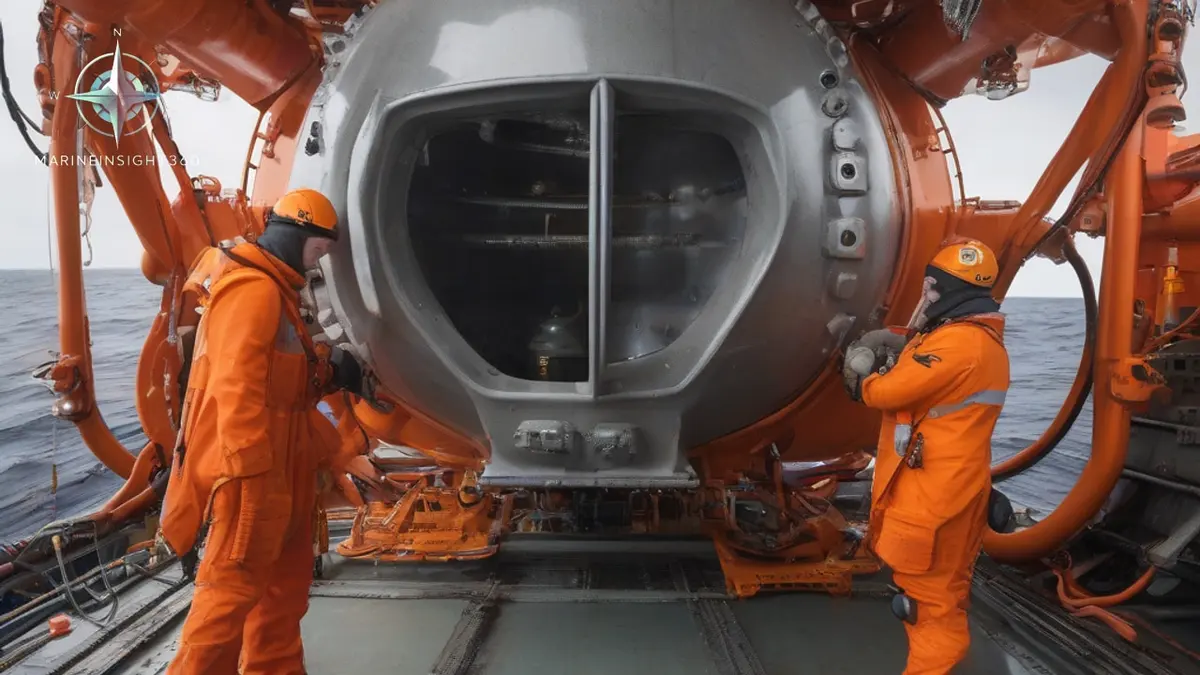
The OceanGate Titan submersible imploded on June 18, 2023, during a dive to the Titanic wreck, killing all five people aboard, and its uncertified carbon-fiber hull is the focus of the safety questions that followed.
Oceangate Titan Submersible Implosion: A Deep-Sea Dream Turned Nightmare
On June 18, 2023, the world watched in horror as news broke of the OceanGate Titan submersible’s catastrophic implosion . What began as an ambitious mission to explore the Titanic wreck—2.4 miles beneath the North Atlantic—ended in the instantaneous loss of five lives. The story of the Titan is equal parts technological marvel, cautionary tale, and human drama, raising questions about innovation, safety, and the limits of adventure.
When OceanGate Titan was built?
Founded in 2009 by Stockton Rush and Guillermo Söhnlein, OceanGate aimed to democratize deep-sea exploration. The Titan, their flagship submersible, was a bold departure from tradition: a 22-foot-long vessel with a carbon-fiber hull, titanium end caps, and room for five passengers. Unlike certified submersibles, it was designed to dive to 4,000 meters (13,000 feet) without the oversight of industry regulators—a choice Rush defended as a way to push boundaries.
For $250,000 a ticket, wealthy adventurers could glimpse the Titanic’s rusting remains, guided by a modified video game controller and a crew of experts.
The Titan wasn’t just a machine; it was a statement. Successful dives in 2021 and 2022 proved it could work, drawing awe and curiosity. But beneath the surface—literally and figuratively—cracks were forming.
What happened to OceanGate Titan?
On that June morning, the Titan descended from the MV Polar Prince with five aboard: Rush himself, French Titanic expert Paul-Henri Nargeolet, British billionaire Hamish Harding, and Pakistani-British businessman Shahzada Dawood with his 19-year-old son, Suleman. The mission? Another pilgrimage to the Titanic, a site Rush called “the ultimate destination.” At 1 hour and 33 minutes into the dive, communication abruptly ceased. The silence was deafening.
Understanding Key Role of Black Sea in Global Politics
What followed was a frantic, five-day international search. The U.S. and Canadian Coast Guards, Navy assets, and private vessels scoured the ocean. Hope dwindled until June 22, when a remotely operated vehicle spotted a debris field 1,600 feet from the Titanic’s bow. The Titan had imploded under the crushing pressure of 6,500 psi—equivalent to the weight of an elephant on a postage stamp. Later, the U.S. Navy confirmed it had detected an implosion signature hours after the dive began. For the families, the wait ended in grief; for the world, the questions were just starting.
Was it a fault in design?
The Titan’s unconventional build was both its allure and its Achilles’ heel. Carbon fiber, while lightweight, is prone to fatigue under repeated pressure cycles—unlike the titanium spheres used in most deep-sea submersibles. By 2020, its hull rating had been downgraded to 3,000 meters after showing wear. Experts warned of imperfections: wrinkles, voids, even a loud bang reported during a 2022 dive.
Former OceanGate employee David Lochridge had flagged safety concerns years earlier, and in 2018, the Marine Technology Society urged Rush to reconsider his “experimental” approach. He dismissed them, famously saying safety certifications were “an impediment to innovation.”
Innovation, though, has limits. At 3,800 meters, the ocean doesn’t forgive flaws. The implosion was so sudden that the passengers likely had no time to react—a small mercy in a tragedy of this scale.
What happens after the tragedy?
OceanGatesuspended operations in July 2023, its dream drowned in controversy. Investigations are ongoing: the U.S. Coast Guard’s Marine Board is digging into the cause, while a federal probe examines potential negligence. A civil lawsuit looms, and the debris—recovered in late 2023—sits as evidence of what went wrong. The incident has sparked fierce debate. Was this a noble push into the unknown, or reckless hubris? Should private companies be trusted with such risks, or is the deep sea a realm best left to heavily regulated science?
Final Thoughts
The Titan tragedy echoes the Titanic itself—a tale of human ambition meeting nature’s indifference. For Rush and his crew, the ocean was a frontier to conquer; instead, it claimed them. Their story reminds us that exploration is a double-edged sword: it inspires, but it demands respect. As we marvel at the wonders below, we’re left wondering—how far is too far?
Recommended Reading
Iran retaliates with missiles and drones, defying Trump’s warning
Learn iran with practical maritime context, safety checks, operational guidance and related resources for global shipping readers.
Hapag-Lloyd Invests in APM Terminals Rotterdam to Drive Growth
Hapag‑Lloyd’s new stake in APM Terminals Rotterdam aims to expand capacity, improve hinterland links and enhance crew efficiency in Europe’s busiest port.
Saildrone Completes Missile Launch Test Aboard its Sail-Powered Surveyor
Saildrone’s autonomous vessel successfully launched a missile‑type payload, showing new possibilities for armed surveyors and implications for shipping operator