
What Is a Remotely Operated Underwater Vehicle (ROV)?
What a remotely operated underwater vehicle (ROV) is, how the vehicle, tether and launch system work, its IMCA classes, its main uses and its limits.
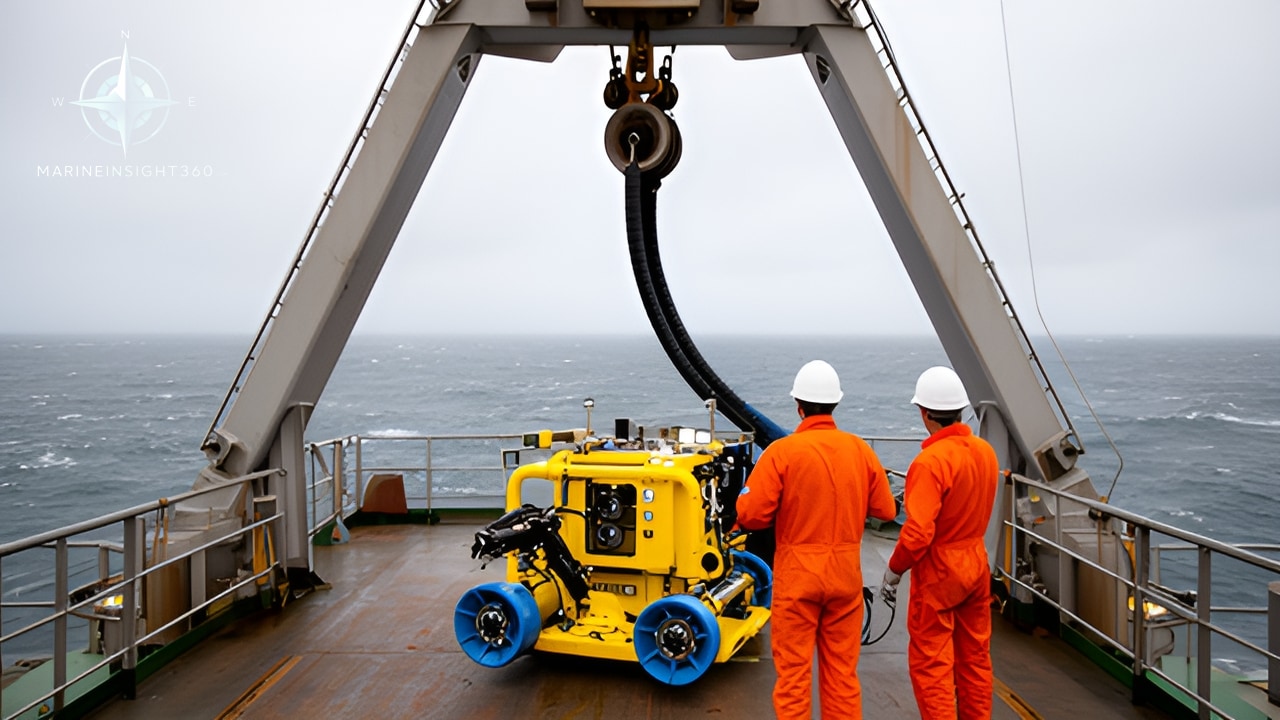
A remotely operated underwater vehicle (ROV) is an unoccupied underwater robot flown by a pilot on a ship or platform. It is connected to the surface by a cable, called the umbilical or tether, which carries electrical power down to the vehicle and video and sensor data back up, usually over optical fibre. Because the power comes from the surface, a working ROV can stay down for as long as the job and the weather allow.
The tether is what separates an ROV from the other main kinds of underwater vehicle. An autonomous underwater vehicle (AUV) carries its own batteries and follows a pre-programmed mission with no cable. A manned submersible carries people inside a pressure hull.
How an ROV system is put together
An ROV is only one part of a spread of equipment that goes on board the support vessel.
The vehicle
The vehicle is an open frame, usually aluminium or plastic, with a block of syntactic foam on top. The foam is buoyant at depth and is trimmed so the vehicle is close to neutral in the water. Thrusters arranged in several directions let the pilot move it forwards, sideways and vertically and turn it on the spot. Small observation ROVs use electric thrusters.
Most work-class vehicles use an electric motor driving a hydraulic pump, which powers hydraulic thrusters, manipulator arms and tools.
Typical equipment includes colour and low-light cameras, LED or other lights, a depth sensor, a gyro or other heading reference, sonar for seeing in poor visibility, and a Doppler velocity log for measuring movement over the seabed. Work-class vehicles normally carry two manipulator arms, one for gripping and holding on, the other for fine work.
Umbilical and tether management system
On deeper work the heavy armoured umbilical is not connected straight to the vehicle. It runs down to a tether management system (TMS), either a cage, known as a garage, that the vehicle sits in during launch, or a top-hat unit that the vehicle hangs beneath. At working depth the TMS pays out a lighter, neutrally buoyant tether, so the vehicle can move freely without being jerked by the ship's motion.
Small vehicles in shallow water often use a single free-swimming tether.
Launch system and control room
The launch and recovery system (LARS) is an A-frame or crane with a winch, mounted at the side or stern. Some vessels launch through a moon pool, a vertical opening through the hull, which gives sheltered water and allows work in heavier seas. The pilot and co-pilot sit in a control van on deck, with screens showing the cameras, sonar, position and vehicle systems.
The vehicle's position is normally fixed by an acoustic system such as USBL (ultra-short baseline) linked to the ship's navigation.
Classes of ROV
The offshore industry uses the classes set out by the International Marine Contractors Association (IMCA) in its ROV code of practice, IMCA R 004.
| Class | Type | Typical work |
|---|---|---|
| I | Pure observation | Visual inspection with a camera and lights |
| II | Observation with payload | Inspection with extra sensors, light survey and light intervention |
| III | Work class | Construction support, drilling support, operating valves, tooling |
| IV | Towed and bottom-crawling | Cable and pipeline ploughing, jetting and trenching |
| V | Prototype and development | Vehicles still being developed or tested |
Recent revisions of the code split some of these classes further, for example by work-class payload, and add classes for AUVs. In conversation offshore, people mostly speak of observation ROVs, work-class ROVs and trenchers.
What ROVs are used for
- Offshore oil and gas: watching the blowout preventer and wellhead during drilling, installing and connecting subsea structures, operating valves through hot stabs and torque tools, and inspecting pipelines and risers.
- Subsea cables: trenching and burying power and telecom cables after they are laid, a job done by the large tracked vehicles carried on cable laying vessels.
- Ships and ports: inspecting hulls, propellers, sea chests and quay walls without divers. Class societies can accept an in-water survey by an approved firm, using divers or an ROV, in place of some of the bottom surveys normally done in dry dock, which can lengthen the interval between dry dockings.
- Science: sampling animals, water and rock at hydrothermal vents and other deep sites. Research ROVs such as Jason at the Woods Hole Oceanographic Institution work at several thousand metres.
- Search and salvage: locating wrecks, aircraft and lost equipment. An ROV found the debris of the Titan submersible in June 2023, as described in our article on the Titan implosion.
- Navies: mine identification and disposal, and inspection of harbours and ship hulls.
Launching and recovering an ROV
Launch and recovery is the riskiest part of most ROV dives, because the vehicle and its TMS are swinging on a wire through the splash zone. A typical sequence on a support vessel goes like this.
- The crew complete pre-dive checks of hydraulics, thrusters, cameras, lights and tooling, and the vehicle is powered up on deck.
- The ROV supervisor agrees the launch with the bridge or the dynamic positioning operator, so the vessel holds position and keeps the stern or side clear of thruster wash.
- The LARS lifts the vehicle and TMS over the side and lowers them quickly through the splash zone, where wave loads are greatest.
- The umbilical is paid out to working depth, the vehicle leaves the TMS and the dive begins.
- For recovery, the vehicle docks with the TMS and the package is winched up, held briefly below the surface and brought through the splash zone and onto deck in one movement.
Throughout the dive the bridge and the ROV control van stay in contact. The ship must not move off position without warning, and the umbilical must be kept clear of the propellers and thrusters.
Limits of ROVs
The tether that supplies power for long dives is the source of most of an ROV's limits. In strong currents the drag on the umbilical can be greater than the vehicle's thrust, and inside wrecks or among structures a tether can snag. The support vessel is the biggest cost of most ROV work, and launch and recovery are limited by sea state.
Manipulator work is slower and less dexterous than a diver's hands, and the pilot's view is only as good as the cameras and the water clarity.
Depth is limited by the rating of the vehicle's housings and the length of the umbilical. Many work-class ROVs are rated to around 3,000 to 4,000 m, and a few vehicles have gone to full ocean depth: the Japanese ROV Kaiko reached the bottom of the Challenger Deep in 1995, as covered in our article on the depth of the Mariana Trench.
Recommended Reading
What are Mid-Ocean Ridges: Earth's Underwater Mountain Chains
Mid-ocean ridges are giant underwater mountain ranges formed by the constant movement of plates and the heat and magma that erupt from the Earth's core.…
Ro-Ro Ships: How Roll-On Roll-Off Vessels Work and Why They Dominate Vehicle Trade
How ro-ro ships work: ramps, decks and lane meters, the difference between PCTC, ConRo and RoPax types, and the stability risks unique to roll-on roll-off.
How Does Shipping Cause Underwater Noise Pollution?
Noise pollution has become a huge issue in today’s world. The primary reason for this is vessels. There’s a vast network of vessels carrying out global…