
PT Bahtera Bahari Shipyard Launches Indonesia's First All-Electric CBG 500 E Crane
Liebherr's all-electric CBG 500 E grab crane goes to work on an Indonesian transshipment barge. What it changes for bulk terminals and crews.
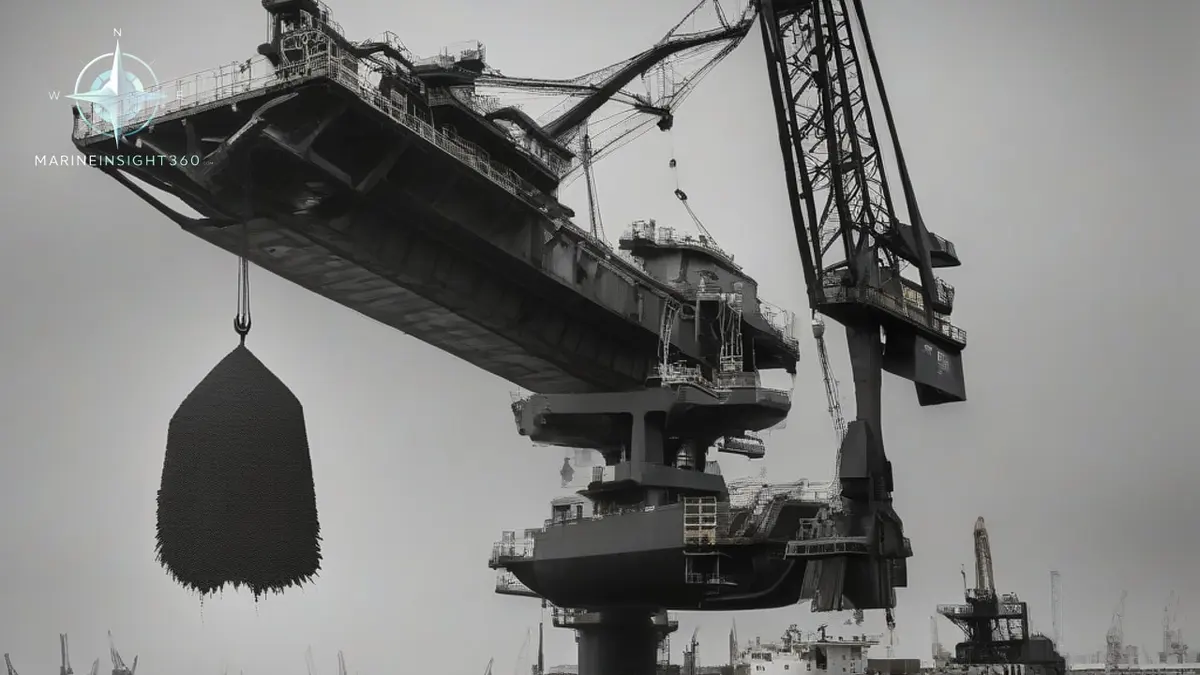
PT Bahtera Bahari Shipyard has launched Indonesia's first all-electric CBG 500 E crane, a Liebherr grab crane destined for a purpose-built transshipment barge named Leo Trans 10. The machine reaches 43 meters (141 ft) and lifts 65 tonnes (72 short tons) safe working load in grab duty, and it will handle coal for PT Bahtera Alam Sejahtera, a sister company in bulk cargo logistics.
The barge was built at the yard's Batam facility, with crane delivery scheduled for October 2025 and the order finalized at Bauma 2025 in Munich.
The detail that matters for terminal operators is not the crane's size. It is that a floating transshipment unit, historically one of the least efficient links in a bulk chain, is being built without a diesel prime mover driving the hoist.
What a floating grab crane actually does
Transshipment barges exist because many loading points cannot take a Panamax or Capesize alongside. The barge moors near the ocean-going vessel, takes cargo from feeder barges, and grabs it across into the ship's holds. Indonesia moves a large share of its seaborne coal exactly this way.
Cycle time drives the whole economics. A grab crane in coal duty runs a short, repetitive sequence: close the grab, hoist, slew, open, slew back. Thousands of times per shift. Every second saved per cycle multiplies into loading rate, and every kilowatt wasted in that cycle is fuel burned at anchor.
Why an all-electric drive changes the numbers
Diesel driven cranes are a large share of a terminal's fuel bill. Industry estimates put crane fuel at up to half of total fuel consumption at some ports, because the machines run continuously while ships and berths cycle. Electric drives cut that directly, and they remove the maintenance that goes with a hard-worked diesel: injectors, turbochargers, filters, oil changes and exhaust aftertreatment.
An electric hoist also holds torque better at low speed and gives finer control at the grab, which reduces spillage into the water between the barge and the ship. In sensitive coastal waters that is a compliance question as much as a cost question.
Energy recovery and supercapacitors in plain terms
Lowering a loaded grab releases energy. On a conventional crane that energy ends up in the brakes as heat. The CBG 500 E uses Liebherr's Licatronic energy recovery system with supercapacitors, which capture the energy from the lowering phase and feed it back into the next hoist.
Supercapacitors suit this duty better than batteries. Grab cycles demand very high power for a few seconds, repeated constantly, and batteries degrade quickly under that pattern. Supercapacitors tolerate high charge and discharge rates and very high cycle counts. The practical result is a lower peak draw on the supply and a smaller installed generation requirement on the barge.
What changes for the crew and the receiving ship
Deck crews notice three things on electric cranes. Noise drops enough that hand signals and radio traffic become usable near the machine. Vibration through the barge structure falls. And exhaust no longer washes across the working deck, which matters on a barge where the crane sits a few meters from where people work.
For the ship being loaded, steadier grab control means fewer heavy drops onto tank tops and hold plating, and less trimming work afterwards. Chief officers running a coal loading plan should still verify tonnage per grab against the rated capacity, because a 65 tonne grab duty rating is not the same as a 65 tonne hook rating.
Where this fits in the wider move to electrify cargo handling
Ship-to-shore and yard crane electrification is established practice in container terminals. Mobile harbor cranes and floating units have lagged, because they need a supply that travels with them. The Port of San Diego took delivery of all-electric mobile harbor cranes, the first in North America, and European ports have been converting terminal tractors and cranes alongside shore power projects.
Regulatory pressure is uneven. Air quality rules in California and emissions targets at EU ports pushed terminal equipment first, while most Asian transshipment operations electrify on cost and reliability grounds rather than compliance. This unit sits in the second category, which is the more durable reason.
What to watch as the crane enters service
The number worth tracking is energy per tonne handled, not headline lifting capacity. Compare it against the diesel units the operator already runs on the same cargo over the same reach. Watch availability through the first full monsoon season too, since electrical enclosures on an open barge face salt, coal dust and humidity that a shore crane never sees. Our Ports section follows terminal equipment programs across the region.
Certification does not change because the drive is electric. On a floating unit the appliance is surveyed with the barge, and class societies including DNV, Lloyd's Register and Bureau Veritas publish the lifting appliance rules and witness the load test behind a rated capacity. The document that follows the machine is the register of lifting appliances and cargo handling gear, in the ILO format, with every thorough examination entered in it.
The wear items are unchanged too. Closing and holding ropes carry the whole cycle load and are the first thing a survey rejects, on broken wires, diameter loss or corrosion where they run over the sheaves. Grab lips and teeth wear round, wet coal sticks in the jaws and spills between the hulls, and coal dust packed into electrical enclosures is what usually fails first in that climate.
Sources and further reading
- PT Bahtera Bahari Shipyard brings Indonesia's first all-electric CBG 500 E to life
- PT Bahtera Bahari Shipyard Purchases Indonesia's First All-Electric CBG 500 E Crane
- Ditching Diesel in Seaports in Favor of Electrification
- Port of San Diego Celebrates Arrival of All-Electric Mobile Harbor Cranes
What to read next
Recommended Reading
When Were Boats Invented? A Timeline From the First Dugout to the First Sail
The oldest boat ever found is about 10,000 years old, and humans were crossing open water long before that. The real timeline of when boats were invented.
The 10,000 Ton Electric Container Ship Powered by a 50,000 kWh Battery
Inside the 10,000 ton electric container ship running on a 50,000 kWh swappable battery bank, and why the model works on rivers but not deep sea.
Techano Oceanlift Secures Offshore Crane Contract for New MPSV Build
Techano Oceanlift secured the offshore crane contract for a new MPSV build. What a 70-tonne heave-compensated knuckle boom crane changes for the vessel.