
The 10,000 Ton Electric Container Ship Powered by a 50,000 kWh Battery
Inside the 10,000 ton electric container ship running on a 50,000 kWh swappable battery bank, and why the model works on rivers but not deep sea.
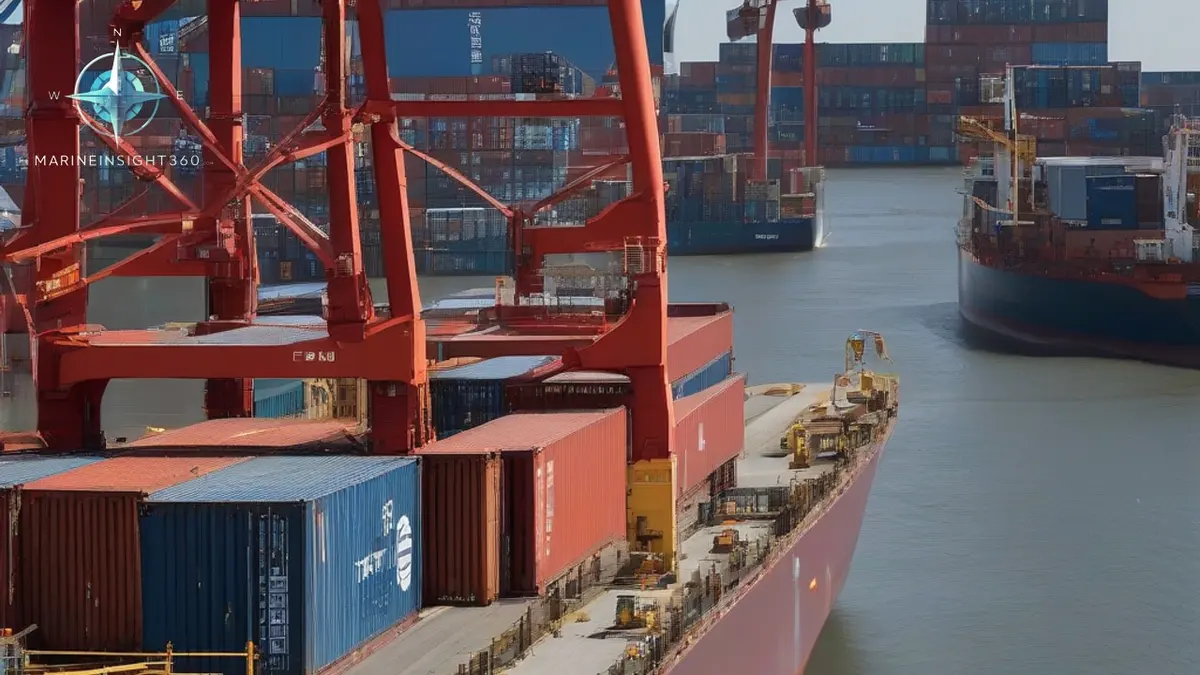
The vessel behind this story is Greenwater 01, a 10,000 deadweight tonne container ship operated by COSCO Shipping and powered by a battery bank of more than 50,000 kWh. It runs a fixed river and coastal service between Shanghai and Nanjing, roughly 965 km (600 miles) along the Yangtze, and carries 700 TEU. It was the largest fully electric container ship in service on entry, and the way it takes on energy is more interesting than its size.
Instead of a fixed battery room, most of the energy sits in standard 20 foot containers holding about 1,600 kWh each. They are charged ashore or lifted off and swapped by crane, exactly like cargo. The base installation exceeds 50,000 kWh and can be built up toward 80,000 kWh by adding as many as 24 further boxes when a voyage needs the range.
What 50,000 kWh buys on a 10,000 tonne ship
The reported operating saving is about 3,900 kg of fuel per 100 nautical miles, with roughly 12.4 tonnes of carbon dioxide avoided over the same distance. Across the Shanghai to Nanjing run, the operator projects fuel savings measured in tens of thousands of tonnes over the vessel's service life.
Put the energy figure in context. 50,000 kWh is 50 MWh. A medium speed diesel burning residual fuel at around 190 g/kWh would need in the region of 9 to 10 tonnes of fuel to put the same energy on the shaft. Battery energy is expensive to store and cheap to deliver, because there is no thermal loss chain between the tank and the propeller.
The penalty is mass and volume. Marine fuel carries roughly 11,000 kWh of chemical energy per tonne. Marine lithium iron phosphate battery systems deliver on the order of 100 kWh per tonne at system level. Even after allowing for a diesel engine wasting more than half its input as heat, the installed mass penalty for the same delivered energy is around fiftyfold.
Swappable battery containers change the bunkering model
Containerized batteries solve the problem that has held back electric shipping harder than cell chemistry has: turnaround time. Charging 50 MWh at a berth needs shore infrastructure that most terminals simply do not have. Swapping charged boxes off a stack takes about as long as a normal container move.
It also shifts capital off the ship. Battery boxes can be owned by an energy provider, cycled across several vessels and replaced as they degrade, without drydocking the ship. For an operator that converts a large capital item into an operating cost that tracks actual use.
The trade-offs are real. Every swap is a lifting operation involving an energized unit, which changes the terminal's risk assessment and its firefighting plan. Connection standards, earthing and fire detection have to be identical across every box and every ship in the pool. And deck space used by batteries is deck space not earning freight.
Why this works on the Yangtze and not on a deep sea trade
Greenwater 01 is a river to sea design: about 120 m (394 ft) long, 23.6 m (77 ft) molded breadth, 9 m (30 ft) molded depth and 5.5 m (18 ft) design draft, with a maximum speed near 19.4 km/h, or about 10.5 knots. Those numbers describe a short haul, fixed schedule, low speed operation.
That profile is exactly what batteries suit. The route is fixed, so energy demand per leg is predictable within a few percent. Both ends have shore power and crane capacity. Speed is low, so propulsion power stays modest and the cube law works in the operator's favor. Voyage length is measured in hours.
Remove any one of those conditions and the case collapses. A 14,000 TEU ship on an Asia to Europe rotation needs orders of magnitude more energy per voyage, with no opportunity to swap boxes mid ocean and no berth window long enough to recharge.
What marine engineers should take from it
- Electrical rather than mechanical watchkeeping. The main plant becomes a distribution system with power management software. Fault finding shifts to protection settings and converter behavior.
- Thermal management is the new cooling system. Cell temperature control determines both usable capacity and fire risk, and it never stops while the ship is alongside charging.
- State of health replaces running hours. Maintenance planning follows charge cycles and depth of discharge rather than hours since overhaul.
- Firefighting differs fundamentally. Lithium battery events need cooling, containment and gas management strategies that engine room foam and carbon dioxide systems were never designed for.
- Class and flag approval is the gate. Battery installations of this size run under specific class notations covering redundancy, ventilation and detection.
Where battery propulsion scales next
Short sea, ferry, inland and harbor craft trades are where this technology grows, because they share the fixed route and the frequent charging window. Deep sea decarbonization will run on fuels rather than cells. Engineers who want to stay employable across both should treat power electronics and battery management as core competence rather than a specialism. The Marine Insight 360 Marine Machinery section follows how these systems are being fitted, classed and maintained.
Battery installations of this size are approved by class, not by rule of thumb. DNV, Lloyd's Register, ABS, Bureau Veritas and ClassNK each publish battery power notations covering cell chemistry, ventilation, gas detection, redundancy and fire containment. Those rule sets and the flag administration behind them are where the enforceable requirements for a marine battery room currently sit.
What goes wrong with marine battery systems is mostly connection and cooling. Busbar joints work loose or corrode and then overheat, coolant leaks trip whole strings offline, and one weak cell drags down the usable capacity of its module. Thermal runaway is the casualty everyone plans for, and it vents flammable gas, so detection and ventilation have to keep working when the power does not.
Sources and further reading
- A fully-electric 10,000 ton container ship has begun service
- World's largest electric container ship launches in China
- Largest Electric, Battery-Powered Containerships Commissioned in China
- World's first 700 TEU pure battery-powered containerships are here
What to read next
Recommended Reading
Container Tracking: How Shippers Actually Follow a Box Across the Ocean
How container tracking works, from free carrier lookups to visibility platforms: what each tool layer does, what it costs, and how to pick for your volume.
Hydrogen Powered Inland Container Ship Launch: What H2 Barge Proved
Future Proof Shipping launched H2 Barge 1 in Rotterdam in May 2023. How fuel cell retrofits work on inland container ships, and where they stop.
Iranian Gunboat Fires at Container Ship off Oman Coast, Maritime Agency Reports
A British maritime agency reported an IRGC gunboat firing on a container ship 15 miles off Oman. What the attack profile means for ships hardening for Hormuz.